
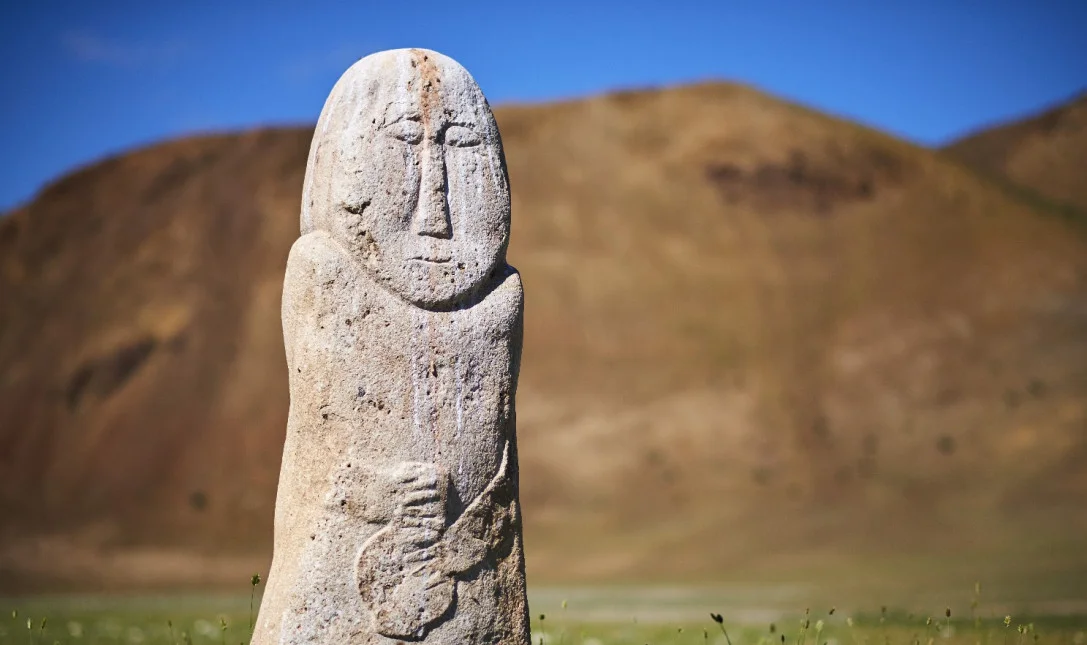
Who were the Turks? On the face of it, the question seems simple, but it has fueled heated debates for generations among scholars and the general public alike. The deeper one digs into the origins of the Turkic peoples, the more the certainties dissolve into blank spots, contested theories, and competing claims. In an interview with Qalam, historian Joo-Yup Lee explains why the ethnonym ‘Türk’ originally referred to a small ruling class at the head of a vast empire, and how, over centuries, it expanded to encompass an entire family of peoples scattered across Eurasia.
In your book, The Turkic Peoples in World History, the first Turks appear under the name Tiele, or Dingling, as early as the third century BCE. Who were they and why are they considered the earliest Turkic people rather than the Xiongnui The Xiongnu state was a powerful nomadic confederation founded by Modu Chanyu, a brilliant military leader, dominating the eastern Eurasian Steppe until its fragmentation in the first century CE. ?
The Tiele were not a single people. They were a nomadic people made up of different tribes who lived in northern Mongolia. They first appeared in Chinese histories by the third century BCE as one of the peoples who were conquered by the Xiongnu. Later, in the mid-sixth century, they were subdued by the Turks who founded the first Turkic empire in history. So, what we should remember about the Tiele is that, at first, they were not Turks.
The Turks and the Tiele had separate identities. The Tiele rebelled numerous times because they were not the same people, and in the mid-eighth century, they finally succeeded in overthrowing the rule of the Turks and founded the Uyghur Empire. And so, the Uyghurs were Tiele people. Importantly, we consider the Tiele to be the earliest confirmed people to be Turkic speakers.
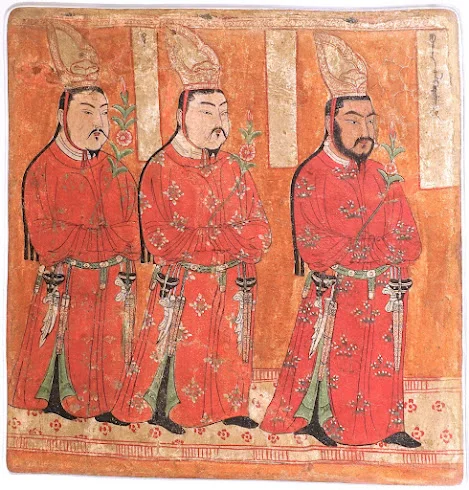
Uyghur princes. Wall painting from Cave 9 of the Bezeklik Thousand Buddha Caves. 8th–9th century / Ethnological Museum, Berlin / Wikimedia Commons
On the other hand, there is also no evidence that the Xiongnu were a Turkic people. We should also note that some component groups of the Xiongnu likely spoke a Yeniseian languageiYeniseian is a small language family of indigenous Siberian peoples, of which only Ket survives today, spoken along the Yenisei River in central Siberia.. Well, perhaps not all of them, but at least some of them. So, even if they were partly Turkic, the Xiongnu were not entirely Turkic speakers.
Specialists in Xiongnu history say that the Xiongnu may have included Turkic-speaking inhabitants, but they do not define the Xiongnu as a Turkic people. Looking at recent genetic studies, it is much safer to view the Xiongnu as a mixed group than to define them as a Turkic people.
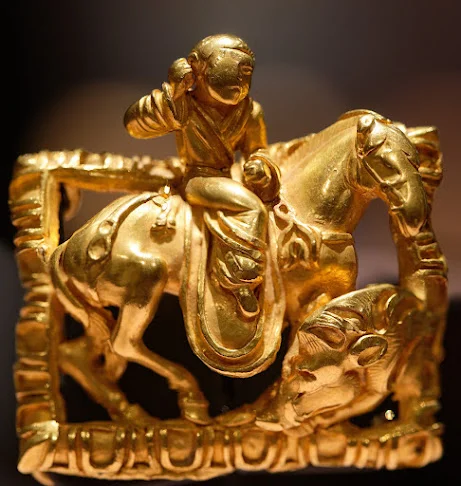
Gold buckle with a scene of boar hunting. 2nd–1st century BCE. Found at Saksanokhur, Tajikistan / National Museum of Antiquities of Tajikistan / Wikimedia Commons
It is said that the ruling clan of the Turks, the Ashina, may have been of Indo-European origin. Meaning the founders of the first Turkic empire may not have been Turkic by blood. What evidence points to that?
First, I would like to emphasize that I do not claim an Indo-European origin for the Ashina. I only say that this is a possible scenario for several reasons. Peter Golden, the leading historian of the Turkic peoples, suggests that the clan name Ashina was probably an Iranic or Saka word meaning ‘blue’. Further, we find the presence of Iranic titles and terms among the Ashina.
More about
THE ORIGINS OF THE TURKS
Peter B. Golden on Etymology, Identity, and Power in the Early Turkic world
For reasons we do not fully understand, their titles and names have Indo-European or Iranic origins. We should also note that the Chinese historical record, the Zhou ShuiThe Zhou Shu (Book of Zhou) is an official Chinese dynastic history that records the Northern Zhou dynasty, and it is part of the canonical Twenty-Four Histories., mentions that the Ashina were related to the Kyrgyz. Indeed, both the Turks and the Kyrgyz cremated their dead, and in contrast, the Tiele buried their dead.
Unlike the Tiele, Chinese histories described the Kyrgyz as having Indo-European features—tall, blond, and blue- or green-eyed. It is highly likely that the Kyrgyz were originally a Turkicized people rather than a Turkic people. This connection between the Kyrgyz and the Ashina, as some sources suggest, implies that the Ashina clan might have been of Indo-European origin. We have to consider these facts carefully, but the safest conclusion we can reach about the Ashina is that they were a mixed group.
The Ashina Turks gave their name to all Turkic peoples and then vanished, disappearing from historical memory by the turn of the millennium. How did that happen and who inherited their legacy?
Mongolia is a large territory, but even now its population numbers only around 3.5 million. In a vast land so sparsely populated, when wars, natural disasters, and migrations happened simultaneously, it was common for some nomadic groups to disappear—and they often did.
The KarakhanidsiThe Karakhanids were the first Muslim Turkic dynasty to rule Central Asia, controlling a vast region from the Tarim Basin to the Oxus River from the late tenth to early thirteenth centuries. were made up of western Turkic tribes, and importantly, they identified themselves as Turks. However, the Uyghurs who overthrew the Turkic Khaganate did not identify themselves as Turks.
All Turkic peoples believe that they are descended from the Ashina Turks. I would say that the Karakhanids were directly descended from them because right after the Turkic Khaganate collapsed, the first polity directly descended from the Turks was the Karakhanid state.
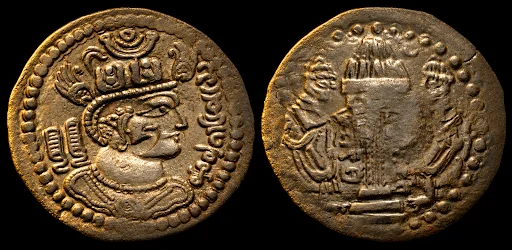
Coin of Shahi Tegin (Sri Shahi), ruler of the Turk Shahi dynasty. After 679 CE / Classical Numismatic Group / Wikimedia Commons
On the other hand, in their inscriptions, the Uyghurs refer to the Ashina Turks as hated enemies. Likewise, the Kyrgyz, who destroyed the Uyghur Empire, did not call themselves Turks. Therefore, we should exclude the Uyghurs and the Kyrgyz from the list of direct descendants.
Chinese historical sources, which usually do not use the term ‘tujue’ (Turk) to refer to non-Turkic groups, applied the term ‘Turk’ to the Khazars, who formed a Turkic nomadic empire (c. 650–969 CE) whose elite famously converted to Judaism. This is very rare. The fact that the royal clan of the Khazars was likely of Ashina origin, combined with the Chinese designation, makes the Khazars a strong candidate for a direct successor state.
Apart from the Karakhanids, I should also mention the Khazar Khaganate because it is likely that its royal family belonged to the Ashina clan. This is a consensus among specialists. However, after the collapse of the Karakhanid state and the Khazar Khaganate, no direct successor states emerged from them. This means that no direct descendants exist today, and only indirect descendants remain.
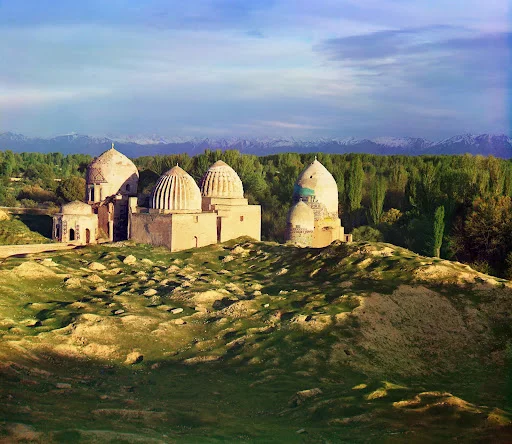
Sergey Prokudin-Gorsky. General view of the Shah-i-Zinda complex. Samarkand, 1905–1915 / Library of Congress / Wikimedia Commons
If descendants of the Karakhanids survived in the Kazakh steppe and were integrated into the modern Kazakh population, the Kazakhs could also be viewed as indirect descendants, though this cannot be definitively proven.
The Orkhon inscriptionsiThe Orkhon inscriptions are bilingual texts in Middle Chinese and Old Turkic carved onto two memorial steles that the Göktürks erected in the early eighth century in the Orkhon Valley, in present-day Mongolia. from the eighth century are the earliest monuments of Turkic writing. What do they say and how did the Turks describe their own identity?
The inscriptions themselves differentiated between the Turks and the Tiele. As for the Uyghurs of Tiele origin, they used the name ‘Uyghur’ to refer to themselves in their inscriptions and never Turk—indeed, the Turks were depicted as enemies. Simply put, the Orkhon inscriptions use the name ‘Türk’ only to refer to the core tribes of the Turkic Khaganate. They use the term ‘Oghuz’ for the Tiele.
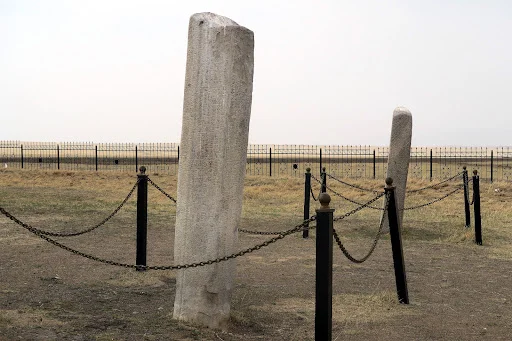
Monuments bearing the Tonyukuk inscriptions, part of the Orkhon inscriptions complex. Mongolia / Vezirtonyukuk / Wikimedia Commons
The same is true for the Kyrgyz: they referred to themselves strictly as Kyrgyz, not Turks. The Orkhon inscriptions, along with the Uyghur and Kyrgyz inscriptions, are the earliest monuments of Turkic writing. They show that the Turks, Uyghurs, and Kyrgyz possessed separate identities, and this distinction helps correct common historical misunderstandings. I must emphasize that the adoption of a Turkic language did not automatically make someone a Turk. For instance, even after the Mongols of the Ulus of Jochi (or the Golden Horde) became Turkic speakers, they did not call themselves Turks.
The Mongols of the Ulus of Jochi or the Kipchak steppe who became Turkic speakers maintained their Jochid Ulus identity, which later split into Uzbek, Kazakh, and Tatar identities.
In the steppe region or in Siberia, the term ‘Türk’ was not used as an ethnonym. Many non-specialists assume that this term was widely used in Siberia or the Volga region, but my research highlights the distinction between Islamic Central Asia and the Kipchak steppe in this regard. The term ‘Türk’ was used in the oasis regions of Central Asia, but not in the Kipchak steppe or further north. Consequently, Kazakhs and Tatars did not refer to themselves as Turks.

Fragment of the Tonyukuk inscription, written in the Old Turkic runic script. 8th century / Wikimedia Commons
In Central Asia, Mongols who became Turkic speakers did adopt the term ‘Türk’, but this was a broad Inner Asian nomadic identity that encompassed Mongol heritage. For instance, Timur identified himself as a Turk while simultaneously maintaining his Mongol identity. In post-Mongol Central Asia, Mongols were considered among the most prominent Turks in primary sources, such as in the Timurid and ShibanidiThe Timurids were a Turco-Mongol dynasty founded by Timur, while the Shibanids were an Uzbek dynasty descended from Chinggis Khan's grandson Shiban. official histories.
More about
THE MONGOLS AND THE KIPCHAKS
Why Did the Mongol Elite of the Golden Horde Adopt Turkic Language?
In summary, linguistic Turkicization did not lead to the formation of a Turkic identity in the modern sense. In Central Asia, the historic Turkic identity was broad and encompassed non-Turkic heritage, including Mongol lineages.
The underlying question is why linguistic Turkicization occurred across various Iranian, Mongolian, and other populations. We can divide the mechanism into two main scenarios: either the language of the ruling elite expanded to commoners, or the Turkic-speaking population was already the demographic majority. Additionally, for the Mongols, Turkicization could have partly occurred through Turkic-speaking mothers, with children acquiring the language as their mother tongue.
The word ‘Türk’ was originally not a name for all Turkic-speaking peoples, but the name of one specific ruling group, the Ashina clan, as we discussed earlier. When and how did it become a general term?
Although the name Turk fell out of use in the Mongolian steppe and East Asia, it became widespread in the Islamic world because Muslim authors began calling all Inner Asian nomads Turks (Atrak in the plural). Under this broad usage, even non-Turkic-speaking groups were categorized as Turks.
Consequently, when the Mongols appeared in the Islamic world in the early thirteenth century, they were called Tatars as well as Turks. Muslim authors spread the designation and turned it into a generic term. However, many nomads designated as Turks by these Muslim authors did not use the name for themselves. While Islamic geographers called the Uyghurs and Kyrgyz Turks, neither group identified as such.
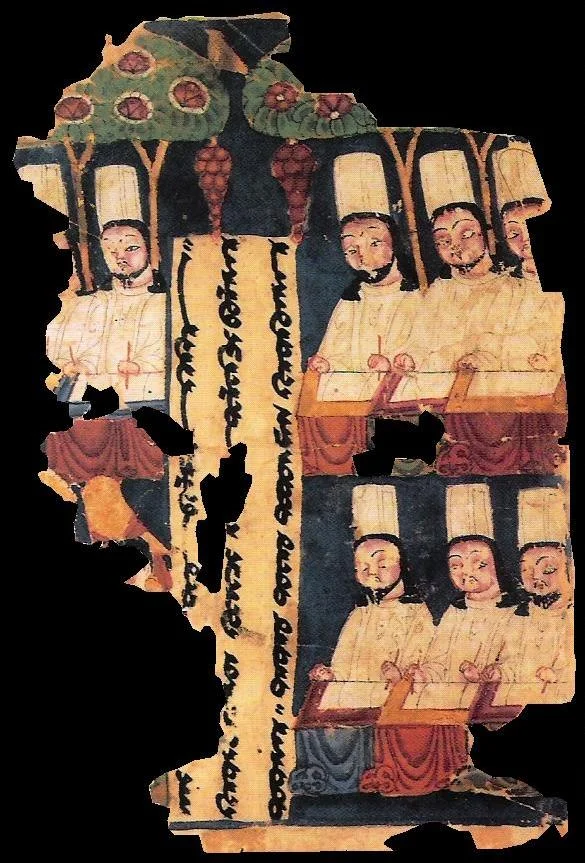
Manichaean priests writing at their desks. Leaf from a Manichaean manuscript from the Uyghur Kingdom of Qocho. 8th–9th century. Painting on paper / Wikimedia Commons
Conversely, Turkic nomads who moved south into Islamic Central Asia and the Middle East adopted the Islamic generic usage of the name ‘Turk’ to distinguish themselves from the settled Iranian-speaking population.
Outside the core Islamic world, Turkic-speaking groups did not adopt the name ‘Turk’ as an endonym. This was true for the Sakha and Tuvans in Siberia, populations in the Volga region, and nomads in the Kipchak steppe. Kazakh oral traditions, for instance, do not contain the name ‘Türk’.
In Europe and China, unlike in the Islamic world, Türk was never used as a generic term for all Turkic speakers, and no general overarching term existed for them until the development of comparative linguistics. In Europe, only the Seljuks and Ottomans of Anatolia were called Turks, whereas Kazakhs were called Kazakhs or Tatars.
The Oghuz, the ancestors of the Seljuks and Ottomans, were nomads near the Aral Sea. In the eleventh century, they moved west through KhorasaniKhorasan is a historical region spanning northeastern Iran, western Afghanistan, and southern Turkmenistan, central to Persian culture and Silk Road trade. into Iran and Anatolia. Who were they before that move and what pushed them westward?
We do not know the precise origin of the Oghuz, but because the Tiele were referred to as Oghuz in Turkic inscriptions, some scholars argue that a portion of the Tiele moved west and became the Oghuz. In addition, recent DNA studies support the view that the Oghuz originated from the Tiele group rather than the Turks.
Regarding their migration, the Oghuz were pushed westward from the Aral region by the Kipchaks. Some were later pushed southwest, leading to the renaming of the steppe region north of the Syr Darya River from the Oghuz steppe to the Kipchak steppe.
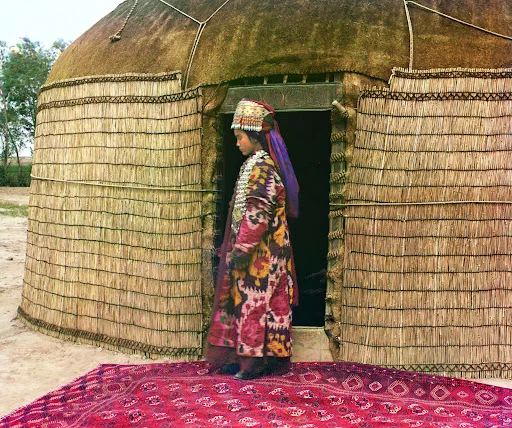
Sergey Prokudin-Gorsky. Turkmen woman in traditional clothing and jewelry at the entrance to a yurt. 1911 / Library of Congress / Wikimedia Commons
The subsequent movement of the Oghuz further west into Anatolia was tied to two major historical events: the rise of the Seljuk Empire, which defeated the Byzantines, and the expansion of the Mongol Empire.
