To a medieval traveler, the women of the Golden horde on horseback must have resembled warriors from legend. From a distance, they would have been mounted figures wearing helmets, their fierce spears rising high above their heads. But what the traveler may not have known is that these were not helmets; they were towering headdresses, adorned with silk, feathers, and precious ornaments. The sight was so exotic and striking to this foreign visitor that his account survived in chronicles for centuries.
Yet, these steppe headdresses were more than a curiosity. They had a visual language all of their own. Their shape and ornamentation conveyed a woman’s age, marital status, lineage, and position in society. This meaning changed with each empire that ruled the steppe, but today, archaeology allows us to explore this sartorial tradition in remarkable detail.
For Qalam, archaeologist, historian, and restoration specialist Tetiana Krupa explains what women of the Golden Horde wore on their heads, why they wore it, and where the oldest surviving saukeleiFor more information on Kazakh bridal wear and the saukele, please see From Saukele to Veils and Back on the Qalam website. have been discovered in Kazakhstan.
Today, the Golden Horde is viewed not as a savage empire but as a civilization at the heart of a vast Eurasian network, where trade routes converged, diplomats negotiated, and cultural exchange flowed smoothly. Women occupied a distinctive, influential place within this world. The khan, as it turned out, did not rule alone, and many modern scholars and medieval accounts suggest that alongside him stood a ‘political partnership’, while elite women played an active role in governance, diplomacy, and economic life.

Celebration at the court of the Mongol Ilkhans. Miniature from Rashid al-Din’s Jami' al-Tawarikh (Compendium of Chronicles). Tabriz, first quarter of the 14th century / Berlin State Library (Diez Albums) / Wikimedia Commons
The status of women, and these ones in particular, was often reflected in their clothing, and nowhere more clearly than in their headdresses. More than adornment, this towering creation was one of the most distinctive elements of a woman’s attire, serving as a kind of social passport. Its shape, height, materials, and ornamentation conveyed information about a woman’s age, marital status, and position within the social hierarchy.
Interestingly, the everyday dress of unmarried nomadic women differed little from that of men. This changed, however, when a woman married. In her new position as a wife, she adopted a new hairstyle and wore a distinctive headdress that was designed to be visible from a distance. One medieval author even remarked that a group of female riders resembled warriors wearing helmets with raised spears. Such striking headdresses appear again and again in surviving art, from Chinese imperial portraits to Persian manuscript miniatures, a visual testament to their enduring power across the vast reaches of the Mongol Empire.

Portrait of Chabi, wife of Kublai Khan. Ink and colors on silk. 14th century / National Palace Museum, Taipei / Wikimedia Commons
It was precisely their extraordinary height, luxurious fabrics, feathers, and precious ornaments that made these headdresses particularly striking to travelers and artists. They became the most recognizable image of women’s headwear, even though they represented only one part of a far more diverse world of female headdresses.
What Lay Beneath the Silk and Feathers
Despite their soaring appearance, these headdresses followed no single design. What they shared was a basic principle: a lightweight framework had to give the headdress height, support its fabrics and ornaments, and allow the wearer to move freely.
The most detailed description of the construction of a women’s headdress in the Golden Horde was left by the medieval traveler Friar William of RubruckiFor more information on William of Rubruck, please see the article ‘How “Tatars” Prepare Kumis and Kurt’ on the Qalam website.. It consisted of a rounded base that widened toward the top and was crowned by a four-sided element resembling a column capital. The framework was covered in costly silk fabric. A long rod made of reeds, stems, or feathers was inserted into the upper section, and it was often decorated with peacock feathers, mallard tail feathers, and gemstones.
Particularly noteworthy is the almucia that caught Rubruck’s attention. It was a type of hooded garment that covered the head, neck, and shoulders. The traveler used the term to describe the headdress’s large, soft lower section, with distinctive ‘wings’ that draped over the shoulders.
Its upper section had an opening through which it was fitted over another structure that provided the height and ceremonial grandeur of the headdress, which Rubruck calls a botta. The entire assembly was then secured and tied beneath the chin. Thus, the soft base covering the head and shoulders was joined to a tall, rigid upper section, creating, to a European eye, the appearance of the familiar almucia—the traditional garment worn at the time by European clergy and university professors.
The missionary Giovanni da Pian del CarpineiGiovanni da Pian del Carpine was a thirteenth-century Franciscan envoy who journeyed to the Mongol court and authored the earliest European account of the empire., who visited the court of Batu Khan, the grandson of Chinggis Khan who founded the Golden Horde, also described women’s dress and used the word corona. However, it is unlikely that he meant a European crown. The term may instead have referred to a rounded form or a circlet decorated with metal ornaments.
Similar rounded caps with metal embellishments have been known since antiquity. They appear in Scythian archaeological finds, medieval depictions of the goddess Umai, and the traditional dress of Central Asian peoples. A modern example is the taqiia, a traditional round or square embroidered skullcap worn by Kazakh women, which girls still decorate with embroidery, beads, and metal elements.
Later, another traveler, Ruy González de Clavijo, described a different ceremonial style at Timur's court. A tall cimeraiA cimera is a crest-like headdress worn by brides and noblewomen. was adorned with alxofar (pearls), gemstones from Badakhshan (a historic source of lapis lazuli and other precious stones in Central Asia), turquoise, three-dimensional gold appliqués, and a gold garland. ‘Above it rose a magnificent plume of white feathers, reaching a cubiti
A cubit is defined as the distance from the elbow to the tip of the middle finger. in height; bound together with gold thread, the feathers swayed as she walked.’
What the Kazakh Land Has Preserved
Over the years, archaeological discoveries have added further layers to this diverse picture. Excavations from Kazakhstan have shown that the Ulus of Jochi was not a peripheral recipient of imperial fashion, but instead, it was a cultural space where distinctive forms and traditions, new technologies, and cultural influences converged and mingled.
I have had the opportunity to study several very different archaeological assemblages associated with women’s headdresses. One of the most striking examples comes from the Bolgan Ana Mausoleum in Ulytau in central Kazakhstan and belonged to a woman of high status. Her headdress, along with other grave goods, reveals unmistakable echoes of Chinese courtly traditions, a testament to the far-reaching connections that shaped the lives of steppe women.

Over the years, archaeological discoveries have added further layers to this diverse picture. Excavations from Kazakhstan have shown that the Ulus of Jochi was not a peripheral recipient of imperial fashion, but instead, it was a cultural space where distinctive forms and traditions, new technologies, and cultural influences converged and mingled.
I have had the opportunity to study several very different archaeological assemblages associated with women’s headdresses. One of the most striking examples comes from the Bolgan Ana Mausoleum in Ulytau in central Kazakhstan and belonged to a woman of high status. Her headdress, along with other grave goods, reveals unmistakable echoes of Chinese courtly traditions, a testament to the far-reaching connections that shaped the lives of steppe women.

A particularly important example is the women’s assemblage found at the Mukyr burial site in the Pavlodar Region of northeastern Kazakhstan. Unlike many graves that yield only fragments, this site preserved its textile, leather, and birch-bark elements remarkably well. In fact, some of them were found in their original positions near the head and shoulders of the deceased. The excavated headdress was a layered creation combining plain-weave Chinese silk, red silk brocade woven with gold thread, leather, and a complex birch-bark framework.
It is clear that the craftsman had planned the construction of the headdress in advance. Some pieces were cut along the grain so that the fabric would retain its shape, while others were cut on the bias so that they would fit more closely around the wearer’s head and hairstyle. The tall birch-bark section was attached to the base with a leather insert, and it functioned as a shock absorber, allowing the headdress to sway slightly in the wind or with movement without breaking. This suggests that it was designed for more than ceremonial occasions. Its wearer could ride horseback and travel with the khan’s encampment.
In form, the Mukyr headdress was likely connected to a local Kipchak tradition known from twelfth- and thirteenth-century stone sculptures. It also resembles the headdress of the goddess Umai, the ancient Turkic and Tengrist deity of fertility, women, and children, depicted on medieval stone monuments of Central Asia. Yet alongside these local influences, the expensive imported fabrics belonged to the broader world of imperial court fashion. However, the headdress from Bolgan Ana, by contrast, was constructed differently. Together, the two finds tell a compelling story: they demonstrate that tall, structured headdresses existed in numerous local variations across the steppe.
A third find—this one from a mausoleum near the ancient city of Saray-Jük—offers yet another variation: a delicate hairnet woven from gold thread, crafted in the Byzantine style. Together with the birch-bark frameworks from Mukyr and the Chinese silks from Bolgan Ana, these discoveries reveal just how diverse women’s dress was in the Ulus of Jochi. Local traditions intersected here with fashions and technologies arriving from different parts of Eurasia.
The Significance of Height
A tall headdress was, above all, a signal that a woman was married. After marriage, her hairstyle, the way she arranged her hair, and the headdress itself all changed. Her transition into a new family and social role thus became visible to those around her.
But the height of a headdress indicated more than marital status. It also proclaimed her social standing. A towering headdress elongated the silhouette and set its wearer apart during ceremonies and formal appearances. Ruy González de Clavijo, a Spanish ambassador to Timur’s court and a noted travel writer, described how the great ruler’s wives appeared before guests in a prescribed order and took their places according to rank. Some headdresses were so tall and heavy that attendants had to walk alongside their wearers, helping to support the weight. Dress, thus, became part of court ritual, visibly expressing the hierarchies of the court.
Expensive fabrics and ornaments were also used to convey status. Silk, gold thread, pearls, turquoise, and rare feathers were a testament to a family’s wealth, its access to distant trade routes, and the work of skilled artisans. The headdress, therefore, represented not only the woman herself, but also her family, clan, and political circle.

This public display was no mere pageantry, reflecting the real influence and status of elite women in the Mongol Empire and the Ulus of Jochi. They played a role in dynastic alliances, managed mobile courts and households, controlled property, and occupied a prominent place in court life. A tall headdress was not, in itself, a symbol of power, but it made a woman’s status immediately visible to those around her.
At the same time, it is also important not to assign a separate, fixed meaning to every color, gemstone, or feather. The significance of these items could vary according to period, region, and circumstance. It is more accurate to speak of the broader significance of the tall headdress, which signaled marriage, high status, wealth, and a woman’s place within court society.
From the Golden Horde to Kazakh Tradition
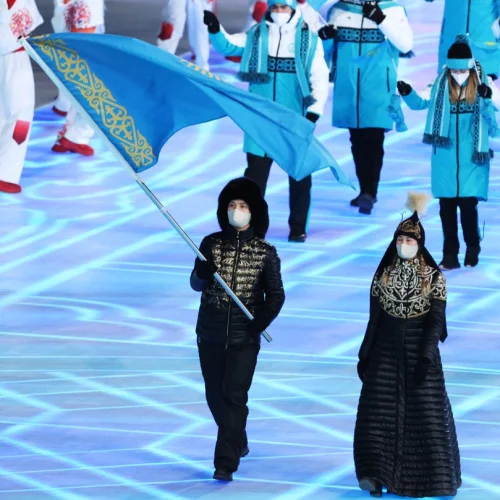
The tradition of tall, structured headdresses did not end with the Golden Horde—it lived on in the Kazakh saukele, or the traditional ceremonial bridal headdress. Worn at weddings, it marked the moment a young woman entered a new family and assumed a new social role. Its height distinguished the bride from the other participants in the ceremony, while the costly fabrics, precious metals, gemstones, pearls, and pendants reflected her family’s wealth.

At the same time, the saukele should not be regarded as a direct copy of the medieval bogtag, the tall, elaborate ceremonial headdress worn by married Mongol noblewomen in the thirteenth and fourteenth centuries. Over the years, its form, framework, fastening methods, and ornamentation changed, but what endured was primarily a broader cultural principle—that a significant transition in a woman’s life was marked by a tall, richly decorated headdress.
Throughout these transformations, one enduring feature was the use of feathers. Clavijo described the headdress worn by Kanyo, one of Timur’s wives, with a tall, mobile plume. Feathers also adorn the Kazakh saukele and other ceremonial headdresses. They are associated with beauty and festivity and, in some contexts, were also regarded as protective charms for the wearer.
But tall headdresses were not the only tradition to endure. The Kazakh tradition also preserved the small, round taqiya caps, decorated with embroidery, beads, and silver elements. Today, girls wear them both with traditional dress and as part of contemporary ethnic-inspired styles. The detachable chain mesh ornaments used to decorate some taqiya resemble the gold-thread hairnet discovered near medieval Saraychik. This similarity makes it possible to compare the two types of adornment, although it does not, in itself, establish a direct line of continuity between them.

The connection with the medieval past lies not in the unchanged survival of individual details but in the enduring understanding of the headdress as a marker of beauty, protection, marital status, and affiliation with a particular clan.