
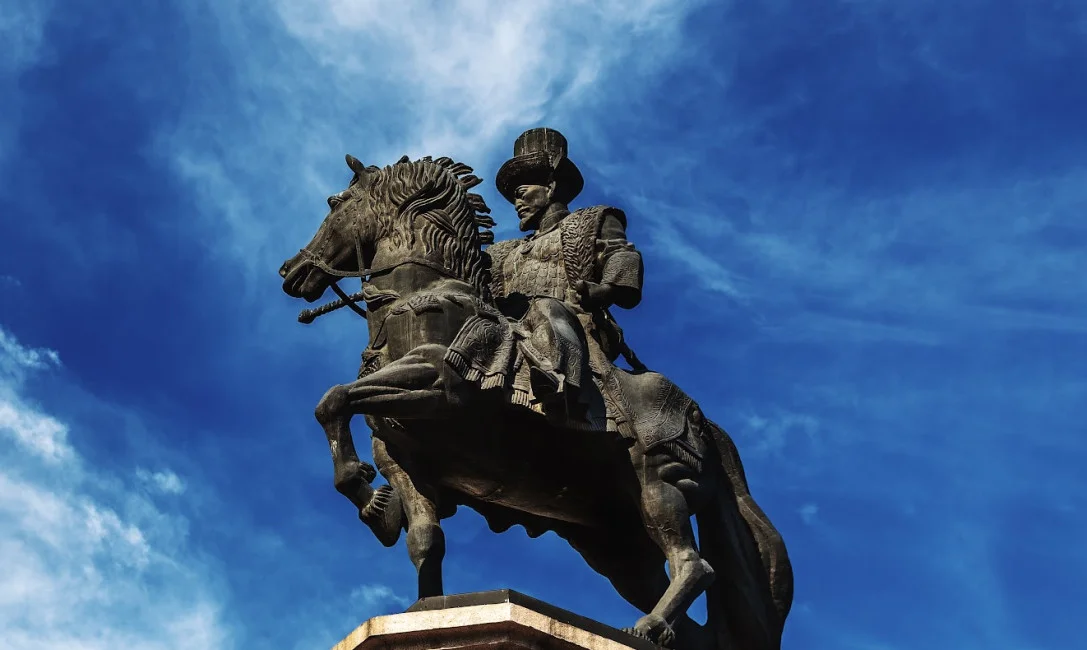
Ablai Khan earned his place in history not only as an outstanding military commander but also as a statesman who managed to preserve the Kazakh Khanate during an era of devastating wars, internal conflicts, and confrontations among the greatest empires of Eurasia. Maneuvering between Russia, the Qing Empire, the Dzungars, and the Central Asian khanates, he not only defended the Kazakh steppe but also laid the groundwork for its political and territorial unity.
In Kazakh historiography, 23 May is traditionally considered the birthday of Abilmansur Ualiuly—the man the world would come to know as Ablai Khan. Interestingly, the same date is also regarded as the day of his death. On the 315th anniversary of his birth, Professor Nabizhan Mukhametkhanuly spoke about why the era of Ablai Khan became a turning point in the history of the Kazakh people.
The Era of Great Calamity
During his nearly forty-year reign, Ablai Khan (1711–1781) became one of the most important figures in the history of the Kazakh people. What makes this especially remarkable is that his life unfolded during an extraordinarily difficult period, and against all odds, he held his nation together.
Beginning in the eighteenth century, European powers that had embarked on the path of industrial development increasingly expanded eastward. The Russian Empire, having strengthened its economic and military power through the reforms of Peter I (reigned 1682–1725), launched a series of expansionist wars aimed at extending its borders. At the same time, the struggle for regional dominance in Central Asia intensified. Seeking to strengthen their own influence, states became increasingly drawn into destructive wars and mutual raids. In this rapidly changing geopolitical environment, the Kazakh Khanate was almost constantly subjected to external threats.
Shoqan Walikhanov wrote of that period:
The first decade of the eighteenth century was a terrible time in the life of the Kazakh people. The Dzungars, the Volga Kalmyks, the Yaik Cossacks, and the Bashkirs devastated their aulsi The word aul means ‘village’ in Kazakh, and typically encompasses 100–200 yurts. from all sides, drove away their livestock, and took entire families into captivityiШ.Ш.Уәлиханов. Абылай хан. – Алматы : Айқап. 1992, 32 p. .
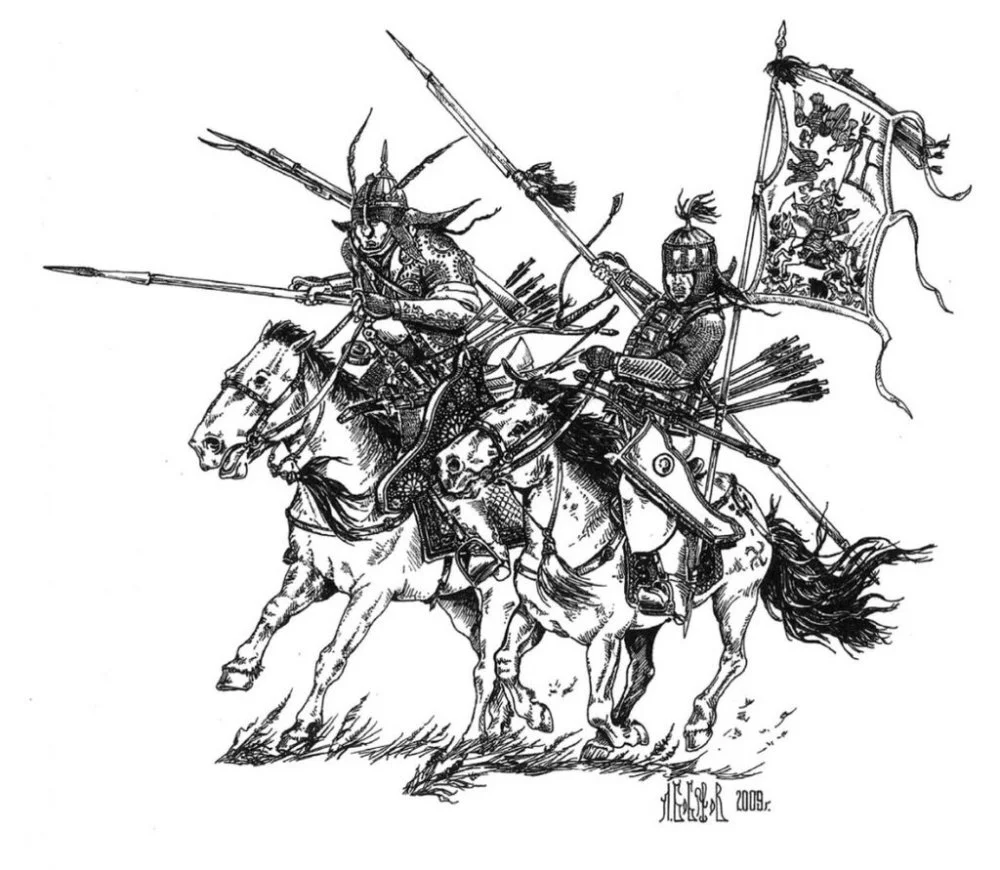
Kalmyk warriors. Reconstruction / Wikimedia Commons
However, the most serious threat to the Kazakh people came from the east—from the Dzungar Khanate. After the death of Khan TaukeiKhan Tauke (c. 1635–1718) was a prominent Kazakh ruler who united the three jüzes and codified the Zhety Zhargy (Seven Charters), the definitive legal code of the Kazakh Khanate. in 1718, internal unity within the steppe weakened significantly, and the struggle for succession to the khanate intensified. The number of claimants to the throne increased, undermining the authority of the supreme khan. Meanwhile, the Dzungar Khanate, which was hostile to the Kazakhs, was rapidly growing stronger.
The Dzungar ruler Tsewang Rabtan carried out campaigns against the Kazakh steppe in 1711–1712, 1714, and 1718. However, each time, the Dzungars encountered fierce resistance from the Kazakhs and they were forced to retreat. Later, after careful preparation and the mobilization of a large number of forces, the Dzungars launched a sudden invasion of the Kazakh steppe in the early spring of 1723. They advanced as far as Turkestan, destroying the population and driving off livestock.a This tragedy, which left the Kazakh Khanate severely weakened, remained in popular memory as Aqtaban Shūbyryndy, Alqaköl Sūlama, or the era of the Great Calamity.
How Did ‘Shaggy’ Become Ablai?
The Dzungar invasion, which became a catastrophe for the entire steppe, also left a tragic mark on the fate of the still-young Abilmansur. During the Dzungar attack on Turkestan, his family was devastated, and his father was killed. Abilmansur himself survived only by a miracle, and it was the help of strangers that kept him alive. He eventually found refuge in the lands of the Senior Jüz, where he tended camels for Tole Bi, who took him under his protection. It was during those years of wandering and hardship that he acquired the nickname by which he later became known: Sabalaq (meaning ‘Shaggy’).
One day, during a reconnaissance expedition, the warrior Bogenbai Batyr stopped at Tole Bi’s aul. Sabalaq, who came to greet the batyriBatyr is a historical Turkic and Mongol title meaning 'hero', or 'warrior', usually bestowed upon military leaders and folk heroes for their courage, strength, and service to the people., asked to be taken along on the campaign. Seeing the fire in the young man’s eyes, Bogenbai agreed and took him with him to Saryarka. From that moment, Sabalaq’s life changed forever. At first, he accompanied Bogenbai as an assistant during military campaigns, but over time, after mastering military skills and the art of steppe warfare, he began taking an increasingly active role in battles.
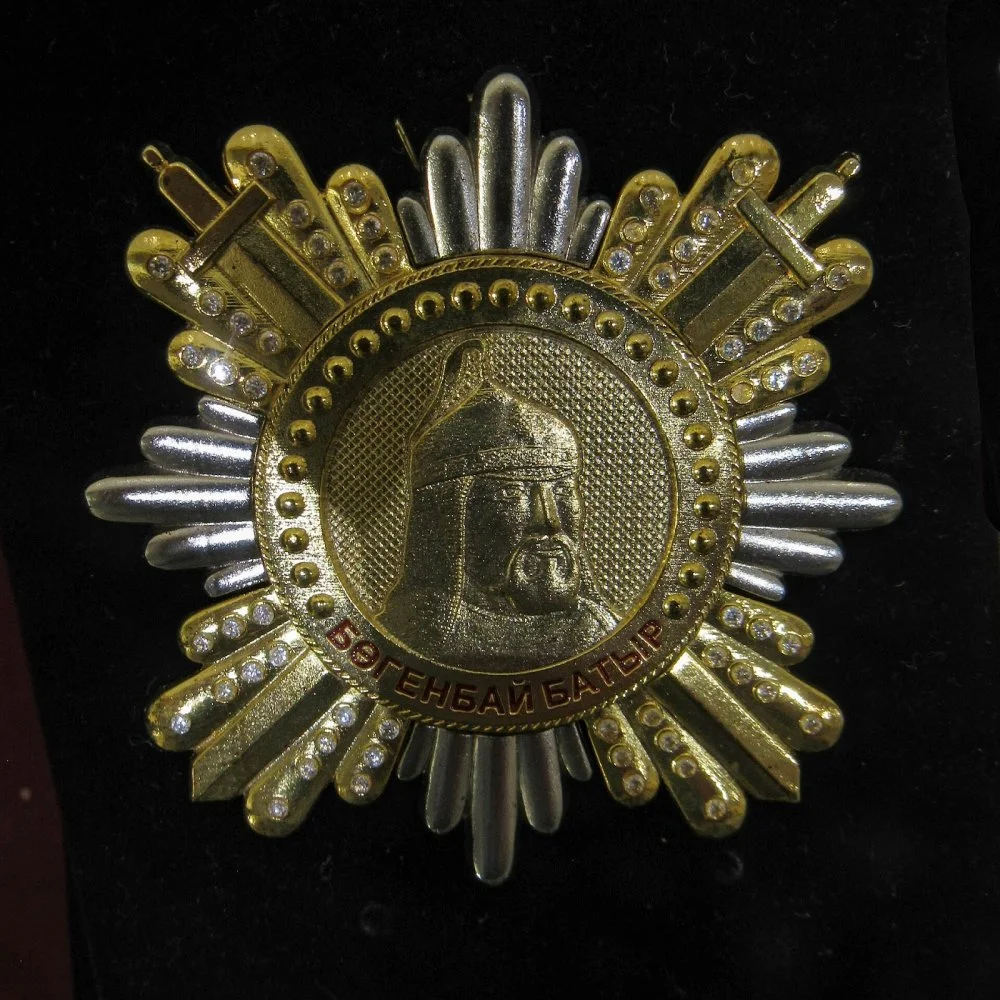
Order of Bogenbay Batyr. National Museum of the Republic of Kazakhstan, Astana / Wikimedia Commons
It is important to note that the Kazakh Khanate recovered relatively quickly from the devastation caused by the Dzungar invasion of 1723. By 1726, a great kurultaiiA kurultai was a traditional assembly of Turkic and Mongolic leaders, convened to make key political, military, and strategic decisions, such as electing rulers, declaring war, or forming alliances. It played a crucial role in uniting fragmented groups. of the three jüzes was held in Ordabasy, where it was decided to launch a counteroffensive.
The Kazakh army, led by Abulkhair Khan of the Junior Jüz, inflicted heavy defeats on the Dzungars on two occasions, first in 1728 at the Battle of the Bulanty River and then in 1729 in the battle near Lake Itishpes south of Balkhash.
However, the Supreme Khan Bolat died in 1730, after which a power struggle broke out between Abulkhair and Sameke Khan of the Middle Jüz. Ultimately, the khan’s throne went to Abilmambet. Refusing to accept this decision, both Abulkhair and Sameke withdrew their forces from the battlefield. The division within the Kazakh elite at such a decisive historical moment undermined the country’s unity and significantly weakened its strength.
In battles against the Dzungars, the enemy often challenged Kazakh batyrs to duels in an effort to break the army’s morale. One of the most dramatic of these encounters took place in 1731.
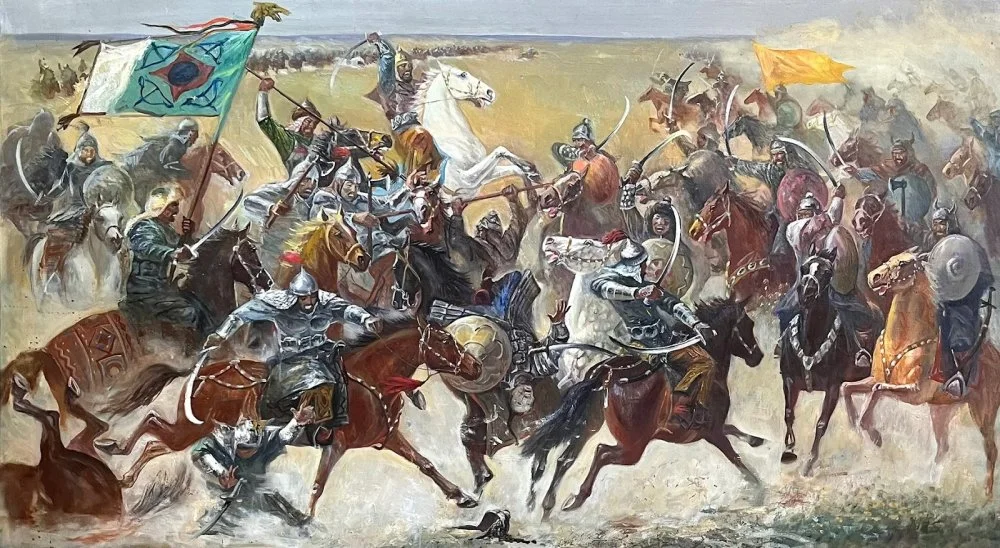
Dias Ustemirov. The Battle of Anyrakai, 2000 / Courtesy of Bonart Auction House (https://bonart.kz/)
When the renowned Dzungar batyr Sharysh stepped forward, he was met by the young and then-unknown Abilmansur. With the battle cry ‘Ablai! Ablai!’, the young man charged into battle and killed Sharysh in single combat. It was after this battle that Khan Abilmambet summoned Abilmansur and appointed him Sultan of the Middle Jüz and one of the army's commanders. From that time on, he became known among the people as ‘Ablai’.
Ablai’s influence in the steppe continued to grow, and over time, he became one of the leading political figures of the Middle Jüz, effectively second only to Khan Abilmambet. The consolidation of his authority did not go unnoticed by either the Russian Empire or the Dzungar Khanate. In 1740, the head of the Orenburg Commission, Vasily Urusov, wrote in a report to Russia’s College of Foreign Affairs:
The rulers of the Middle Jüz are Khan Abilmambet and Sultan AblaiiКазахско-русские отношения в XVI-XVII веках (Сборник-документов и материалов) - Алма-Ата. -1961, № 65. p.127 - 128; Зарқын Тайшыбай. Абылай хан (өмірі мен қызыметыне қатысты құжаттар мен материалдар). – Астана : Астана баспасы. 2005, 77 p. .
This demonstrates how much Ablai’s political influence had grown by that time. A note by Alexey Levshin supports the same idea:
In 1739, in the Middle Jüz, after Khan Sameke and prior to the election of a new khan, khanly authority was exercised by Abulmambet and Ablai.
If Russian sources maintained that in August 1740, Ablai and Abilmambet, the khan of the Middle Jüz, arrived in Orenburg and declared their willingness to accept the formal ‘protection’ of the Russian government, documents from the era of the Qianlong Emperor dated April 1758 state:
The Kazakh Khan Ablai concluded an alliance with the Russian Empress in 1740iЦияньлун кезіндегі Цин патшалығы мен қазақ рулары қытанстарын зерттеу. - 106 p..
Ablai’s Dzungar Gambit
The Dzungars, however, preferred to subjugate Ablai by force and took him captive. In 1741, after tracking down the sultan, they captured him during a hunting expedition. Yet the nearly two-year Dzungar captivity ended rather unexpectedly: in the end, the Dzungars not only released Ablai, but also gave him an Oirat woman named Topysh in marriageiМәшқұр Жүсіп Көпейұлы. Абылай хан. -Алматы : Айқап. 1992, 23 p. .
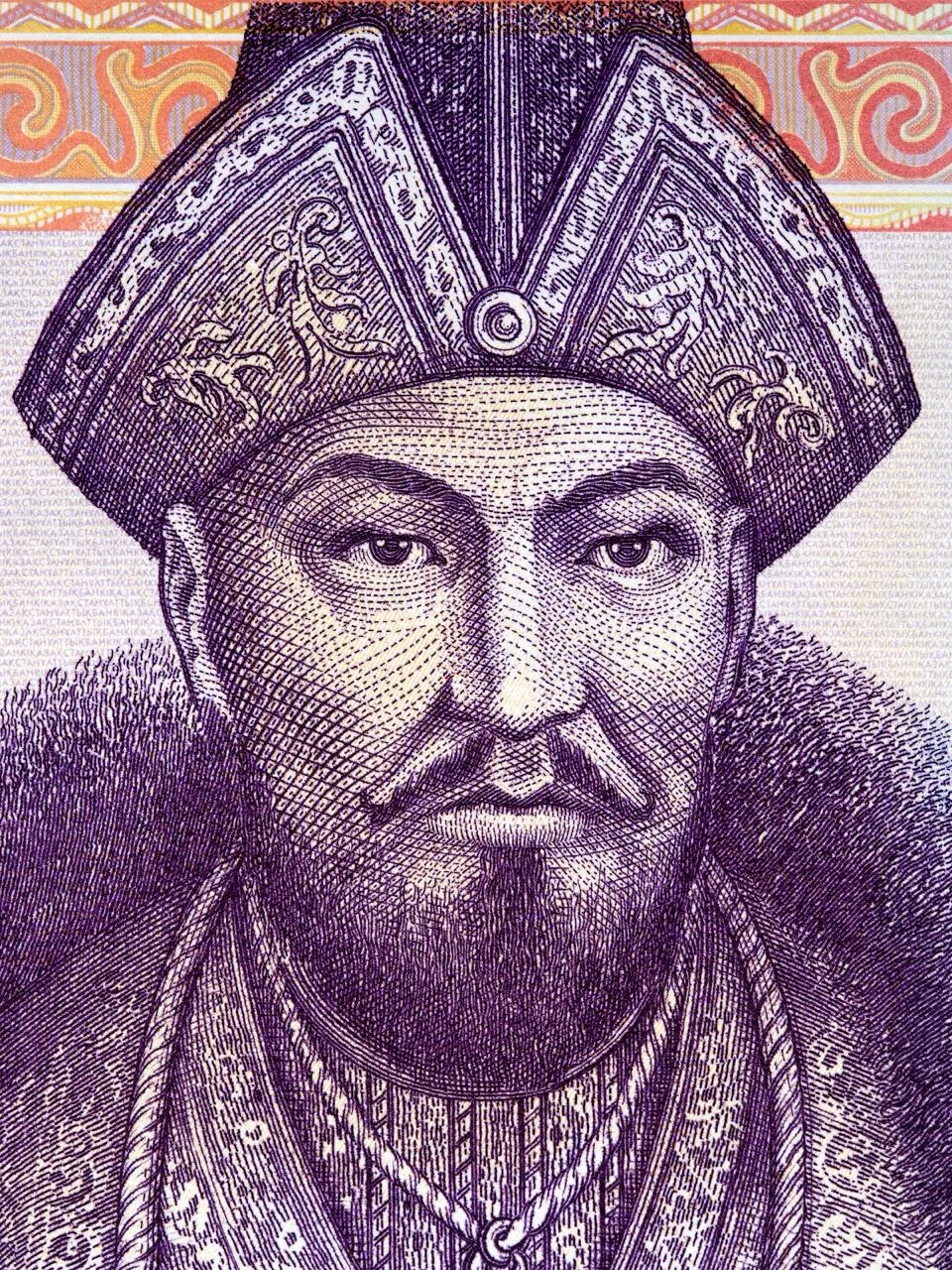
Portrait of Ablai Khan / Getty Images
Khan Abilmambet received Ablai with honors, and in 1743, having convened the nobility of the three jüzes, held a grand ceremonial feast. It was at that time that he transferred khanly authority to AblaiiАбылай хан дастаны (Қолжазба). Қытай халық ауыз әдебиетін зерттеу қоғамы, Шыңжаң бөлімшесін сақталған. . After 1743, it was Ablai who effectively exercised khanly authority in the Middle Jüz, and in matters concerning the Kazakhs, neighboring states were compelled to deal primarily with him. However, the Kazakh Khanate's foreign policy during this period remained highly complex.
From the northwest, tsarist Russia was advancing ever deeper into the steppe, gradually extending its influence from the Junior Jüz toward the Middle Jüz. Pressure from the Kalmyks and Bashkirs intensified from the Volga region. To the south, the khanates of Bukhara and Khiva increasingly asserted their claims. Meanwhile, Dzungar raids from the east continued without interruption. Ablai Khan’s primary objective was to deliver a decisive blow to the main threat—the Dzungar conquerors—by organizing large-scale military campaigns against them.
Following the death of the Dzungar khuntaiji (ruler) Galdan Tseren in 1745, the balance of power between the Dzungars and the Kazakhs shifted dramatically. The Dzungar Khanate entered a period of decline, while the Kazakh state, by contrast, considerably strengthened its position. A fierce internal struggle for power erupted among the Dzungar elite.
Internal conflicts became increasingly bloody, and at a certain point, the contenders for the throne themselves began seeking support from Ablai, who had emerged as a key arbiter. In this situation, he pursued a carefully calibrated political strategy: he extended protection and patronage to weaker factions of the Dzungar aristocracy, thereby balancing the influence of stronger claimants. This strategy proved successful, and the Dzungars were ultimately driven out of the Kazakh nomadic territories. By the early 1750s, Kazakh militias had virtually cleared the country of enemy forces.
Thus, in a report of Russian intelligence from December 1753, the following was stated:
And those Kirghiz [Kazakhs] render assistance to the aforementioned DebacheiDawachi, and those Kirghiz have gone to provide such aid, and many Kalmyk uluses have been defeated, and captives brought back ... Sultan Ablai, together with his uluses, also went to provide that assistanceiЗлаткин И.Я. История джунгарского ханства (1635–1758). – М., 1964, 468 s. .
In January 1753, a Kazakh force of 5,000 troops helped Dawachi defeat the DörbetsiDörbets were a major Oirat tribe in the Dörben Oirat confederation, often allied with the Dzungars and rivals to Ablai Khan's Kazakh Khanate.. However, when a struggle for the khan’s throne broke out between Dawachi and Amursana, Ablai chose to support the increasingly weakened Amursana.
Amursana, hoping to secure power over the Dzungars with the support of the Qing Empire, entered into allegiance with Beijing, along with his ulus of 20,000 people. However, in May 1755, the Qing Empire definitively eliminated the Dzungar Khanate and appointed Amursana only as noyoniNoyon was a Mongol title for a noble, military commander, or tribal leader, historically used for aristocratic commanders under khans and in later Central Asian khanates. of a single subordinate tribe.
Refusing to accept this outcome, he launched two uprisings against the Qing Empire, but both ended in defeat. Ultimately, Amursana fled to the territory of the Middle Jüz, where he found refuge.
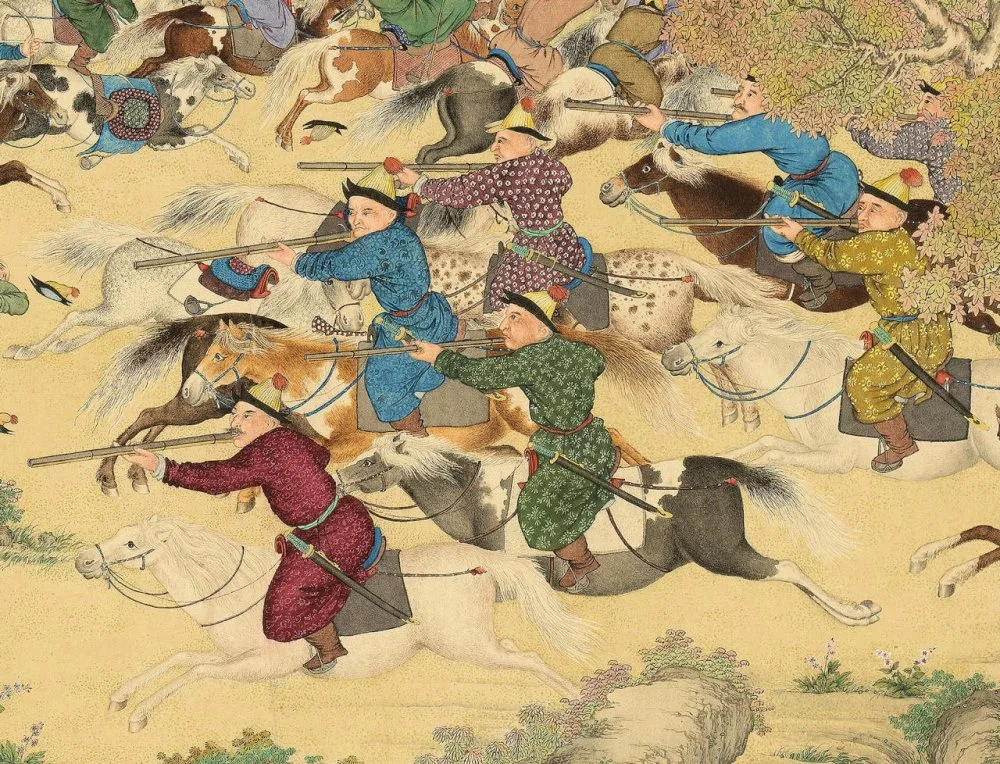
Dzungar cavalry of Amursana in the Battle of Khorgos against Qing China. 1758 / Wikimedia Commons
The Qing Empire and the Question of Land
These events became a serious test for the emerging relationship between the Qing Empire and the Kazakh Khanate. In pursuit of Amursana, Qing authorities sent a 30,000-strong army into the Kazakh steppe, advancing along three key directions. In response, Ablai Khan took up arms against the invading forces. However, the far-sighted Kazakh ruler understood that the enormous military power of the Qing Empire could not be halted through force alone. Consequently, he ultimately chose the path of diplomacy and dispatched envoys to the Chinese military headquarters.
Although Ablai assured the Qing command that he would assist in capturing Amursana, he deliberately prolonged the process and took no concrete action. As a result, Amursana succeeded in crossing into the territory of the Russian Empire, where he later died.
Although the issue of Amursana was thus resolved, an entirely new historical stage now awaited Ablai, one marked by new challenges, new objectives, and a strategy requiring extraordinary political resolve. Previously, the Dzungar Khanate had served as a buffer between the Qing Empire and the Kazakh Khanate. Following its final collapse, the Kazakh steppe came into direct contact with Qing territories. The two states now had to establish relations without intermediaries, inevitably elevating their diplomatic engagement to a fundamentally different level.
When examining the era of Ablai Khan’s state and sociopolitical activity, one cannot fail to recognize his immense—and, without exaggeration, historic—contribution to the restoration and consolidation of the Kazakh people’s ancestral ethno-territorial lands. He sought to resolve this highly complex web of territorial issues primarily through flexible maneuvering and subtle diplomacy.
For its part, from the outset, Beijing pursued an exclusively defensive and cautious approach toward the Kazakhs in the borderlands. The Manchu rulers were well aware of the long-standing and deeply rooted territorial dispute between the Kazakhs and the Oirats.
For this reason, Qing authorities swiftly established a chain of border posts stretching from the Black Irtysh to the Ili River and issued the following directive:
If Ablai intends to graze livestock on Oirat lands, inform him that crossing the demarcation line is strictly prohibitediЦин (Чиң) патшалығы Гаозун патшаның орда күнделіктері (Қолжазба). 481 т., 7 p.; Шыңжаң Ұлтарды зерттеу институты (新疆民族研究所). Цин күнделіктеріндегі Шыңжаңға қатысты материалдар жинағы (清实录新疆资料辑录 – Qingshilu Xinjiang ziliao jilu). – Үрімжі : Шыңжаң Ұлтарды зерттеу институты. 1978, 3- book, 1093 p..
Ablai Khan regarded Tarbagatai and Ili as ancestral Kazakh lands and was, therefore, convinced that Kazakh clans should once again establish themselves in these regions. Through his envoys at the Qing court, he repeatedly sought the return of these territories to the Kazakhs, but the Qing Empire consistently rejected these requests under various pretexts.

State National Nature Park Tarbagatai / Wikimedia Commons
Having failed to achieve his objectives through diplomatic means, Ablai adopted a different strategy. He gradually encouraged and organized the resettlement of Kazakhs into these disputed territories, systematically consolidating their presence across the region.
Some clans and tribes of the Middle and Senior Jüzes moved up to the border fortifications and, in some cases, even crossed the frontier posts at various points along the boundary. With each passing year, the Kazakh presence in these areas became increasingly significant. Ultimately, the Qing Empire was compelled to accept the loss of de facto control over the situation. In 1767, Qing authorities officially sanctioned the permanent settlement of Kazakhs on these lands on the condition that they pay a fixed land tax.
Thus, Kazakh clans once again established themselves in the Ili region, Tarbagatai, and the Altai region, although these territories formally remained under the direct administration of the Qing Empire. The Kazakhs living in present-day China and Mongolia are the direct descendants of those very settlers.
Ablai Khan and International Trade
Pragmatic economic considerations led Ablai Khan to raise the issue of trade with the Qing Empire as early as 1757. In practice, this arrangement was beneficial to both sides: the Qing court had a particular need for Kazakh horses, and by the following year, the two parties had officially agreed to establish a system of barter trade. Ablai proposed establishing trade centers near Lake Ulungur, close to Kazakh nomadic territories. However, the imperial administration offered counterarguments. The court chronicles dated 15 December 1757, preserve the following record:
Trade with the Kazakhs in Urumqi has been agreed upon with Ablai and approved by imperial decreeiФу Хэн. Жоңғарды тыныштандырудың жалпы жобасы (Қолжазба). - Бейжин. 1777. .
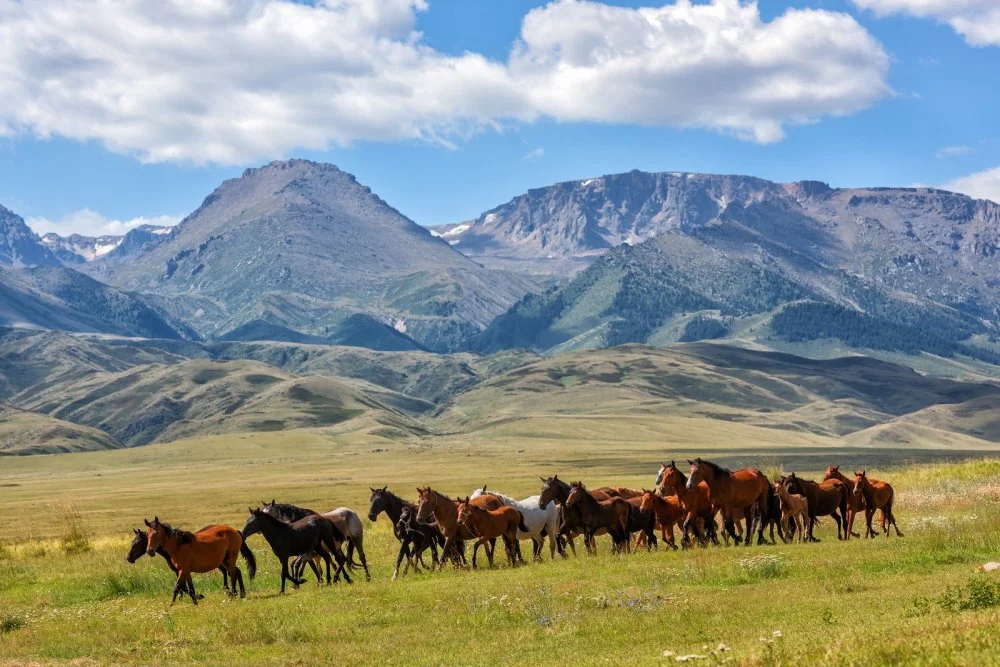
A herd of horses, Kazakhstan / Getty Images
In the autumn of 1758, the first official trade market opened in Urumqi, operating under regulations specifically approved by Qing authorities. These rules were based on a directive issued by the Qianlong Emperor, which stated:
Trade must invariably be conducted fairly. People arriving from such distant lands should personally experience the benevolence and mercy of the Emperor.
The leadership of such a responsible mission and the escort of the first Kazakh trade caravan were entrusted by Ablai Khan to the legendary Qabanbai Batyr.
Driven by growing mutual demand, the Qing Empire established a special barter market in the Ili region—near present-day Khorgos—in 1760 and, in 1763, they opened a similar trading center in Tarbagatai. At the same time, trade with the Kazakhs remained under strict Qing state monopoly control.
Over time, Kazakh merchants began to actively develop barter trade not only with the Qing Empire but also with the Uyghurs of Kashgaria, as well as with the Uzbeks and Tajiks to the south. However, in Beijing, it was concluded that direct trade contacts between Kazakhs and the Uyghur population could pose a potential economic and political threat to the empire. Therefore, the authorities imposed a strict ban on such interactions.
Against this backdrop, the Russian government, having noted the clear revival of Kazakh trade with its eastern neighbors, also took active steps to strengthen its own commercial presence in the region. This foreign policy interest is clearly reflected in a letter from Colonel Fyodor Lestock addressed to Ablai:
In the message delivered by me through an interpreter, I intended to communicate with you regarding matters of trade. It would be highly useful if you would be pleased to inform me of the specific goods which your uluses will have need of in the futureiНәсенов Б. Абылайхан. – Алматы. 2005, 601 p. .
In reality, the tsarist authorities were seriously concerned that close contacts between the Kazakhs and the Qing Empire would create significant obstacles to the implementation of their colonial policy in the steppe. Seeking to neutralize this influence and attract the steppe elite to their side, the government of the Russian Empire issued a strict directive to the Orenburg and Siberian provinces:
To all authoritative and influential Kazakhs, distribute generous offerings and gifts. And for those among them who settle in the border areas on our terms, erect permanent houses and buildingsiНәсенов Б. Абылайхан. – Алматы. 2005, 601 p. .
Ablai Khan was repeatedly invited to make an official visit to Orenburg or Troitsk. However, while diplomatically declining these invitations, he nevertheless maintained stable and friendly relations with the Russian Empire. According to archival documents, Qing authorities viewed the pragmatic maneuvering of the Kazakhs with understanding:
The Kazakhs are cautious in their dealings with the Russians. The fact that they maintain peaceful relations with them is entirely reasonable. If they come to us with sincere intentions, bringing visits and gifts, we should show them favor. If they do not come, there is no great harm. Whether they fear the Russians or not should not be a matter of concern to us.
Moreover, Qing officials explicitly stated:
We do not restrict the Kazakhs in their relations with RussiaiЛевшин А.И. Описание киргиз-казачьих, или киргиз-кайсацких, орд и степей (под общей редакцией М.К. Козыбаев). – Алматы: Санат. 1996, 656 s. .
These documents clearly demonstrate that the Qing Empire regarded the Kazakh Khanate as an independent sovereign state. They also clearly indicate the extent to which Ablai Khan skillfully constructed a flexible, multi-vector foreign policy and system of trade relations within an extremely complex geopolitical environment.
Governance and Centralized Authority
In the 1770s, Ablai Khan focused his efforts on resolving emerging political crises in the region. In 1771, the Torguts, numbering approximately 170,000 people, including up to 40,000 warriors, undertook an exodus from the banks of the Volga back to Dzungaria—toward their historical lands. Their route passed through the Kazakh steppe.
On the Emba River, they were attacked by the forces of Nuraly Khan of the Junior Jüz. As the Torguts approached Balkhash, they were also surrounded by detachments of the Middle Jüz, which enclosed the retreating group in a tight ring and intensified pressure from all sides. However, Ablai Khan strongly disapproved of the extermination of the Torguts. He understood that they were not passing through the steppe in order to seize Kazakh lands, but were attempting to return to their former nomadic territories.
Demonstrating political foresight, Ablai concluded an agreement with the Torgut leaders Ubashi and Tseren and opened a safe corridor for their passage through Kazakh territory. Thus ended the Torgut exodus, which entered historical record as the ‘Dusty March’. By 1774, slightly more than 66,000 Torguts had successfully reached Dzungaria. The Qing Empire later resettled them in the southern Tian Shan Mountains in the Bayangol region.
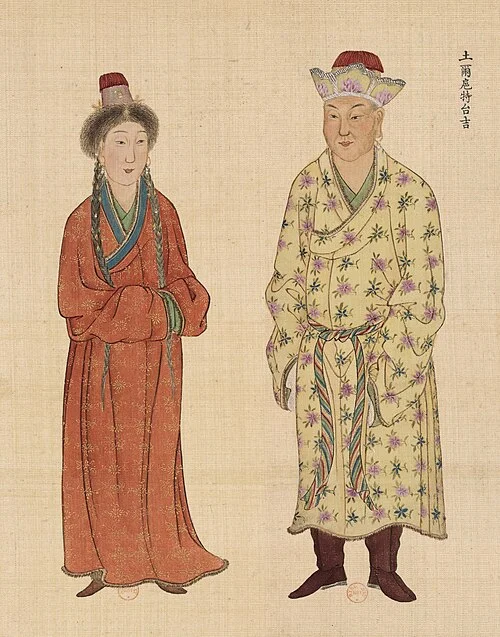
Tayiji (prince) of the Torghuts and his wife. From the album Huang Qing Zhigong Tu, China, 1769 / Wikimedia Commons
In 1774, Kyrgyz detachments invaded the lands of the Senior Jüz, subjecting the local population to plunder and devastation. Outraged by this treacherous attack, Ablai Khan personally led a large army and delivered a decisive counterstrike. These events are described in detail in a report sent to the imperial court in May 1774 by Yiketun, the Ili general of the Qing Empire.
According to the testimony of a Kazakh named Tuisik, Ablai and Abilpeiz, at the head of a large army, arrived in the Kara-Balta region, where they engaged in a fierce battle with the Buruts [Kyrgyz]. They devastated their nomadic encampments, capturing many men and women and driving away a vast amount of livestock. A Burut leader named Akteke pursued them, but suffered a crushing defeat in a major battle in the Talas valley. More than a thousand of his warriors were killed on the battlefield, and over 1,000 people were taken captive (barimta)iЦин (Чиң) патшалығы Гаозун патшаның орда күнделіктері (Қолжазба). 481 т., 7 p.; Шыңжаң Ұлтарды зерттеу институты (新疆民族研究所). Цин күнделіктеріндегі Шыңжаңға қатысты материалдар жинағы (清实录新疆资料辑录 – Qingshilu Xinjiang ziliao jilu). – Үрімжі : Шыңжаң Ұлтарды зерттеу институты. 1978, 3- book, 1093 p. .
Ablai Khan resettled these captured Kyrgyz in the northern regions with the intention of integrating and assimilating them into the Kazakh ethnos. Shoqan Walikhanov wrote of the scale of this resettlement:
Their numbers were so great that their descendants now form two separate volosts and are known as ‘Jaña Qyrgyz’ and ‘Bai Kyrgyz.’iШ.Ш.Уәлиханов. Абылай хан. – Алматы : Айқап. 1992, 32 p.
Ablai’s strategy toward a hostile yet closely related people was not one of physical destruction, but rather of their gradual incorporation into the broader Kazakh identity. During that campaign, Ablai Khan established the boundary extending from Narynkol to Kordai as the official Kazakh–Kyrgyz border.
At the same time, he appointed his eldest son, Adil, to govern the Uyusun tribal confederation in the Senior Jüz, while assigning his other sons authority over various Kazakh clans and tribes, granting each a specific territorial domain. In this way, Ablai ultimately established a clear vertical structure of direct administrative control that extended across virtually the entire steppe.
Ablai Khan also firmly opposed the aggressive actions of the Kokand ruler Irdena-bi, taking a stand in defense of the southern borders of Kazakh territories. According to historical accounts, Irdena-bi killed Ablai’s own brother, Eskendir, along with his four children, and took his wife as war booty (barymta).
Ablai Khan personally led a military campaign against the Kokand forces and defeated their large army. The Kokand ruler himself fled and took refuge in the fortress of Pishpek. Seeking to deliver a decisive strike against the entrenched enemy in the citadel, Ablai Khan appealed to the Qing state with a request to provide artillery. However, the Qing court refused, presenting the following justification:
Both the Kazakhs and the Kokand people are my subjects. Therefore, it is not permissible to assist one in destroying the otheriЦин (Чиң) патшалығы Гаозун патшаның орда күнделіктері (Қолжазба). 481 т., 7 p.; Шыңжаң Ұлтарды зерттеу институты (新疆民族研究所). Цин күнделіктеріндегі Шыңжаңға қатысты материалдар жинағы (清实录新疆资料辑录 – Qingshilu Xinjiang ziliao jilu). – Үрімжі : Шыңжаң Ұлтарды зерттеу институты. 1978, 3- book, 1093 p. .
It is reasonable to assume that the Qing Empire was wary of arming Ablai Khan with artillery, fully aware of the potential consequences. However, following a heavy defeat in that war, the Kokand forces no longer attempted further expansion into the Kazakh steppe during Ablai’s lifetime.
During the southern campaigns between 1765 and 1767, Ablai Khan significantly strengthened the Kazakh Khanate's influence in key urban centers such as Turkestan, Sayram, and Shymkent. Moreover, the inhabitants of Tashkent were required to pay a poll tax to the Kazakh authorities regularly.
In 1777, Ablai Khan once again marched south and struck against the rulers of Tashkent and Khojent, who had flouted and disrespected Kazakh authority. After this campaign, they were once again compelled to pay tribute to the Kazakh Khanate. Ablai Khan firmly suppressed any actions that could disrupt the internal stability of the country and severely punished the instigators of rebellions. It is no coincidence that Shoqan Walikhanov wrote that none of the Kazakh khans possessed the same authority as AblaiiШ.Ш.Уәлиханов. Абылай хан. – Алматы : Айқап. 1992, 32 p. .
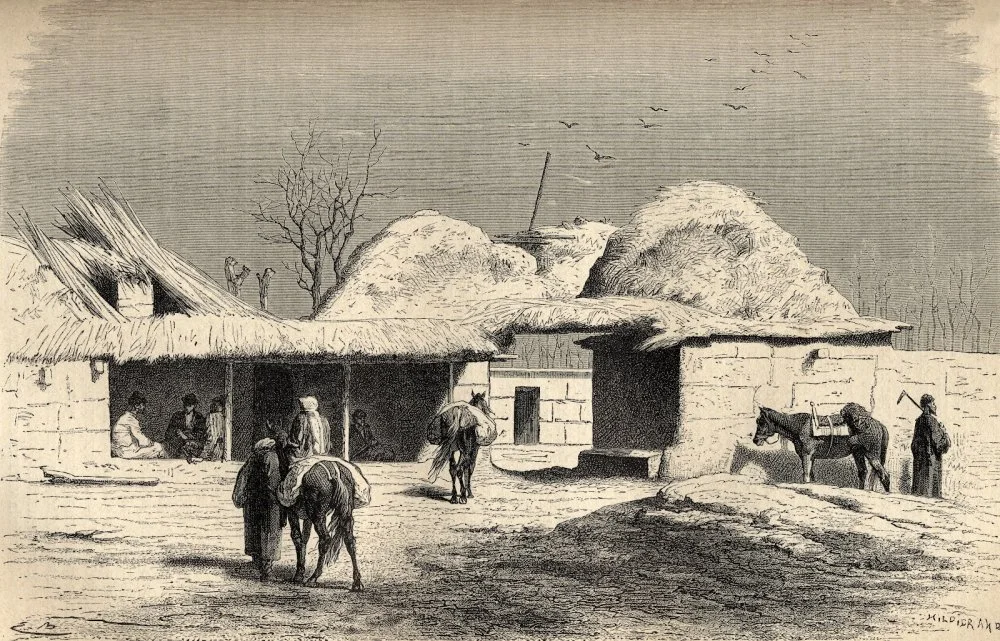
A caravanserai in Tashkent. 19th century / Universal Images Group via Getty Images
In order to centralize and strengthen the institutions of state authority, Ablai Khan consistently curtailed the autonomy of unruly clan leaders and sultans. It is precisely for this reason that the words of Būqar-jyrau Qalqamanūly—‘Ascending the golden throne, you united the three jüzes’—so profoundly reflect his exceptional talent as a statesman and his historic calling as the unifier of the Kazakh lands.
Was Ablai Khan’s Dream Fulfilled?
In the final year of his life, Ablai Khan spent quite a lot of time in southern Kazakhstan. In 1781, while traveling from Tashkent to Turkestan, the great khan died on the banks of the Arys River, and he was buried in the mausoleum of Khoja Ahmed YasawiiKhoja Ahmed Yasawi was a twelfth-century Sufi mystic and poet who profoundly influenced Islamic spirituality across Central Asia. He is revered as a central spiritual figure, and his magnificent mausoleum in Turkistan, Kazakhstan, remains a major pilgrimage site..
In a qazanama (condolence letter) sent to Sultan Uali by the Qing court in June 1781, it was stated:
According to a report from the Tarbagatai governor, your father has died of illness, and the Emperor is deeply saddened by this news. Previously, when you visited our capital, you were granted an audience with the Emperor and received his favor. Moreover, you are the eldest son of your father and are capable of governing the people under your authorityiЦин (Чиң) патшалығы Гаозун патшаның орда күнделіктері (Қолжазба). 481 т., 7 p.; Шыңжаң Ұлтарды зерттеу институты (新疆民族研究所). Цин күнделіктеріндегі Шыңжаңға қатысты материалдар жинағы (清实录新疆资料辑录 – Qingshilu Xinjiang ziliao jilu). – Үрімжі : Шыңжаң Ұлтарды зерттеу институты. 1978, 3- book, 1093 p. .
This message may be regarded as an official recognition by the Qing Empire of the legitimacy of Khan Uali’s authority, who had been elevated to the khan’s throne by Kazakh biys (judges). Moreover, such a step also indicated Beijing’s intention to maintain the stable and mutually beneficial relations that had been established under Ablai Khan.
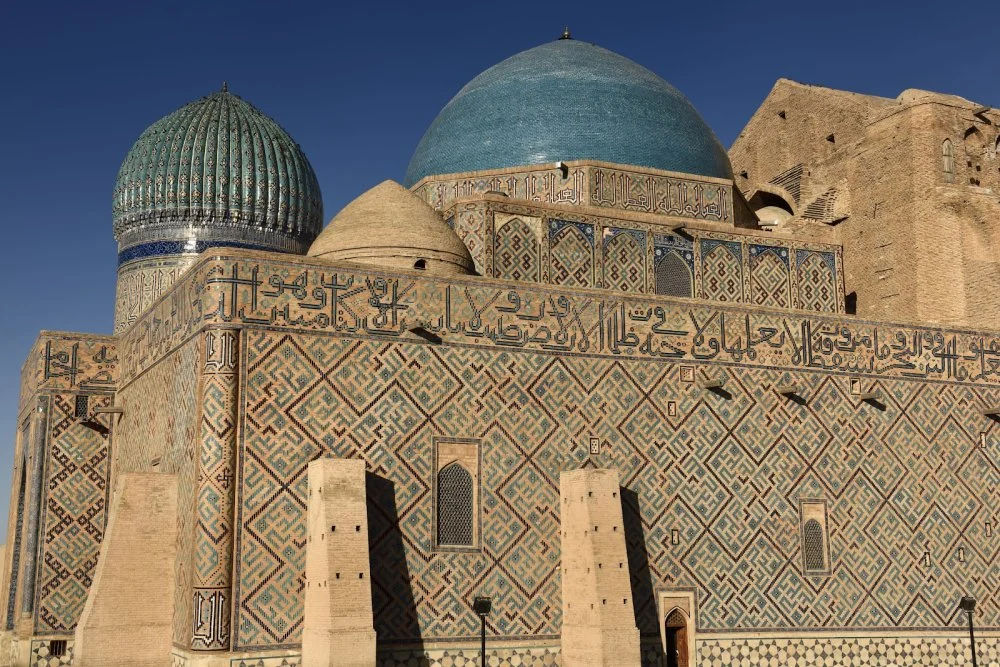
Mausoleum of Khoja Ahmed Yasawi in Turkistan / Getty Images
Thanks to his carefully calibrated, multi-vector policy, Ablai Khan succeeded in maintaining relations with both the Russian Empire and the Qing Empire. At times, he used Russia as a counterbalance to Qing influence. At other times, he relied on the Qing Empire to counter pressure from tsarist authorities. This approach enabled him to strengthen khanly authority and give new momentum to the development of Kazakh society.
It was under Ablai that Kazakh clans once again began settling their ancestral lands in the east, which formally remained under Qing rule. In the south, he succeeded in halting the advance of the Kyrgyz and Kokand forces into Kazakh territories. In this way, Ablai Khan played a major role in the formation of the unified ethno-territorial space of the Kazakh people.
Of course, it cannot be said that Ablai Khan succeeded in fully accomplishing everything he had envisioned. The era in which he ruled was extraordinarily complex, and as a hereditary Chinggisid, he nevertheless did not come to power solely by right of lineage. Ablai became khan through his own will, personal courage, and his ability to respond to the challenges of his time. It is precisely for this reason that he fulfilled the expectations of his people and remained one of the most significant figures in Kazakh history.
