
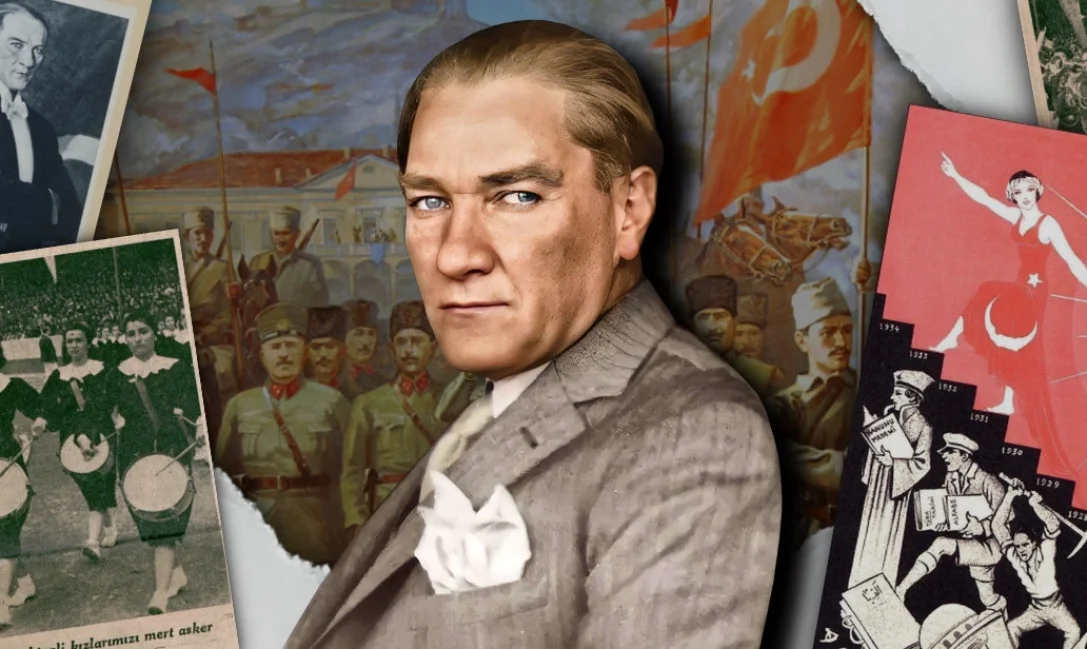
Every year, 19 May is celebrated in Türkiye as the Commemoration of Atatürk, Youth and Sports Day, a turning point in modern Turkish history. On this day in 1919, Mustafa Kemal Atatürk, the future founder of the Republic of Türkiye, landed in the Black Sea port of Samsun, marking the beginning of the Turkish War of Independence. To commemorate this important date, Qalam spoke with Professor Konuralp Ercilasun, author of The Turkish Revolution and Atatürk (Türk Devrimi ve Atatürk), to discuss how Atatürk balanced nationalism, modernization, and political realism while building a new republic out of the ruins of empire.
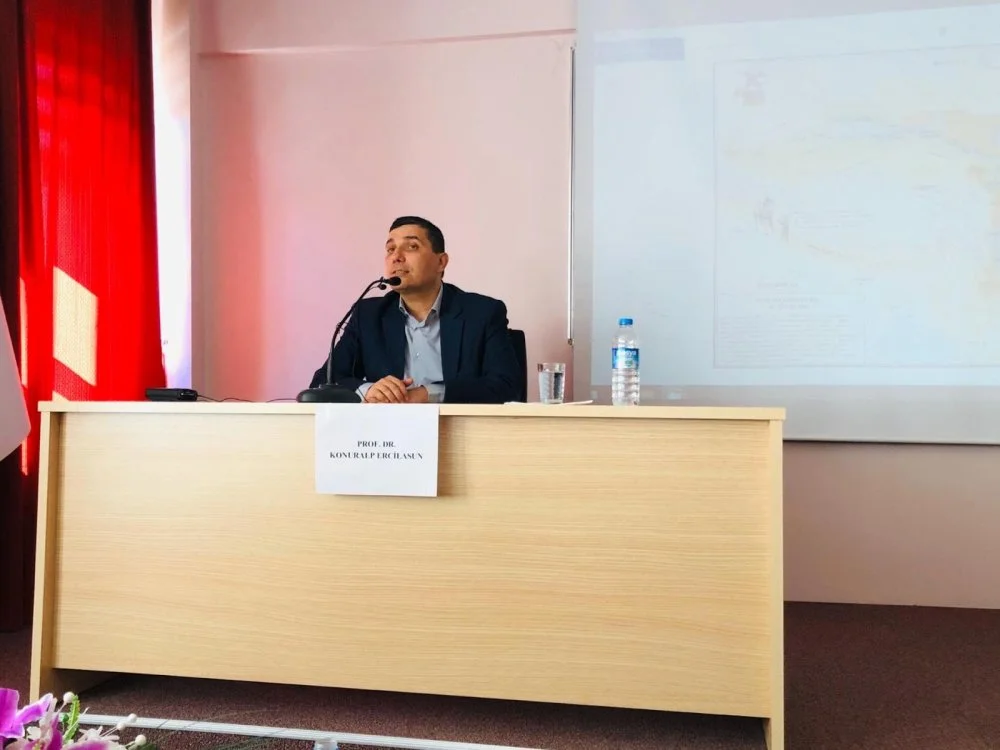
Prof. Dr. Konuralp Ercilasun
Why and how did Mustafa Kemal Atatürk become the central figure in the struggle for independence?
The fact is that Mustafa Kemal was not the only person fighting for Turkish independence. There were many intellectuals and statesmen—even in the nineteenth century, different views existed regarding the future of the country and the fate of the state. He was one among many who envisioned a new nation, but he was the most determined and arguably the most intelligent.
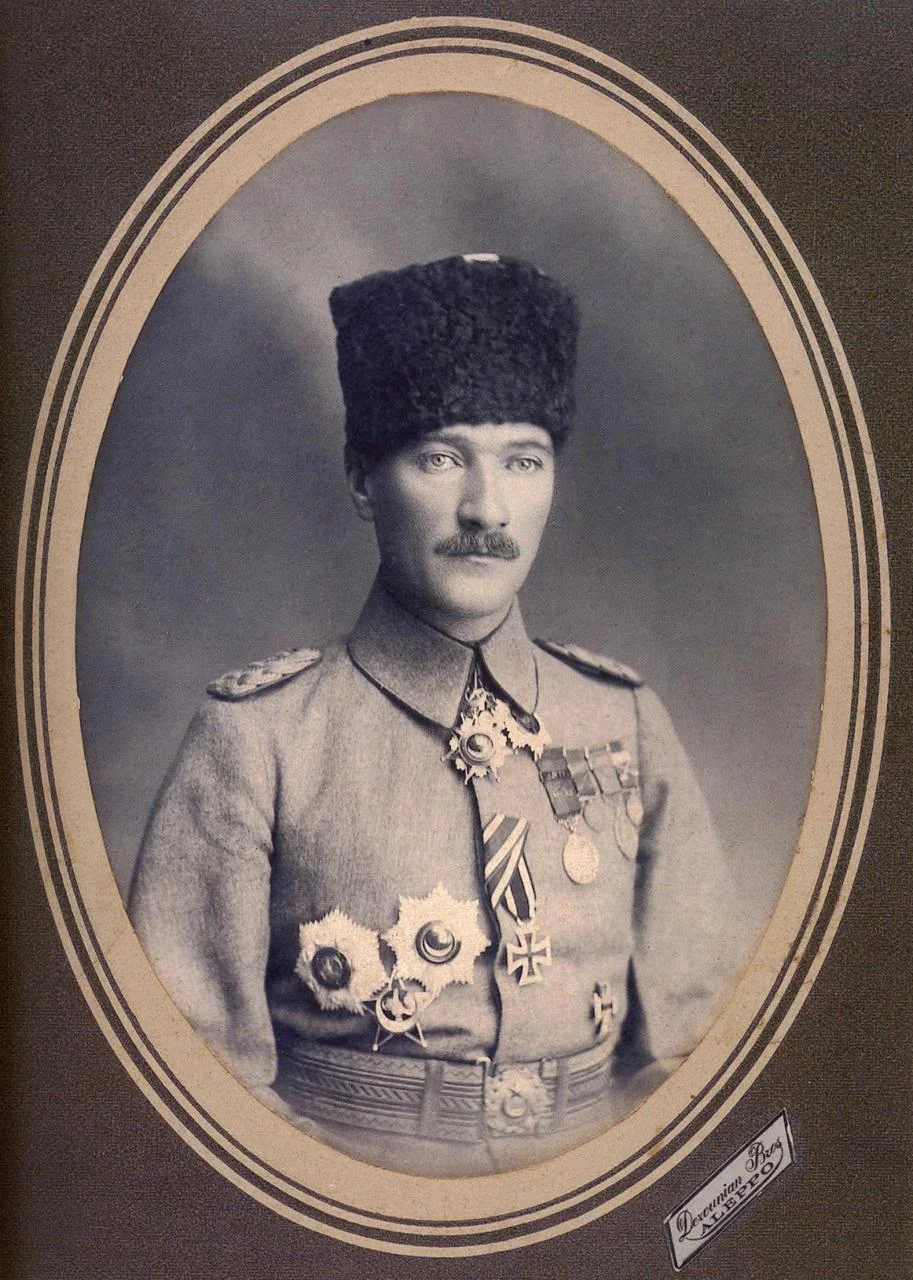
Mustafa Kemal Pasha in Aleppo, 1917 / Wikimedia Commons
Besides, between 1918 and 1919, he had already become a well-known public figure thanks to his role as a hero of the Gallipoli Campaigni The Gallipoli Campaign (February 1915 to January 1916) was a failed Allied assault on the Dardanelles Strait aimed at capturing Constantinople and neutralizing the Ottoman Empire, resulting in heavy casualties and an eventual Allied evacuation. during the First World War. In this sense, he could be regarded as a primus inter pares, the first among equals. However, he proved to be the wisest among them and the greatest strategist.
How did Atatürk manage to fight simultaneously against the Entente powers, the Greeks, and the sultan’s government during the Turkish War of Independence and ultimately defeat them all?
When Mustafa Kemal Atatürk landed in Anatolia on 19 May 1919, many local resistance movements already existed, scattered, unsure, and fragmented. However, he changed that—his actions helped connect and unite these local struggles, and in many cases he was able to inspire confidence and determination among the population. Thus, his role was not limited to decisive military action—it went far beyond that and included using the telegraph effectively to coordinate resistance across vast distances, encouraging local communities to resist the French, the Greeks, and, of course, the sultan’s troops.
All of this became possible because he was a master strategist who implemented his plan step by step. Yet, even while advancing gradually, he already had a vision of total war. He did not merely organize the army or the military apparatus; he mobilized the entire population of the country in support of his national strategy.
In 1920, the Soviet Union sent military aid to Atatürk, even though the Bolsheviks and the Turkish nationalists belonged to very different ideological camps. What brought them together?
Indeed, it was anti-Western sentiment that brought them closer to each other. Both men employed the rhetoric of anti-imperialism—with a crucial difference. For Atatürk, anti-imperialism was, in fact, a genuine conviction. As for Lenin, it was more a matter of opposing Western imperialism.
In fact, Lenin had two distinct goals. One of them was to distract the attention of the Western powers, while the other was to turn the Turkish republic into a friendly state. Perhaps, in the future, he hoped to see it become a communist state.
The Bukharan Muslims also collected a large amount of gold and sent it to Moscow to help sponsor the national struggle in Türkiye. This arrangement also benefited Lenin, since he kept part of the gold for the Bolshevik Revolution and only then sent the rest as aid to Atatürk, hoping to create a friendly republic.
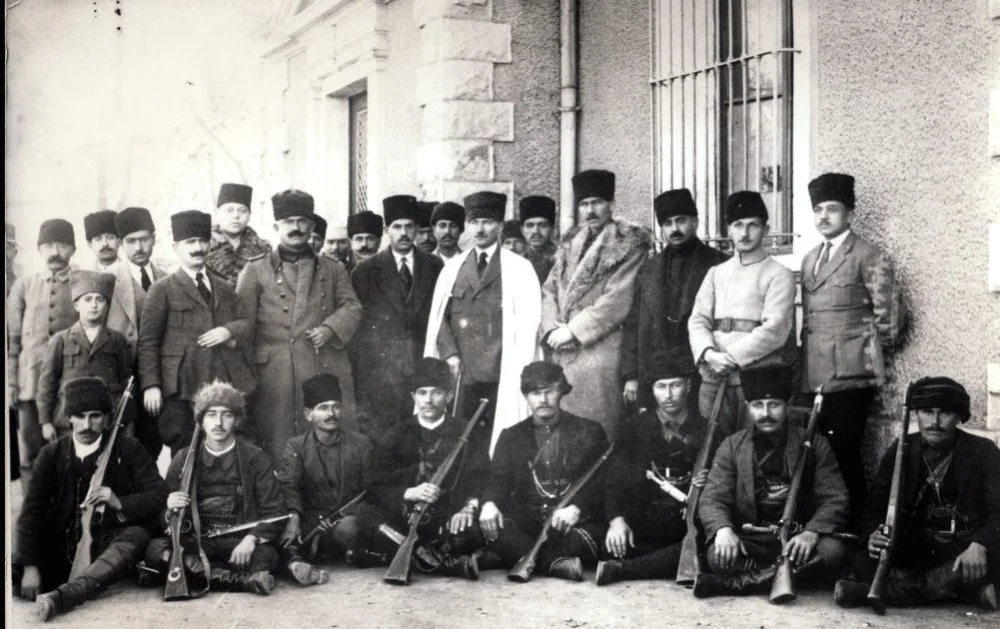
Ethem the Circassian, his Circassian fighters, and Mustafa Kemal Atatürk in front of the station headquarters on their way to suppress the Yozgat uprising, June 1920 / Wikimedia Commons, Public Domain
However, Atatürk’s vision was different from Lenin’s. He was not a communist; he was a nationalist who believed in true independence. He did not want any outside interference in the independent Turkish republic, neither from the West nor from the North.
Jadidism, the movement that sought to modernize Turkic-Islamic societies through educational and language reform, spread from Crimea to Central Asia and beyond. To what extent did Kemalism emerge from this tradition?
Surprisingly, KemalismiKemalism is the founding ideology of modern Türkiye and is named after Mustafa Kemal Atatürk, founder of the Republic of Türkiye. It comprises six principles: republicanism, nationalism, populism, statism, secularism, and reformism (revolutionism). and Jadidism can be regarded as twin brothers. From the nineteenth century onward, there were many interactions between Ottoman intellectuals and Jadid intellectuals. For example,
İsmail Gaspıralı’s11İsmail Gaspıralı (1851–1914) was a Crimean Tatar reformer who pioneered modern Turkic education and advocated for Muslim unity in the Russian Empire. newspaper Tercüman was read not only in Turkestan, but also in Istanbul, Cairo, and other parts of the Ottoman Empire. On the other hand, newspapers from Istanbul were also widely read in Crimea and across the Turkic world. Thus, we can say that there were broad interactions between these two societies and intellectual spheres.
Thus, in a way, Atatürk can be regarded as a product of both Ottoman modernization and Jadidism, since the two movements influenced and reinforced one another. However, Atatürk, as a statesman, transformed many Jadid ideas into concrete reforms. He drew upon the shared reformist ideas that circulated both within the Ottoman realm and across the wider Turkic world in order to create an independent and self-sufficient republic. This was crucial, because the Jadid movement itself emerged from the question of how to build a self-sufficient society independent of European powers. In this sense, it greatly influenced Atatürk’s reforms.
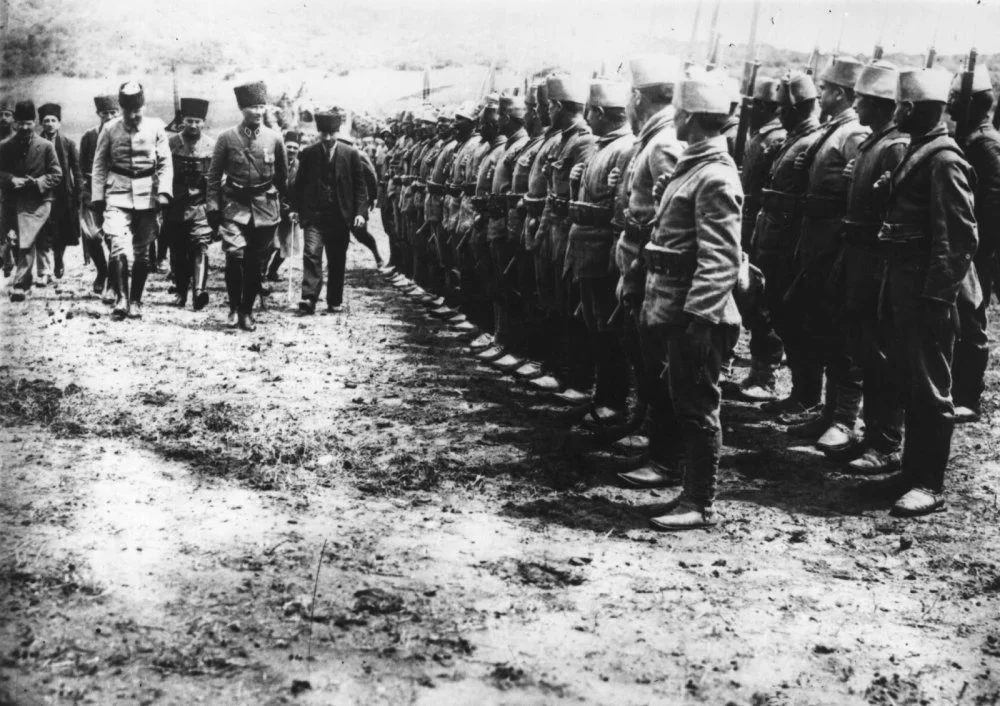
Mustafa Kemal Atatürk reviewing his troops during the War of Independence against Greece, January 1, 1922 / Hulton Archive via Getty Images
Talking about reforms: In 1928, the Republic of Türkiye replaced the Arabic script with the Latin-based alphabet. Why were language and alphabet reforms so important for Atatürk? And how did ordinary people react to this change?
The alphabet issue had long been debated in the Ottoman Empire. For almost a century, Ottoman intellectuals discussed ways to reform the writing system, to make it simpler, more accessible, or better suited to the Turkish language. There were even proposals to replace the alphabet altogether long before Atatürk ever entered the scene.
There were also attempts to reform the Arabic alphabet rather than replace it. Scientifically speaking, Turkish is not an Arabic language, but a completely different one. Moreover, Turkish contains many vowels, whereas Arabic has far fewer. As a result, there was a mismatch between the alphabet and the needs of the language.
And we must remember that in 1928, literacy among the population was still very limited. According to the census of 1927, only around ten percent of the population was literate. And so, Atatürk decided to change the alphabet. However, when discussing this reform today, we often focus only on the change itself, whereas it was much more than that.
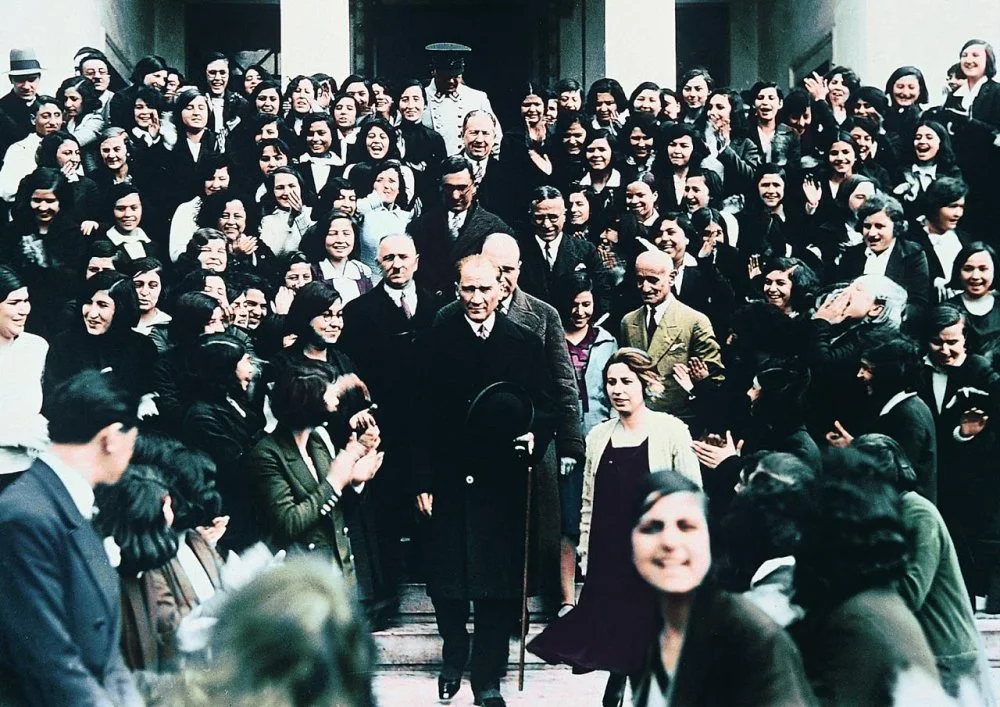
Atatürk visits İzmir High School for Girls, February 1, 1931 / Wikimedia Commons, Public Domain
Following the alphabet reform, the government established the Millet Mektepleri, which can be translated as ‘People’s Schools’ or ‘National Schools’. These were not ordinary schools. They were open to everyone, from young adults to the elderly. The public showed great interest because the Millet Mektepleri taught more than just the new alphabet—they offered basic literacy, numeracy, and other fundamental knowledge.
In the end, the reform generated enormous public interest. Interestingly, this process also reflected a transformation in the very concept of education. Traditionally, education had largely been viewed as a means of training people for the needs of the state and preparing future statesmen. Under the new understanding, however, education came to be seen as a right of the people. Literacy, thus, became a universal right, rather than merely a tool for producing state officials.
After the October Revolution of 1917, many Tatar, Azerbaijani, Crimean Tatar, and Central Asian intellectuals came to Türkiye. What role did they play in shaping this new Turkish national idea?
Indeed they did—and they also came from places like Bukhara. Figures such as Osman KocaoğluiOsman Kocaoğlu was a former head of the Bukharan People’s Soviet Republic who later emigrated to Türkiye., among many others, came to Türkiye as well. These were not ordinary people. They were intellectuals—educated, thoughtful men, many of whom were also experienced politicians. They had already waged their own political struggles in their homelands, especially after 1905.
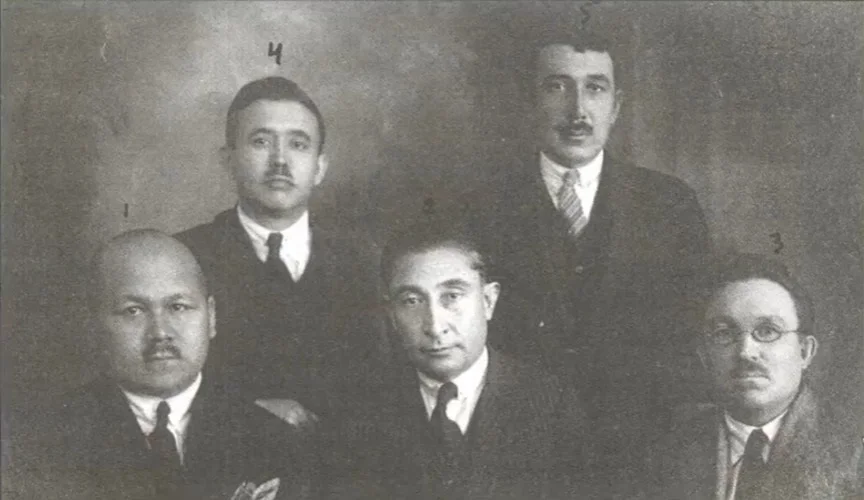
Political émigrés from Bashkortostan and Turkestan in Istanbul, 1926. Seated, left to right: Mustafa Shokay, Usman Khoja, Zeki Velidi. Standing, left to right: Abdulkadir Inan, Mustafa Shahkuli / Wikimedia Commons, Public Domain
All of them possessed well-developed political ideas. Although they ultimately lost their struggles at home, they gained valuable political experience, which proved highly important for the new republic. For example, one of the founders of the Turkish Historical Society was Yusuf Akçura, who greatly influenced Turkish education, particularly the teaching of history. Another prominent figure, Sadri Maksudi Arsal, contributed to the development of the Turkish language. So, we can say that the intellectual legacy of the Turkic world helped lay the foundations of the Republic of Türkiye.
Pan-Turkism, the idea of solidarity among all Turkic peoples, was popular among many of Atatürk’s colleagues. However, Atatürk himself seemed to distance himself from it. Why was that?
We have talked about Jadidism before, and must remember that, in fact, Atatürk was not far away from these ideas too. He was very interested in the Turkic world, but, at the same time, he was a statesman—a statesman, a realist, and a strategist too. So, his priority was to strengthen a modern independent Turkish state. He believed that a strong and a fully independent Turkish state would be a good basis for a future Turkic world.
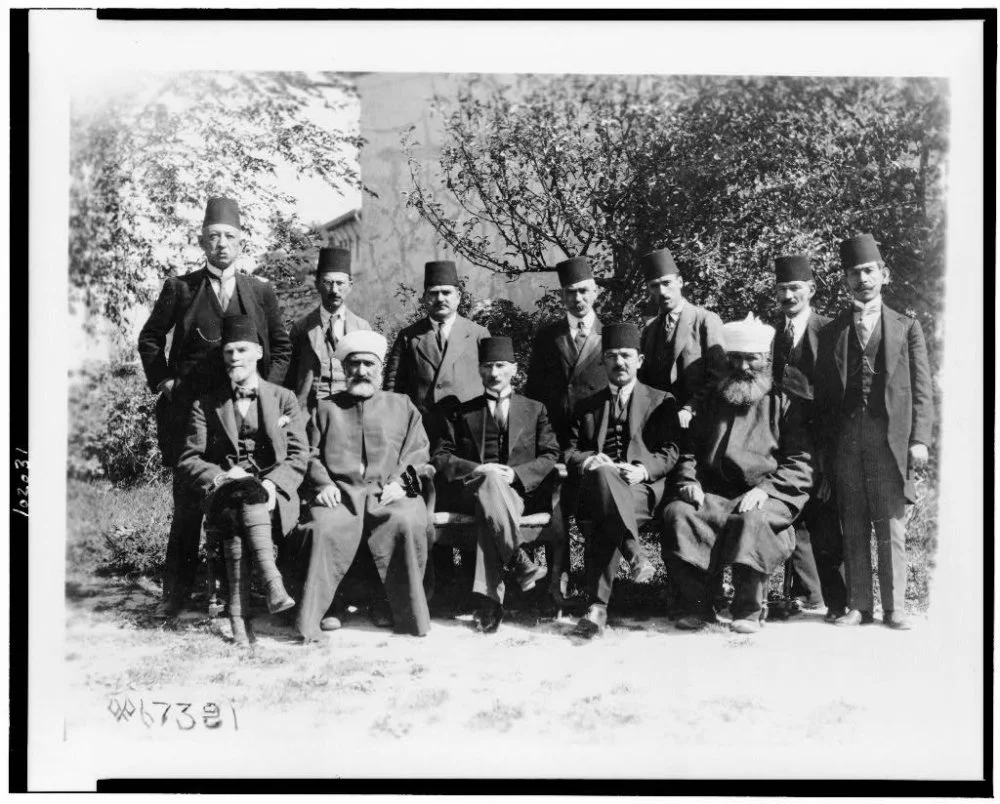
Mustafa Kemal Pasha and members of the Committee of Representation in Sivas, September 1919 / Library of Congress
Therefore, for a time being, he kept his interest only in the cultural sphere. He restrained himself from political attempts, because he wanted to maintain a peaceful environment in the region and in the world, as he believed that strengthened the Turkish republic.
