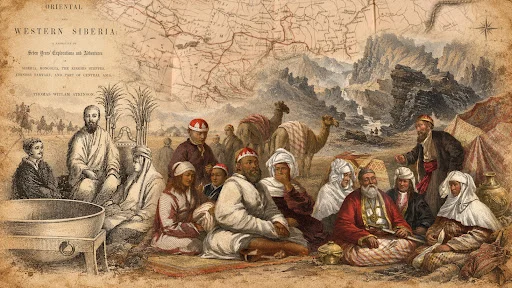
In 1848, an English couple, Thomas and Lucy Atkinson, set out on what would become an extraordinary seven-year journey across Siberia and Central Asia. Thomas, an artist, had already made one solo journey through the Urals and the Altai before he married Lucy. However, it was Lucy, a keenly observant writer, who would produce one of the most vivid firsthand accounts of life on the Kazakh steppe, offering Europeans a rare, intimate perspective on an unknown world.
However, their travels placed the couple at the heart of a historic transformation as the Russian empire advanced southward, Kazakh leaders struggled over territory and allegiance, and memories of Kenesary Khan’s resistance were still vividly alive in the memories of the people. In this article for Qalam, historian Nick Fielding explores the Atkinsons' remarkable journey and what their account tells us about a world on the edge of change.
Rediscovering the Atkinsons
Fifteen years ago, when I started writing about Thomas and Lucy Atkinson’s nineteenth-century travels in Central Asia and Siberia, the couple, despite their extraordinary achievements, were almost unknown—even in their own country. Most compendiums of the adventures of the greatest British explorers either ignored them completely or relegated them to the footnotes. Indeed, even those works who mentioned Thomas Atkinson often left out Lucy, whose own achievements stand comparison with the greatest women explorers in history.
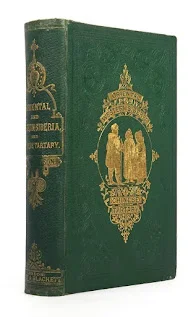
Thomas Witlam Atkinson. Illustration from Oriental and Western Siberia: A Narrative of Seven Years’ Explorations and Adventures in Siberia, Mongolia, the Kirghis Steppes, Chinese Tartary, and Part of Central Asia. London, 1858 / Shapero Rare Books
It was a local bookseller who knew of my interest in Siberia who first alerted me to Thomas’s book Oriental and Western Siberia. The fact that most of it was about what is now the territory of Kazakhstan did not immediately become apparent to me. After all, the Russians used the term Western Siberia rather than Central Asia. And Thomas’s decision not to mention Lucy, the woman he had married in Moscow just prior to setting out for the East, was another puzzle that took some time to unravel.
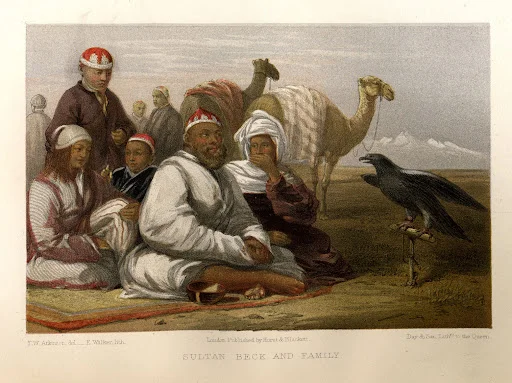
Thomas Witlam Atkinson, Max Rosenthal. Sultan Bek and His Family. Philadelphia, 1865 / Courtesy of the author
Since those days, things have changed radically. In 2014, I published South to the Great Steppe: The Travels of Thomas and Lucy Atkinson in Eastern Kazakhstan 1847-52, which was a first attempt to catalogue the couple’s extensive travels and adventures. A few years later, in 2020, I published my book Travellers in the Great Steppe, which dedicated two substantial chapters to the Atkinsons. The following year, together with Lucy’s relative Marianne Simpson, I published a new edition of Lucy Atkinson’s marvellous book Recollections of Tartar Steppes and Their Inhabitants. In our introduction we made the claim, which I still stand by even to this day, that Lucy’s book ‘stands as one of the earliest—and best—travel books written by a woman explorer’.
Into the Unknown: Why the Atkinsons Went East
The books, however, were only one part of the story. In the intervening years, I spent my time working out precisely where the Atkinsons had travelled in Central Asia and set out to do what few researchers had done before—retracing their journeys myself on horseback. I organised four expeditions on horseback to the Dzungarian Alatau Mountains of southeastern Kazakhstan and one to the Eastern Sayan Mountains of Buryatiai Buryatia is a Russian republic in Siberia along Lake Baikal, home to the Mongolic Buryat people. in Eastern Siberia. I came to know the Dzungarian Alatau, a magnificent mountain range in southeastern Kazakhstan stretching for 450 kilometers along the border with China, very well indeed, and I could appreciate even more just how much the Atkinsons had achieved.
In Qapal (in southeastern Kazakhstan's Jetisu Region), the former Cossack bastion that served as the Atkinsons’ home for almost nine months, I was able to convince the local akimatiAn akimat is the local government office in Kazakhstan headed by an akim, who is a governor or mayor appointed to administer a region, city, or district. to build a substantial memorial to the Atkinsons. It was inaugurated in 2016 with a large ceremony that involved everyone in the town. Among those present were ten of the Atkinsons’ descendants, who had travelled from Britain, the United States, and New Zealand to visit the places so closely associated with their ancestors—especially Qapal itself, where Thomas and Lucy's son, Alatau Tamchiboulac Atkinson, had been born.
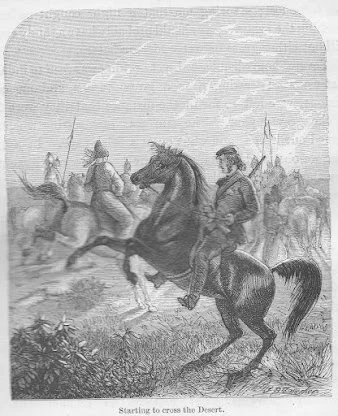
Thomas Witlam Atkinson. Starting to Cross the Desert / Courtesy of the author
Today, the Atkinsons’ name is well known amongst many Kazakhs, and their story has become part of the history of the country, not the least because of their deep affection for the country and its people. But in all my efforts to track their movements and work out precisely where they had been, I avoided grappling with some of the most basic questions about their travels. What was the significance of their journey through Kazakh territory? What was happening in the wider Russian empire? Whom did they meet? Why did they travel?
In this article, I will try to answer some of those questions.
In 1848, when Thomas and Lucy Atkinson left Moscow by sledge for Barnaul in Siberia in the middle of winter, Thomas said his sole objective was ‘to sketch the scenery of Siberia—scarcely at all known to Europeans’. What began as an artistic endeavor stretched into almost seven years of travels, and the Atkinsons covered more than 63,000 kilometers by carriage, boats, and on horseback. And yes, Thomas did indeed produce hundreds of sketches and paintings throughout all that time, resulting in a great body of work, some of which hangs today in prestigious museums around the world and in institutions such as the Royal Geographical Society in London.
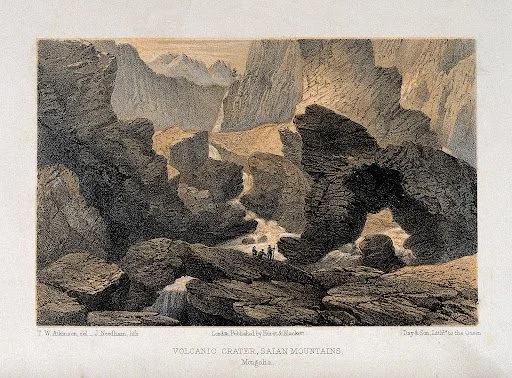
Jonathan Needham after Thomas Witlam Atkinson. Sayan Mountains, Mongolia: the Crater of a Volcano with Irregular Rock Formations. Lithograph, 1858 / Wellcome Collection / Wikimedia Commons
His search for the ‘picturesque’ in the most remote parts of the world was possibly somewhat romantic, and like other artists from that background, he undoubtedly idealized what he saw. Looking back, we can surmise that he was perhaps running from the deep sadness of losing his son John, also an artist, who died of tuberculosis in April 1846 whilst living with Thomas in Hamburg. He was also running from a broken first marriage. All these things were to influence him in one way or another.
But what about Lucy? She was very well educated but she was constantly denied expression for her talents by the suffocating conformity of life in mid-Victorian England. She tried to break out by travelling to St. Petersburg to become a governess to the daughter of General Mikhail Nikolaievich Muravyev, one of the most powerful military officers in Russia. At that time, this was just about the only way at that time that an educated woman could have something close to a career. Her ancestors had sailed the oceans and taken part in the earliest voyages to Australia, and it was with these memories that she prepared herself to travel across the steppe with her new husband.
The Russian Advance into the Kazakh Steppe
The Atkinsons’ route is itself fascinating, a seeming window into their world. After leaving Moscow in February 1848, they made their way almost directly eastwards, across the Urals to Barnaul. They stayed here for a while before setting off south, leaving the Russian forests and heading towards the Great Steppe, then a region barely known to Westerners.
They were not the first outsiders to cross the Irtysh River into the territory of the Middle Jüz of the Kazakhs. Having secured the loyalty of the Kazakh tribes, the Russians had already begun an audacious campaign to secure the eastern border of the steppes with China. It was part of the deal to which most of the tribes had agreed: loyalty to the tsar in exchange for protection from the powerful Dzungars further to the east. The Russians quickly moved south from their main base at Ayagoz (then also known by its Russian name Sergiopol) to seize territory in the Dzungarian Alatau, building fortresses at Lepsi, Sarkand, and Qapal, settlements in the Jetisu Region of southeastern Kazakhstan. Batteries of cannon protected the forts along with hardened Cossack troops.
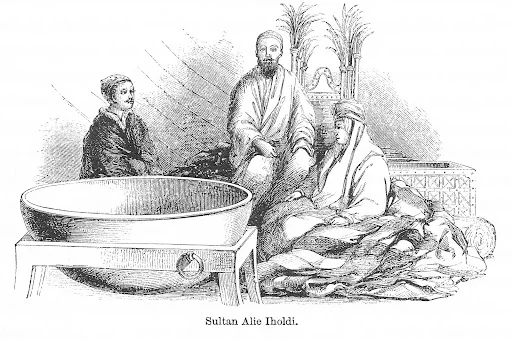
Thomas Witlam Atkinson. Sultan Alie Iholdi / Courtesy of the author
These areas had once been off-limits to Russians, not least because of the activities of Kenesary KhaniKenesary Khan (1802–1847), the grandson of the great Ablai Khan, was the last sovereign ruler of the Kazakh Khanate., who continued a struggle started by his brother in the 1820s to oust Russians from the steppe. Whether Kenesary Khan was a modernizer or a traditionalist is still hotly debated, but he undoubtedly made it very difficult for the Russians to complete their project of subduing the steppe and settling the regions with agricultural peasant farmers from southern Russia. His death at the hands of Kyrgyz warriors in 1847 put an end to the active Kazakh resistance to Russia, and calm soon returned to the steppe.
Sultans, Cannons, and a Battle over the Steppe
In the context of these events, Atkinson’s decision to use a portrait of a person he called Sultan Suk as the frontispiece to his book is fascinating. The man was more than a picturesque figure—he was, in fact, Sultan Suyuk Ablaikhanov, a sultan of the Senior Jüz, the son of the great Ablai Khan and an uncle of Kenesary Khan’s, although with a very different political outlook. In 1831, Suyuk had asked the governor-general of Western Siberia to create an okrug, or a jointly administered territory, on his lands and to bring in Cossacks to pacify recalcitrant Kazakhs. This move opened up Lake Balkash and large parts of the Dzungarian Alatau to Russian exploration.
Other tribal groups from the Middle Jüz followed Suyuk in accepting Russian rule. And it was precisely because he was regarded as being pro-Russian that Kenesary had come to Suyuk in 1846 and had demanded that he join him in his struggle against the Russians. In doing so, Kenesary was acting as head of the Middle Jüz and seeking support from the Senior Jüz. But despite Kenesary’s threats to destroy all Suyuk’s aulsiThe word aul means ‘village’ in Kazakh, and typically encompasses 100–200 yurts., the old man refused his aid.
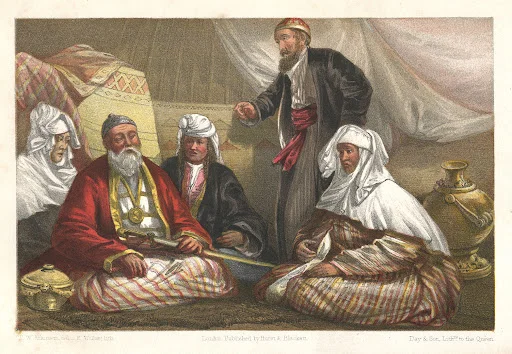
Thomas Witlam Atkinson, Max Rosenthal. Sultan Suyuk and His Family. Philadelphia, 1865 / Courtesy of the author
By the time the Atkinsons met the sultan, he was clearly in favour with the Russians, Qapal being on his territory. Thomas describes in detail how Captain Abakumov, the commander of the fort at Qapal, organized a great gathering of tribal leaders there on 1 March 1849 to discuss the boundary between the Senior and the Middle Jüz. The lack of an agreed boundary meant that there had been constant barymtasiA barymta was a customary Kazakh nomadic practice of sanctioned livestock raiding to resolve disputes or enforce justice. by one group against the other.
Atkinson describes how the tribal chiefs and their retinues arrived on the appointed day, along with their mullahs and elders, in all over 100 men. There was no building large enough to hold so many people, and so they met in the open. The Russian administrators of the steppes arrived from Ayagoz (Sergiopol) and others came from the tribes of the Middle Jüz. Captain Abakumov started off proceedings with a display of artillery fire, which terrified many of the guests—exactly as it had been designed to do so. A Russian official informed all those present that Prince Gorchakov, the governor-general of Western Siberia, had sent a despatch recommending that the sultans and khans should agree to a boundary to stop all the feuds and plundering. He added that the negotiations should be conducted in a polite manner.
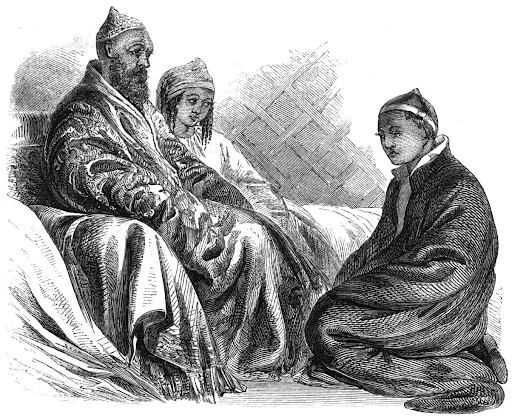
Thomas Witlam Atkinson. Sultan Iamantuck and Family / Courtesy of the author
Sultan Suyuk was the first to speak, saying that he had considered the prince’s suggestions and was willing to adopt them, but that the boundary line was of paramount importance. Thomas Atkinson reported his speech thus:
The boundary to which I shall consent is the Aqsu, including the shores of Lake Balkash. If the Middle Horde agree to this, it is well, if not the chiefs will maintain their right and seize every man and animal found on the pasturesiT. W. Atkinson, Travels in the Region of the Upper and Lower Amoor, London: Hurst & Blackett, p. 176.
It was, undoubtedly, an uncompromising message.
The Russian official tried to get Suyuk to modify his claim, suggesting that the border between the two hordes should be the River Büyen, with the land to the south belonging to the Senior Jüz. Suyuk studied the map presented by the Russian but was not impressed, saying:
I cannot understand this paper, nor why you have marked the Büyen and call that the boundary. It may remain so on the paper, but I will have the pastures to the Aqsu. The Prince has ordered the Lepsi, the Aqsu, and the Büyen to be placed where he pleased on this paper. He may have them so, but I order the boundary to be on the Aqsu, nor shall it be changed. If the Middle Horde do not consent to this, they shall soon see some of my people on the Lepsi.
Atkinson, however, had not finished, either with Suyuk or with Kenesary. He devotes almost sixty pages of his second book, Travels in the Region of the Upper and Lower Amoor, to detailing the adventure-filled story of Suyuk’s attempted marriage with the daughter of Sultan Jangir Khan. The story, however, ends in disaster, with Jangir Khan trying to marry his daughter off to the khan of BadakhshaniBadakhshan is a mountainous historical region in Central Asia, divided between northeastern Afghanistan and Tajikistan, famous for its ancient lapis lazuli mines. and Suyuk stealing her away, only for her to be killed by a tiger in the mountains.
In the Footsteps of Kenesary
High up in the Dzungarian Alatau Mountains, amongst the headwaters of the Basqan River—a place I have visited myself—the guide accompanying Thomas even located one of Kenisary’s old camping grounds. Thomas described the scene:
This was the place in which Kinsara [Kenesary] had lived and held his daring associates in subjection. My guide told me that no one of the band ever dared to disobey his orders, as doing so would have been certain death. He had acquired unbounded power over the minds of his followers by his indomitable courage. If a desperate attack had to be made against fearful odds, he led the van, and was ever first in the fight, shouting his war cry with an uplifted battle axe and plunging his fiery steed into the thickest of the battle. This gave confidence to his men and was the secret of his success; but the Kazakhs thought he was in league with Shaitan and that no steel could touch himiIbid., p. 223.
The guide told Atkinson that Kenesary had 300 men with him, including escaped Chinese convicts from the Ili ValleyiThe Ili Valley is a large, fertile river valley stretching from Xinjiang in China into southeastern Kazakhstan, historically a key route for Silk Road trade and conquest. He led him to the very spot where Kenesary had lived:
This was sacred ground to him, and his eye moistened as we turned away from the spot. We visited several other places which he examined with intense interest and then came to the spot where his yourt [yurt] had stood. There were black ashes of his own hearth; he looked at these for a few minutes and then led the way to the eastward. As he strode along, he often looked back, evidently lingering affectionately over a locality that had called up many pleasant recollections.
Thus, Thomas was an eyewitness to great events on the steppe: the dispute between the jüzes; the Russian use of firepower to frighten the tribes into submission; the final days of Kenesary. And despite his frontispiece tribute to Sultan Suyuk, Thomas considered him a bit of a rogue. He does not mince his words:
A greater robber could not be found in the Steppe and though at this time, being eighty years of age, he could not join in the barantasithe Russian word for barymta, many were planned by him. On another occasion, when I was staying at his aoul [aul], some Kazakhs came from the Middle Horde to beg of him to give up their wives and children, who had been carried off by his bandittiiThe word refers to the Russian word for ‘bandits’ and has been transcribed the way Atkinson heard it.—they formed part of his share of the plunder—but the old scoundrel would not restore one. He received a pension from the Russian emperor, sold his country, and deceived His Imperial Majesty.
Atkinson adds that the sultan sat for a portrait and insisted on wearing ‘a scarlet coat, a gold medal and a sabre, sent to him by Alexander the First, of which he was wonderfully proud’. He also mentions that he was vain:
In one of his barantas, a battle axe had cut his nose and rendered it crooked; and when I was sketching him, he desired me not to copy his present nose, but put in a proper one, or the emperor would discover his plundering habits.
Lucy Atkinson also wrote about the old sultan in her book Recollections of Tartar Steppes and Their Inhabitants. She mentions a visit by him in the spring of 1849, when the couple and their young child Alatau were living in Qapal at the foot of the Dzungarian Alatau Mountains in what is now the Jetisu region.
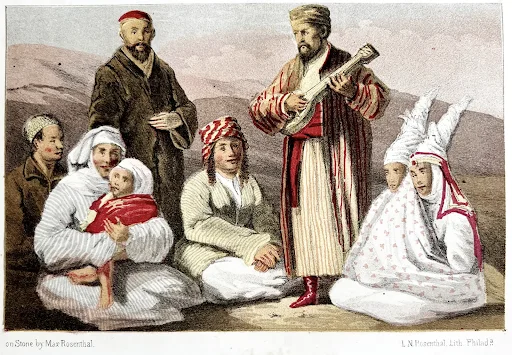
Thomas Witlam Atkinson, Max Rosenthal. A Group of Kazakhs with Two Brides. Philadelphia, 1865 / From open sources
Lucy clearly enjoyed the company of the sultan and he, in turn, was always prepared to tease her: She records:
When it was known we should leave Kopal [Qapal] at the end of the month, we had farewell visits from many of our Kazakh friends. Amongst the foremost was the old Sultan Souk [Suyuk], with whom I was a great favourite, who bade me tell my husband not to fatigue me so much by taking me with him the next time he visited the steppe as he would give him any number of wives he liked; at the same time, he should always be pleased to see me.
Faces from a Changing Steppe
The Atkinsons met dozens of prominent Kazakhs during their stay at Qapal. I have been able to locate around twenty-five names and biographies, but many questions remain unanswered. Who were these people, many of whom were drawn or painted by Atkinson? Allowance must be made for Atkinson’s phonetic spelling of names, but these are some of the most prominent: the Timurid Sultan Ali Iholdi from Jetisu; Sultan Boulania from close to the Lepsu River; Sultan Beck from west of Ala-Kool, whom Thomas called the ‘largest man and most wealthy Kazakh in the Steppes’; Sultan Iamantuck; Sultan Ishonac Khan, from north of the Barluck Mountains and east of Ala-Kool; Sultan Dolembie, whose aul was close to that of Ishonac Khan.
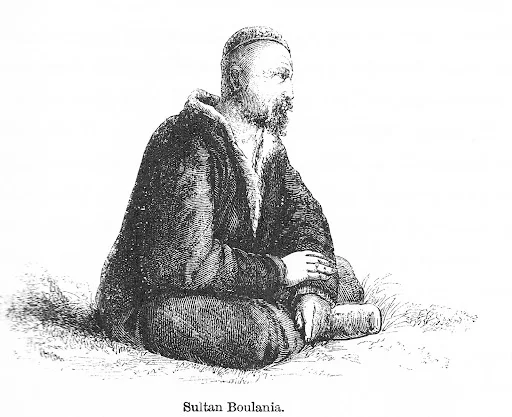
Thomas Witlam Atkinson. Sultan Boulania / Courtesy of the author
These were tempestuous times on the steppe to the east and south of Balkhash. Very few contemporary accounts have survived of events at the time. I have a feeling that there is still more to emerge about those fateful years.
