
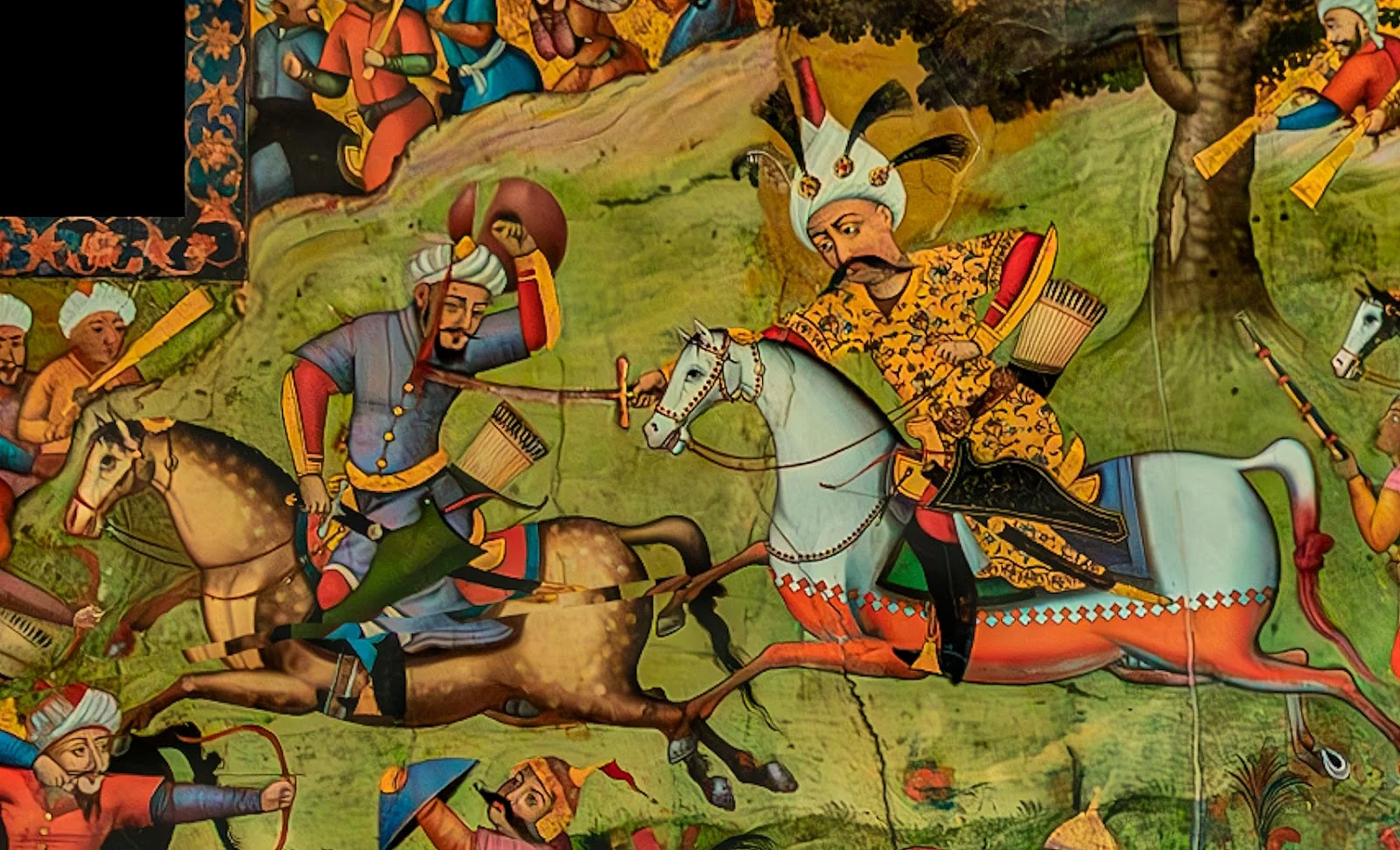
For centuries, the Iranian and Turkic worlds have shaped one another culturally, politically, and economically. Their influence flowed back and forth across empires, dynasties, and trade routes, leaving a complex legacy that still resonates today. One of the most striking examples is Safavid Iran, which ruled from the sixteenth to the eighteenth centuries. But how well do we really know this dynasty? Did the Safavids really have nomadic roots? Were the Ottomans their principal rival? And how did their rivalry shape the modern Middle East? In this interview with Qalam, historian Giorgio Rota answers these questions and more.
Who were the early Safavids: Turks, a Sufi brotherhood, or both?
The history of the Safavids begins in Ardabil, in northwestern Iran, where in the late thirteenth and early fourteenth centuries a tariqai A tariqa, or Sufi order, is a religious brotherhood in Islam, organized around a spiritual master and special practices of prayer, self-discipline, and remembrance of God.] formed around Shaykh Safi al-Din [Tooltip: Safi al-Din was a thirteenth-century mystic and Sufi master who founded the Safaviyya order and is recognized as the eponymous ancestor of the later Safavid dynasty. In principle, it was originally a Sunni order, but it gradually began to change under Shaykh Junayd, the grandfather of the future Shah Ismail. The brotherhood acquired a more militant and political character, moved closer to radical forms of Shiism, and probably absorbed elements of older, pre-Islamic beliefs.
By the fifteenth century, the Safavids were already Turkic-speaking communities and were closely connected with the semi-nomadic Turkic tribes of Azerbaijan, eastern Anatolia, northern Syria, and northern Iraq. But their early ethnic origin remains disputed: some scholars saw them as Iranians, others posited a Kurdish origin, while the Safavids themselves later traced their genealogy back to the Prophet.
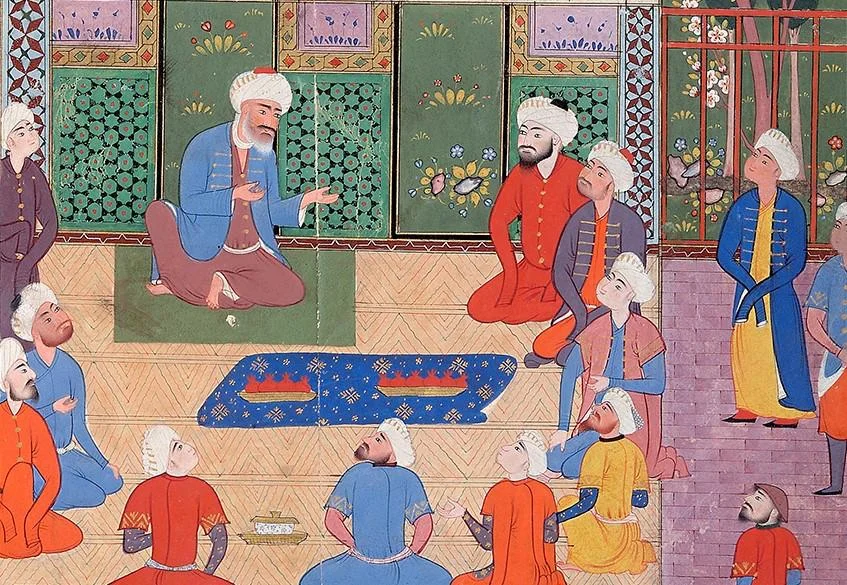
Shaykh Safi al-Din interpreting verses of celebrated poets to his disciples. Illustration from a manuscript of Safvat al-Safa, 16th century / Morgan Library & Museum, New York
Perhaps what matters more is that the town of Ardabil and the whole region were ethnically and culturally mixed, and trying to define the Safavids precisely as ‘Persians’, ‘Turks’, or ‘Kurds’ means looking at the Middle Ages through the eyes of nineteenth- and twentieth-century nationalism.
What caused the bitter rivalry between the Ottoman Empire and Safavid Iran?
This war was clearly caused by the rise of the Safavids. Shaykh Ismail, the first ruler of this dynasty, came to power in 1501 in order to restore his family’s rights. His predecessors had already fought the Ottomans for control over eastern Anatolia half a century before Ismail came to power. And, of course, he proclaimed Shiism the state religion of Iran, a move that fundamentally altered the religious and political landscape of the region. On the throne in Istanbul sat a sultan who was not only Sunni, but who was also already competing for supremacy in the Sunni world with the Mamluks who still ruled Egypt.
More about
THE BATTLE OF THE PROPHECIES AND THE SECRET ALPHABET OF POWER
How the Ottoman sultans won the war of ideas in the Islamic world of the fifteenth to sixteenth centuries
As we know, the semi-nomadic Turkic tribes lived in eastern Anatolia, and they held distinctive, extreme Shiite beliefs. Many of them recognized Shaykh Ismail as their true leader as they had previously recognized Junayd. In addition, there were revolts and insurrections in Anatolia. All this could not but trouble the Ottoman authorities.
How did the Battle of Chaldiran change the balance of power between the Ottomans and the Safavids?
The Battle of ChaldiraniThe Battle of Chaldiran (1514) was a decisive Ottoman victory over the Safavids, establishing Ottoman dominance in Anatolia and shaping the Sunni-Shia divide in the region., of course, had important consequences: it forced the Safavids to recognize their own limits. It was a sort of trauma that remained in the Safavid military mentality: it was better not to challenge the Ottomans in open battle. For the rest of their history, the Safavids tried to avoid this as much as possible.
The battle more or less fixed the border in its Anatolian-Iranian section where it runs today and where it was confirmed forty years later by the Peace of AmasyaiThe Peace of Amasya, signed on 29 May 1555, was a treaty between the Ottoman Empire and Safavid Iran, which ended the decades-long Ottoman–Safavid War of 1532–1555 and defined their borders..
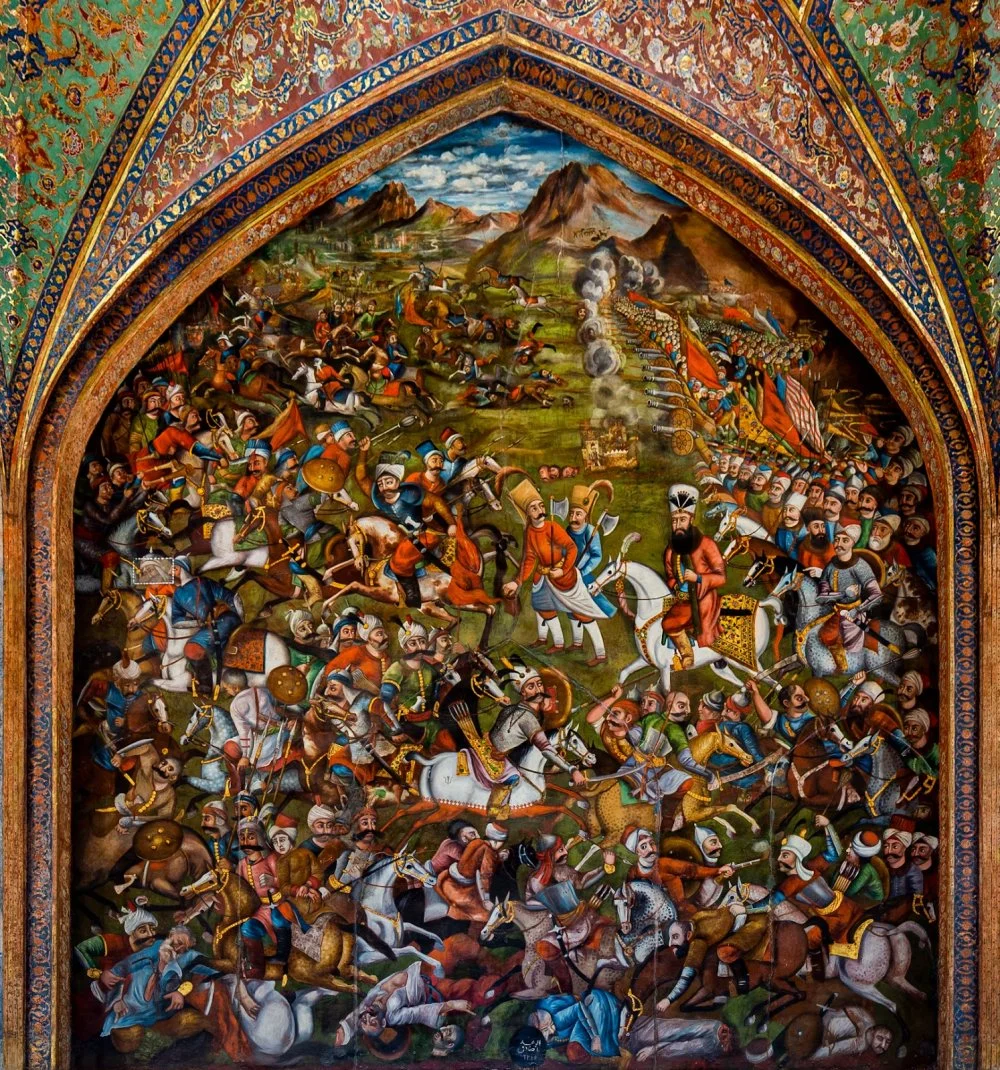
Battle of Chaldiran, 1514. Mural in Chehel Sotoun Palace, Isfahan, 17th century / Wikimedia Commons
Nevertheless, Shaykh Ismail did not give up his political and organizational activity. He tried to reform the army, tried to introduce firearms into the Safavid army, and doubled down on his attempts to find allies in Europe. The problem is that this work of reorganization and preparation for revenge was cut short by his personal habits. Shaykh Ismail was a very heavy drinker, and this led to his untimely death in 1524, his young kingdom vulnerable to the very enemies he had sought to defeat.
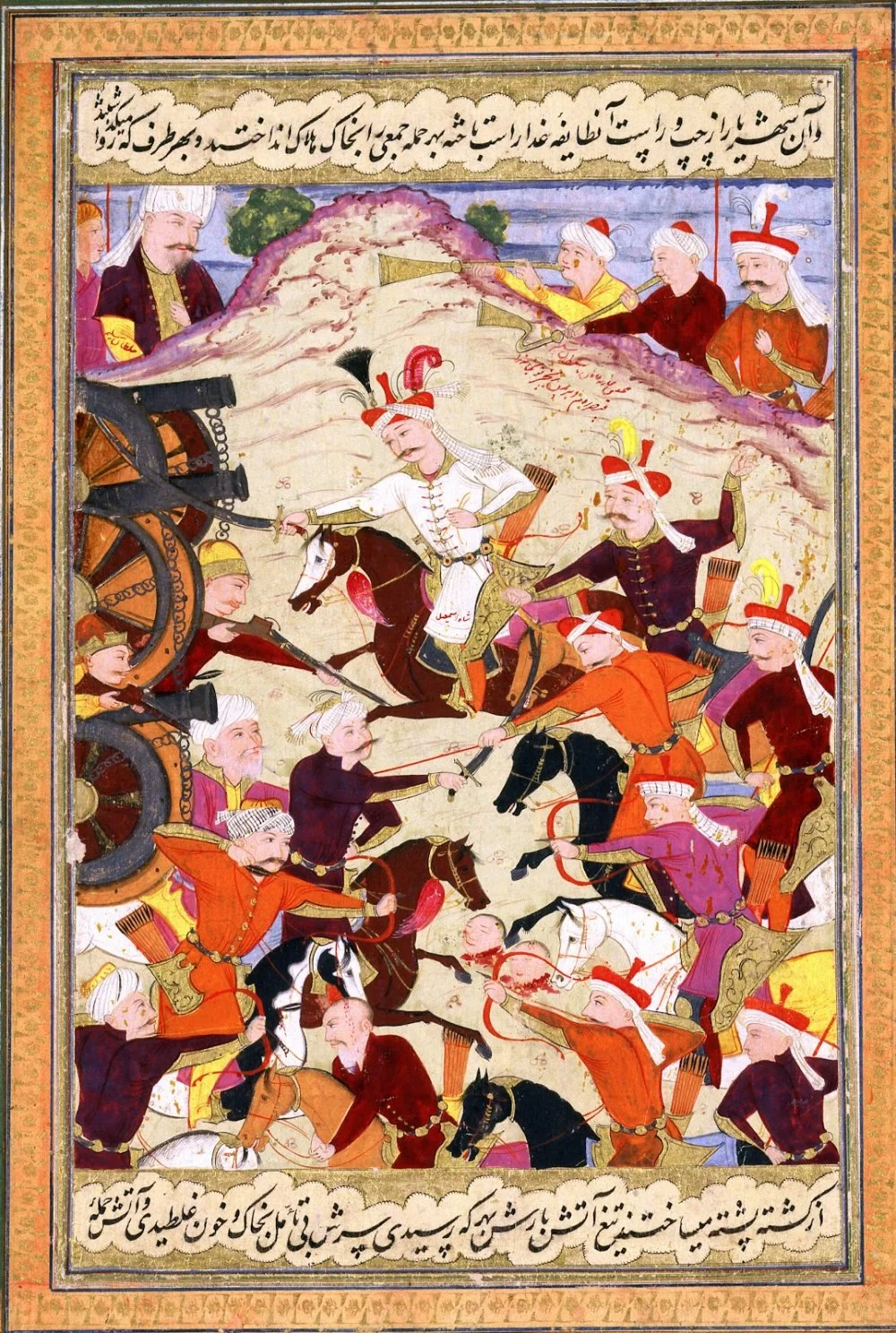
Shah Ismail I at the Battle of Chaldiran. Miniature from Bijan’s Tarikh-i Jahangusha-yi Khaqan Sahibqiran, 17th century / Wikimedia Commons
Was the conflict primarily about territory or religion?
It was about many things at once. It was a struggle over land, religion, prestige, and control of commercial routes. When we speak of Iran today, of course, we think of the Islamic Republic of Iran within its modern international borders. But at the time, the notion of Iran was much larger. The territory claimed by Shaykh Ismail, and potentially controlled by him, was much larger both in the east and in the west, encompassing much of the Caucasus, Mesopotamia, and parts of Central Asia, including present-day Armenia, Azerbaijan, Iraq, Afghanistan, and portions of Turkey, Syria, Pakistan, Turkmenistan, and Uzbekistan. His state also laid claim to Baghdad, the historic seat of the Abbasid Caliphate and a city of immense symbolic and strategic importance.
And with Azerbaijan came, of course, the question of the South Caucasus. Iranian Azerbaijan faces the South Caucasus on the other side of the Aras River. The South Caucasus is very fertile land, highly important for agriculture. In addition, caravan routes ran there northwards, towards Russia and the Russian steppes.
So it was not only about religion. Religion is always very useful: it is a good way to mobilize people, to give a veneer of idealism to more worldly factors. From my point of view, only a minority of people are ready to fight, kill, and die solely for the sake of religion, without any other motives.
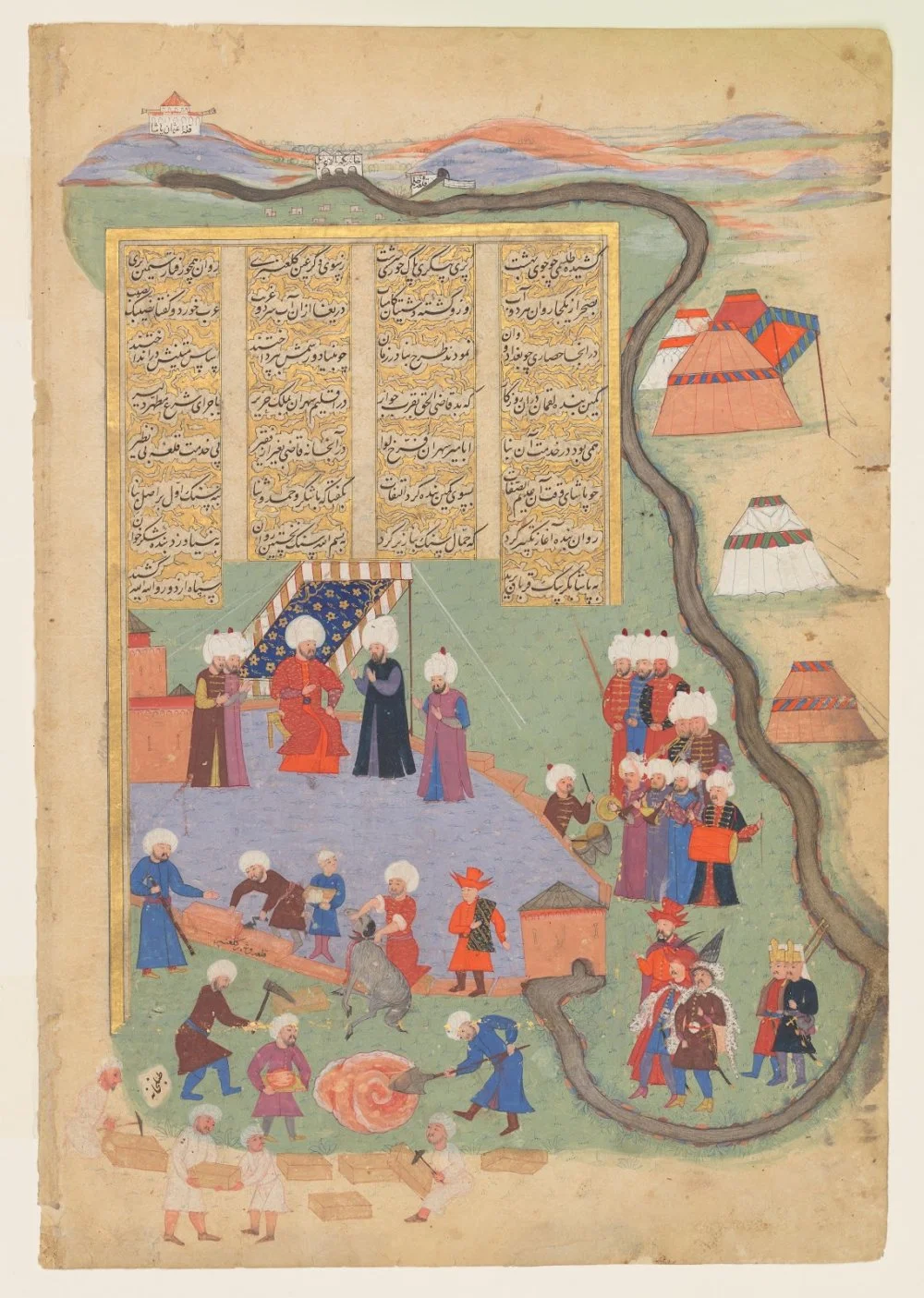
Ottoman frontier fortifications along the border with Safavid Iran. Miniature from The History of Sultan Süleyman by Sayyid Luqman, 16th century / Wikimedia Commons
Did the Ottoman–Safavid rivalry sharpen the confessional divide within the Islamic world? Did it solidify Sunni and Shia identities?
Yes, that is correct. This was also because, for the first time, together with a new Islamic state, there was a new religion as the state religion. Shaykh Ismail claimed a certain territory as a temporal ruler. But in this territory, Shiism was the official religion. This meant that, from the Ottoman point of view, it was a heretical state that had to be fought.
At the same time, the Ottoman state also included Shiite minorities. Therefore, Shiites were not persecuted simply as Shiites. They were persecuted or punished when their activities strengthened the Safavid side or undermined the authority of the sultan. That is why Bayezid II (1481–1512) ordered a number of Turkic tribesmen to be deported from eastern Anatolia to the Balkans, where their descendants still live. For instance, in Bulgaria, there are people who, in a certain sense, venerate Shaykh Ismail. So yes, the religious-ideological border certainly became stronger.
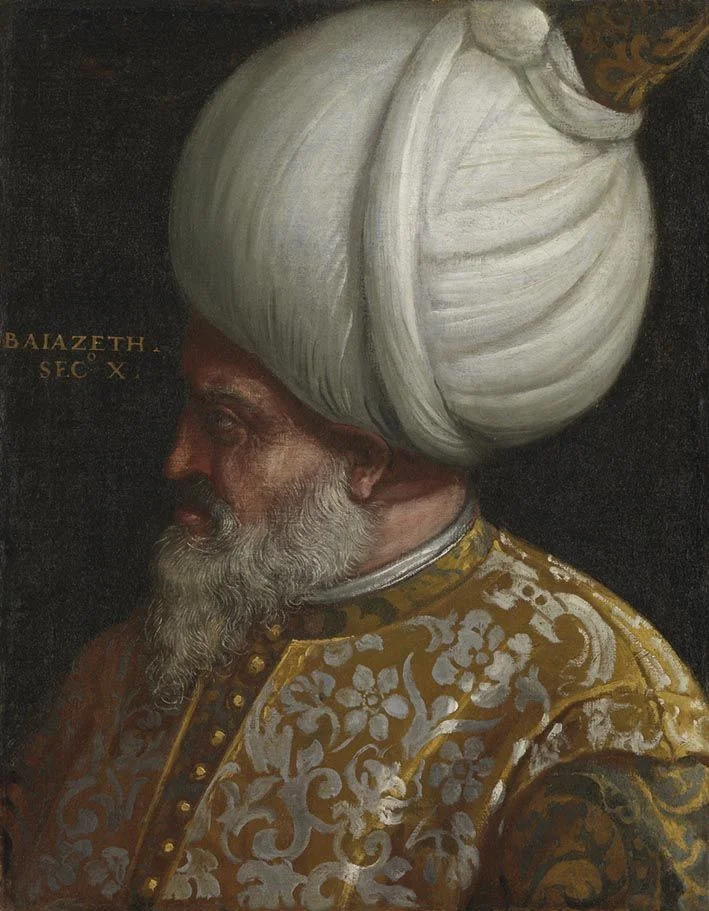
Portrait of Sultan Bayezid II. Follower of Paolo Veronese, 16th–17th century / Bavarian State Painting Collections, Munich / Wikimedia Commons
However, this did not prevent international trade. At the same time, we know of many cases of defections: people left the Safavids for the Ottoman Empire, and vice versa, for all sorts of reasons. And they could build a second life in their new land of exile. This again shows that one thing is the official policy of the state, and another is how this policy is actually implemented in everyday life.
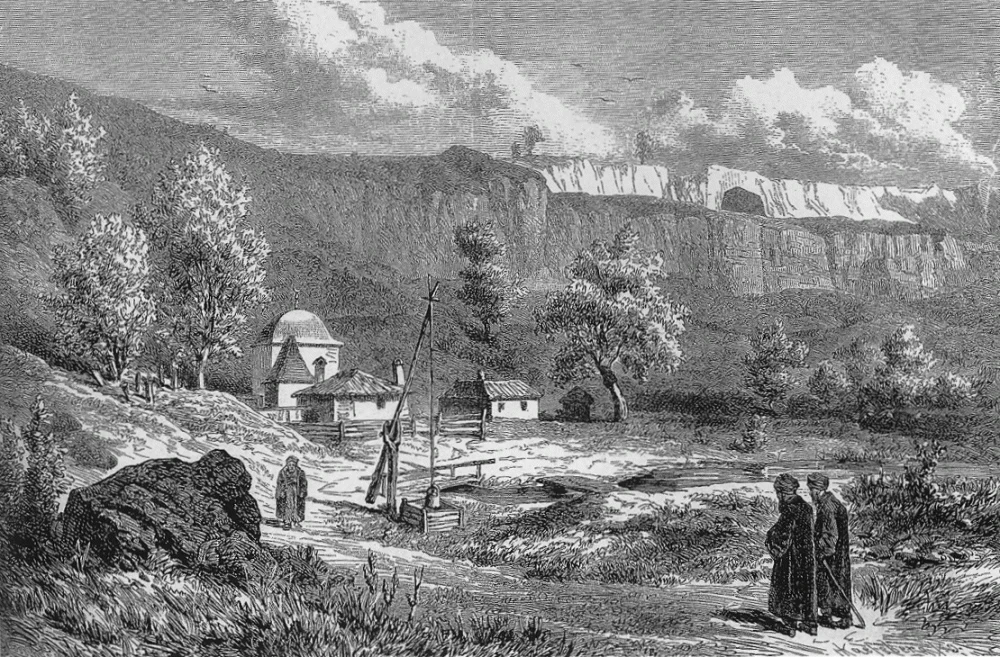
Demir Baba Teke in northeastern Bulgaria. Lithograph by the Hungarian traveller and ethnographer Felix Kanitz, 19th century. The shrine was one of the major religious centres of the Balkan Alevi and Bektashi communities, among whom traditions associated with the Qizilbash movement and the veneration of Shah Ismail I endured.
The borders between modern Türkiye, Iraq, and Iran largely date back to the Treaty of 1639. Was this a deliberate outcome or a historical accident?
I would say it was both. As I have already hinted, it was very difficult for the Ottomans to push eastwards. There was no real reward in conquering, say, the cities of Kermanshah, Qazvin, or Tabriz. The valuable prize could have been the Caucasus, the South Caucasus, and the Ottomans would indeed take it once the Safavids were deposed in 1722.
For the Safavids too, there was no real point in conquering the cities of Van or Baghdad if this meant new decades of exhausting and expensive war against the Ottomans. Later, in the eighteenth century, Nader Shah tried to expand westwards and tried to reach Van and Mosul. But if you operate from centers, from political and military bases located on the Iranian plateau, then attacking Mosul, Van, or Baghdad is not really so easy.
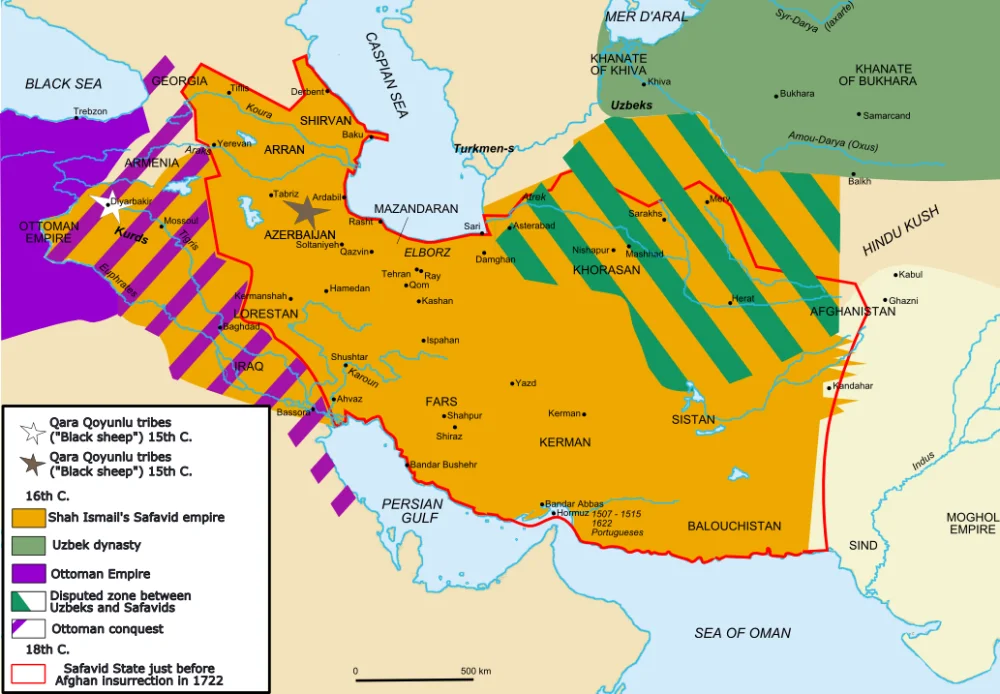
Map of Safavid Iran and the Ottoman Empire after the Treaty of Zuhab (1639) / Wikimedia Commons
Therefore, the border fixed in 1555 and 1639 corresponded—again in quotation marks—to a sort of natural border. It was ‘natural’ not in the sense of the natural borders of the two countries, which of course can be debated, given the way those countries took shape, but in the sense that it corresponded to the real possibilities of the two states, governments, or dynasties in terms of military expansion.
