
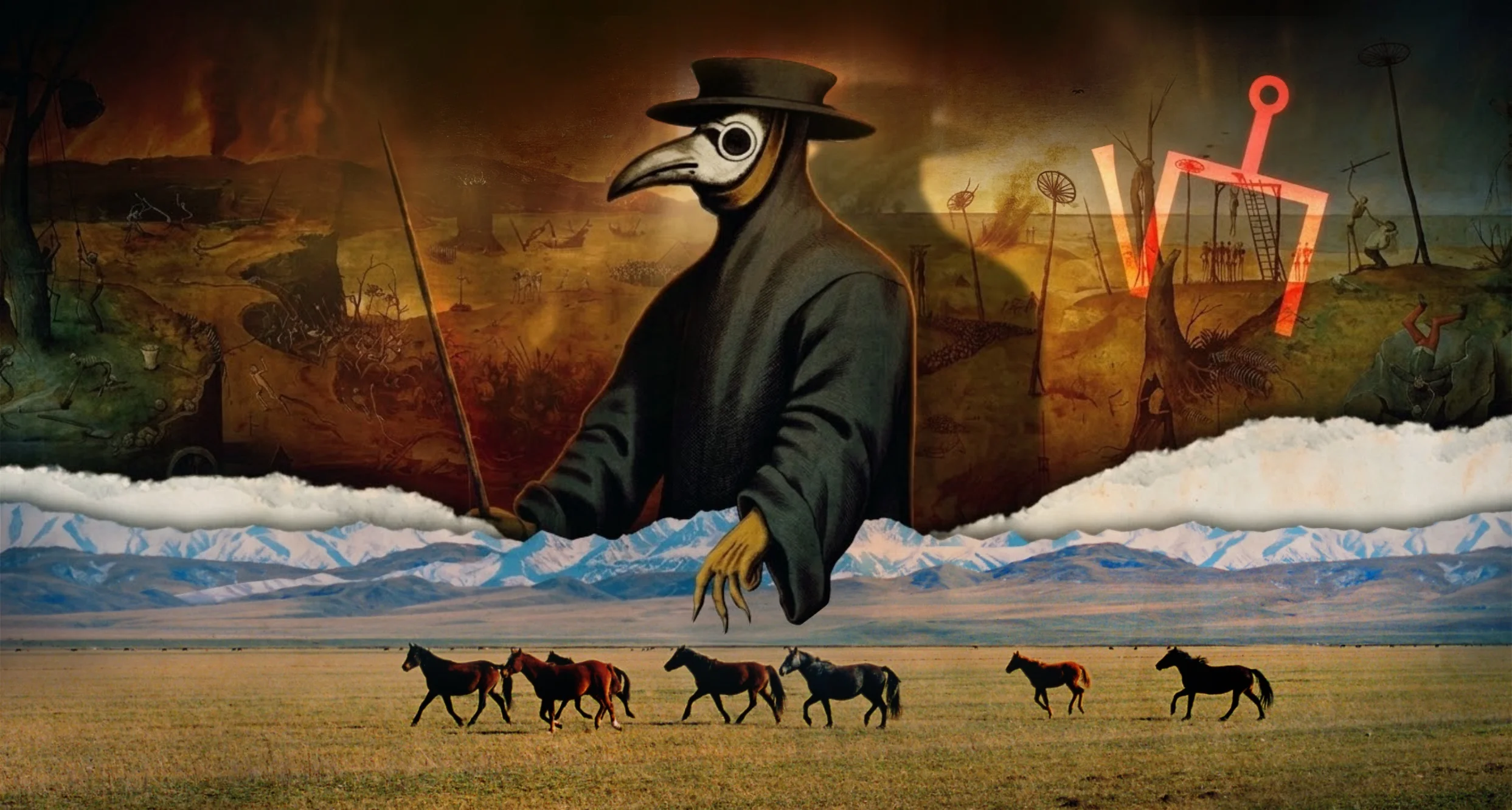
In the early fourteenth century, the Golden Horde was at the peak of its power. It ruled over a vast territory stretching from the Irtysh River to Eastern Europe, and its cities were bustling hubs of trade. Yet within a few decades, this formidable empire was tearing itself apart, plunged into the chaos of internal and external conflicts. What devastated the once-unshakeable state? One long-overlooked answer is the Black Death. The plague that swept across Eurasia in the 1340s did not spare the Golden Horde: it killed millions, disrupted trade, and shattered the foundations on which the empire rested. Qalam spoke with Uli Schamiloglu, professor at Nazarbayev University, about this crisis, the origins of the plague, and the role of the Turkic peoples in the history of the empire.
At what point did the Ulus of Jochi, the Mongol realm later known as the Golden Horde, stop being simply a part of the Mongol Empire and become an independent Turko-Mongol empire?
First, thank you very much for inviting me to your program, and thank you for the question. This is an interesting question, because many people think that the Ulus of Jochi, also known as the Golden Horde, became independent in 1269, when they held the Talas Kurultaii The Talas Kurultai was a Mongol assembly convened by Ögedeid prince Kaidu in 1269 that divided Transoxiana among the Chagatayid, Ögedeid, and Jochid lines..
I don’t have a problem with trying to be legalistic about it. I would just say that I don’t really see what changed. And I would also ask: what was the Ulus of Jochi, or the Golden Horde, before that?
Very early on, Chinggis Khan granted JochiiJochi was Chinggis Khan’s eldest son; his descendants ruled the western Mongol lands known as the Ulus of Jochi, or Golden Horde. the territories from the Zaysan Pass, from the Irtysh River, all the way to northern and eastern Europe and the territories beyond. They had their first campaigns in the early 1220s, and with the conquest of those territories by BatuiBatu Khan (c. 1205–55), Chinggis Khan’s grandson, led the Mongol conquest of the western steppe and Rus’ and founded the Golden Horde., he was there as khan. As far as I can tell, he was pretty much independent there and was respected.
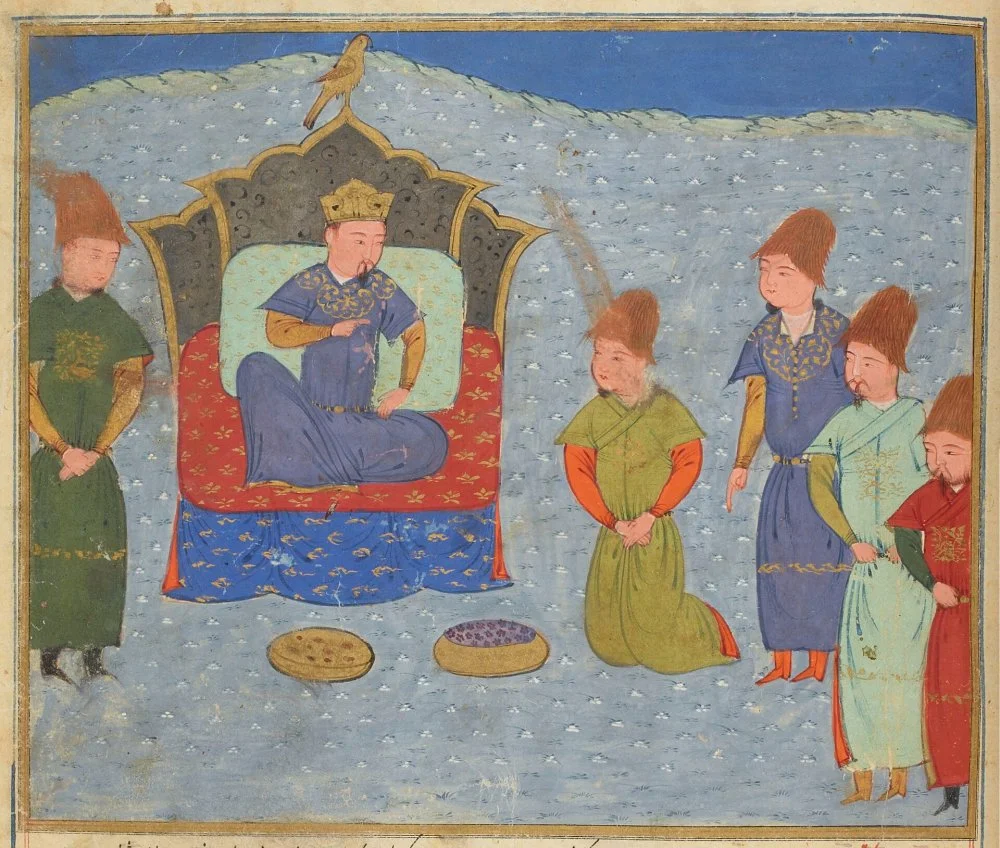
Batu Khan on the throne. Miniature from Rashid al-Din’s Jami' al-Tawarikh (Compendium of Chronicles). Early 14th century / Wikimedia Commons
So I don’t really see what the fundamental transformation was. I may be wrong, but I just don’t see how it was a fundamental transformation. It’s more of a legalistic argument.
The Mongols who conquered the western steppe were vastly outnumbered by the Turkic peoples they ruled. How exactly did the Turkicization of the Mongol elite happen?
I believe that the Chinggisid elite—we’re talking about Batu Khan, Berke KhaniBerke Khan, Batu’s brother, ruled the Golden Horde from 1257 to 1266 and was its first Muslim khan., and others—in that founding generation, maybe even the second generation, would have been speaking Mongolian with their spouses, if the spouses were Mongolian. We have some information about the genealogies and about the background of the wives.
On the other hand, what if the Mongolian armies were not bringing their wives and families with them? I’ve looked a little, and I haven’t found any information about this.
So here is what I’m thinking, if we leave the elite aside. It’s really interesting: if we consider that the Mongolian troops might not have had their wives with them, whom were they marrying, if they were starting families and having children?
If you think about it, the majority of the population in western Eurasia, along the Volga River, in the North Caucasus, and in some of these other places, would have been Turkic-speaking Kipchaks, or CumansiThe Kipchaks, or Cumans, were Turkic nomads who ruled the western steppe before the Mongols and later formed most of the Golden Horde’s population..
Some of them would have been Iranian-speaking AlansiThe Alans were an Iranian-speaking people of the North Caucasus, ancestors of today’s Ossetians.. There were some Germans, especially in Crimea. In Crimea, you had dozens of different languages, and in the North Caucasus too. You would also have had some Ruthenians and some other Slavic peoples.
And in the north, in the Volga region, you would have had speakers of perhaps Volga BulgarianiVolga Bulgaria was a Turkic Muslim state at the confluence of the Volga and Kama rivers, conquered by the Mongols in 1236. and the ancestors of Chuvash, two very closely related groups, plus Finno-Ugric peoples.
So I think one way to look at it is that probably the Mongolian men were having children with non-Mongolian women, and that this might have led, partially, to the ethnic and therefore the linguistic transformation. This seems especially plausible if we consider the account of William of RubruckiWilliam of Rubruck was a Flemish Franciscan friar who traveled to the Mongol court in 1253–55 and wrote a celebrated account of the journey., who traveled around 1253–55 from Sinop in Anatolia to the Cuman territories, was greeted by Chinggisid soldiers, was taken to see Batu Khan, and later went to see the Great Khan. He left an amazing description of the camp of Batu Khan.
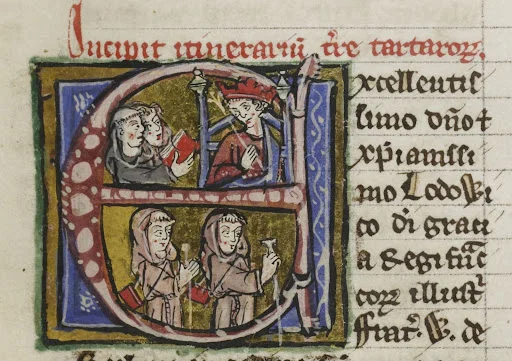
William of Rubruck before a Mongol ruler. Miniature from a medieval manuscript. 14th century / Parker Library, Corpus Christi College, Cambridge / Wikimedia Commons
And so Batu Khan didn’t have his own tent or house, but he had … I’m making it up, forty … Or each wife had forty carts drawn by oxen with houses on them, each one pulled by, like, twelve oxen. Even if each of his wives was a Mongolian speaker, probably her servants were not Mongolian, and probably the women who took care of the children were not Mongolian.
The wet nurses—or, as in older Kazakh custom, the women who sang songs and lullabies to the children—were probably not Mongolian speakers either. So I really think that within one or two generations, the children, even children of the elite born and raised within their camps, were probably not being raised in Mongolian. Or if they were bilingual, maybe they stopped being bilingual and became monolingual within a generation after 1253. Are we talking about the 1270s, perhaps?
Somewhere I read about coins being struck in Turkic in that period, around the 1270s. By the time we get to the first half of the fourteenth century, we begin to see the rise of a tradition of Muslim Turkic literature.
Nicholas PoppeiNicholas Poppe (1897–1991) was a Russian linguist and leading specialist in Mongolic languages who taught in Leningrad and later at the University of Washington., the great scholar of Mongolian, has an article, ‘Золотоордынская рукопись на бересте’ (‘A Golden Horde Manuscript on Birch Bark’), about two birch-bark fragments that have been preserved, with Mongolian written in Mongolian script. Maybe these are from the thirteenth century.
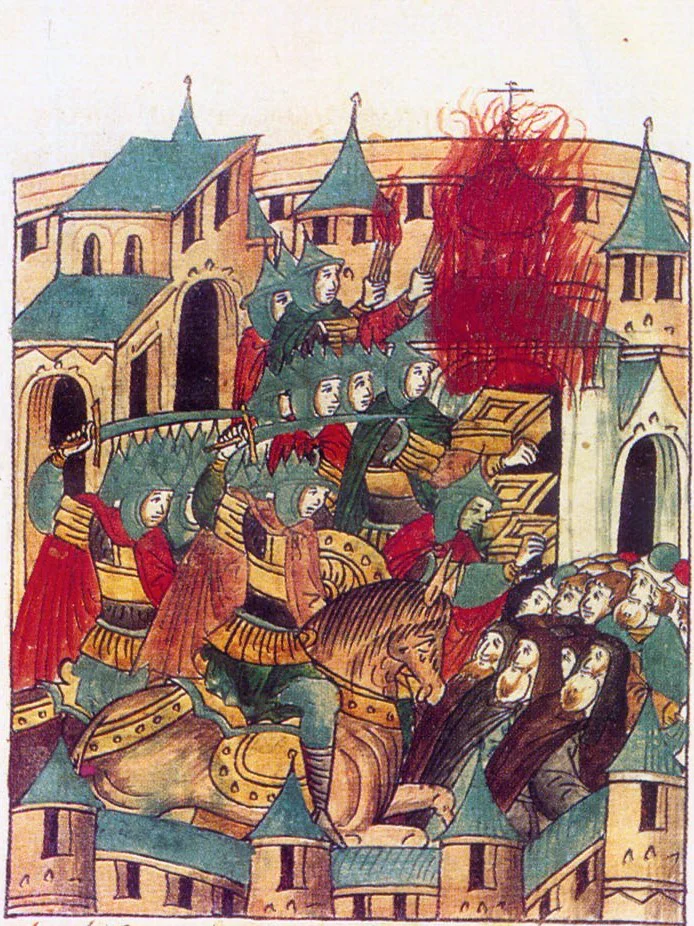
The Sack of Suzdal by Batu Khan’s army in 1238. Miniature from the Illustrated Chronicle of Ivan the Terrible. 16th century / National Library of Russia / Wikimedia Commons
I’ve seen them at the museum, and those are really the only examples, unless you count these paizasiA paiza was a tablet carried by Mongol officials and envoys as a sign of their authority and privileges., these seals or something like that, and I don’t know how many of them have been found. So we have very little evidence to suggest that Mongolian was being used as a language.
You have written extensively about plague and crises in the Golden Horde. How was the Golden Horde connected to the spread of the Black Death, the great plague pandemic of the mid-fourteenth century, across Eurasia?
The first thing is that today, based upon modern genetic analysis of antibodies against the strains of the plague, a group of Chinese scholars a little over ten years ago reconstructed the genetic history of the different strains of the bacterium Yersinia pestis, which is responsible for the disease called bubonic plague—in Russian, bubonnaya chuma, in Kazakh, oba. This is spread by rodents. One can talk a lot about that too, but I won’t.
So it’s clear that for them, the point of origin can be localized to the Qinghai-Tibet Plateau. That’s where you have major trade routes crossing, and they linked that region to the moments when there were mutations in the bacterium that made it more deadly. This happened around or before 540, at the time of the first pandemic in recorded history, during the reign of the Byzantine Emperor Justinian.
It happened again sometime in maybe the thirteenth century, the 1200s, though they believe more likely around the 1330s, maybe earlier, or the 1340s. An important role is played by the Lake Issyk-Kul region, because it seems there were moments when the plague, or the bacterium, would spread, but it needs to establish itself in what people would call a focus, or locus.
It seems that in the Lake Issyk-Kul region, they found seventeen bodies in BuranaiBurana, in northern Kyrgyzstan’s Chüy Valley near Tokmok, is the site of the medieval city of Balasagun. that showed traces of the bacterium Yersinia pestis, as DNA analysis revealed.
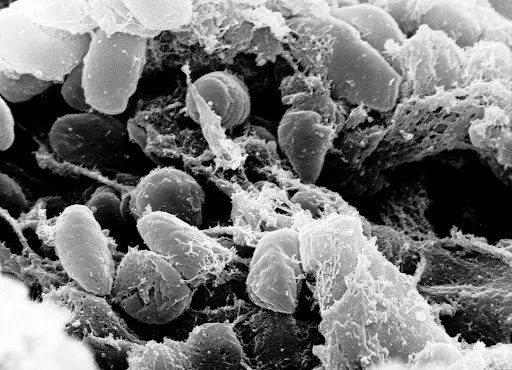
Yersinia pestis bacteria, the causative agent of plague. Scanning electron microscope image / National Institute of Allergy and Infectious Diseases (NIAID) / Wikimedia Commons
The same bacterium has been found in one specimen in BolgariBolgar, on the Volga near its confluence with the Kama, was the former capital of Volga Bulgaria and an important city of the Golden Horde., near the confluence of the Volga and Kama rivers. I’ve been arguing since the 1980s—my first publication on this was in 1993—that what probably happened was that the NestorianiNestorian Christians of the Church of the East lived across Central Asia; their gravestones near Issyk-Kul record deaths from ‘pestilence’ in 1338–39. community around Lake Issyk-Kul was affected by an outbreak of this plague, of this pandemic really.
It spread across Central Asia. It came to KhwarazmiKhwarazm is a historic region on the lower Amu Darya, south of the Aral Sea, now divided between Uzbekistan and Turkmenistan.. Recently, there has been scholarship in Iran showing that it went south across northern Iran, and all over Iran. We also think that it went north around the Caspian Sea to Crimea, where it arrived around 1346.
From 1346, it spread via the Black Sea trade to Constantinople, from Constantinople to Alexandria in Egypt and to Sicily, and then on to Europe.
There are other theories, too, that there may also have been a northern route of transmission.
I think what inspired me to study this was one paragraph in a book by the great American historian William McNeilliWilliam H. McNeill (1917–2016) was a Canadian-born American historian at the University of Chicago whose Plagues and Peoples (1976) examined disease in world history.. The book is called Plagues and Peoples, and in that one paragraph he says, ‘Oh, probably this was the cause of the collapse of the Mongol world empire.’
Of course, as somebody strongly interested in the Golden Horde, I said, hey, wait a minute, this is very, very interesting. So I started looking around for written sources, and indeed there are a tremendous number of them. There are Arabic sources, references in the Russian chronicles, and other kinds of sources where you can find information about it.
The problem is that people did not look for this kind of information, or they did not contextualize it. For example, the European scholar Ole Jørgen Benedictowi Ole Jørgen Benedictow is a Norwegian historian whose studies of the Black Death estimate that it killed about 60 per cent of Europe’s population. estimates that from the first outbreak of the plague until the mid-1350s, about 60 per cent of the population of Europe died from it.
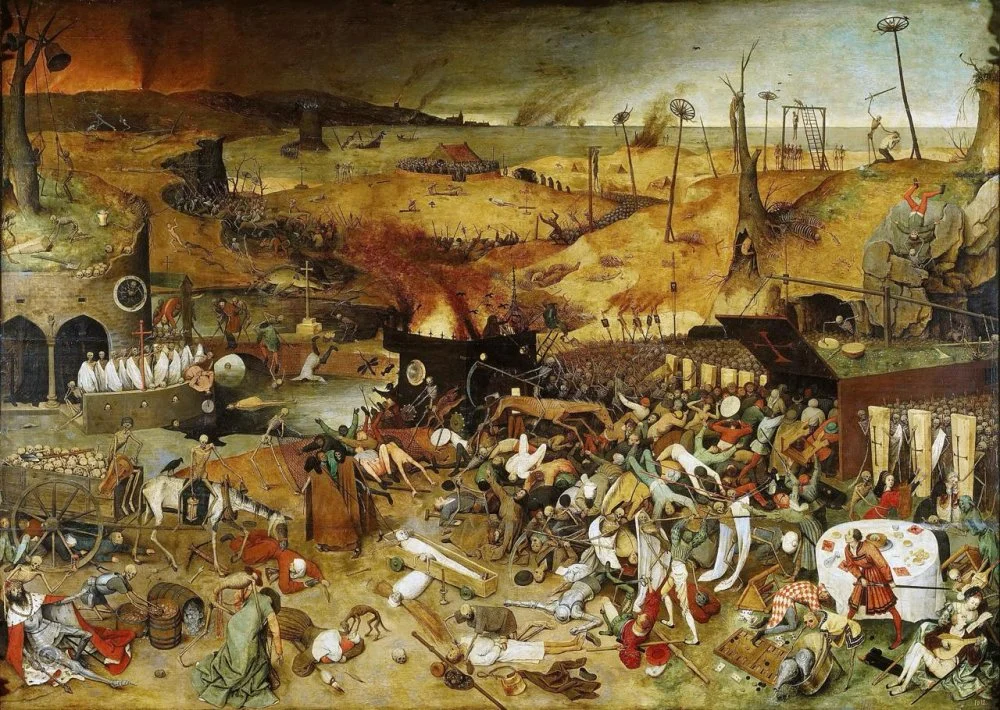
Pieter Bruegel the Elder. The Triumph of Death. Circa 1562 / Museo del Prado, Madrid / Wikimedia Commons
So I’m thinking: if this same outbreak of plague was first in Turkestan, or first in the territories of the Golden Horde, where you have cities like Sarai and heavily populated areas like Crimea, what if it had the same consequences there?
And I started to find lots of information. The brief summary of my conclusions is, first of all, that from the 1340s or earlier, certainly earlier for Khwarazm, waves of bubonic plague were affecting the territories of the Golden Horde. Where it hit sedentary centers, you may have had a catastrophic decline in population.
In Europe, in some places 10 per cent of the population would die; in the next neighborhood, 90 per cent. So I’m not making any uniform statements, but it really does seem now, the more I think about it, that there was tremendous depopulation in western Eurasia.
Let’s say along the Volga River, maybe along the Ural River, and points to the west. So I think there was tremendous depopulation. The amazing thing about the Golden Horde, or the western part of the Ulus of Jochi, the Aq OrdaiAq Orda, or the ‘White Horde’, names one wing of the Ulus of Jochi; historians disagree whether it was the western or eastern wing., around Sarai, the Volga, and Crimea, along that axis, is that it was only in 1359 that it collapsed.
Before that, there were evidently multiple waves of plague in the 1340s, and in the 1350s: 1357, 1358. That is certainly when the Volga Bulgarian inscriptions stop being written. We know from various sources that there were waves of plague in the 1360s, which affected, among others, the author of the Nahj al-Faradis.
So it’s surprising that the Golden Horde didn’t collapse before 1359. When it did collapse, it collapsed very, very hard.
So I think what happened is that the sedentary territories lost population. I think nomads in general are not as easily affected by epidemic disease, so epidemiologically, they were not affected. I think this was also true in the time of the Prophet Muhammad, when the plague of Justinian was still recurring. The Bedouins remained strong, while the sedentary populations disappeared.
In the case of the Golden Horde, I think Sarai, Crimea, and Volga Bulgaria suffered very greatly from population loss. But what we see in this period is that nomadic groups such as the Sicivut, the Qongirat, the Manghit, and the Qiyat remained, as far as we can tell, as forces, while the sedentary political center collapsed.
The other thing I see is that when TokhtamyshiTokhtamysh was a Chinggisid khan who reunited the Golden Horde around 1380 but was overthrown after his defeats by Timur in the 1390s. comes from the east later on, in the last quarter of the fourteenth century, he brings with him the Shirin, the Barin, the Argyn, and, I think, the Kipchak tribes. Later on, these became the fundamental population of the Khanate of Kazan, the Crimean Khanate, and, partially, of some of the others.
So how is it possible that the people who came with Tokhtamysh became the fundamental population? I think if you take into account that there was tremendous depopulation … The Qongirat moved to the territories of Khwarazm, in today’s Uzbekistan; the Manghit were in the steppe; some of the others we don’t know so much about. But I think such a population transformation was a result of the original depopulation after the 1340s, or after 1359.
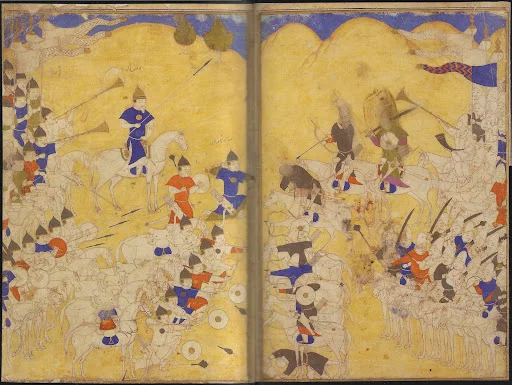
Battle between Timur and Tokhtamysh Khan. Miniature / Topkapı Palace, Istanbul / Wikimedia Commons
Can we say that it was one of the reasons the Golden Horde weakened?
I think it was one reason for its total collapse. What you have is 1359, and then, later, the establishment of new khanates, like Crimea in the 1440s and the Kazan Khanate in the 1430s. That’s not the same period. That’s a totally different set of circumstances.
The Golden Horde stretched from Lake Zaysan and the Irtysh all the way to Eastern Europe. The Khanate of Kazan covered about 100 kilometers. The Crimean Khanate was centered on Crimea.
KasimoviThe Kasimov Khanate (1452–1681) was a small Tatar state on the Oka River, created by Muscovy and increasingly under its control. was even smaller. Perhaps the Siberian KhanateiThe Siberian Khanate was a Tatar state in western Siberia, centered on Tyumen and later Qashliq, and conquered by Russia in 1582–98., around Tobolsk and Tyumen, potentially had large numbers of troops. But none of them had the manpower to control that entire central part of a huge continent.
That’s what the Golden Horde did.
