
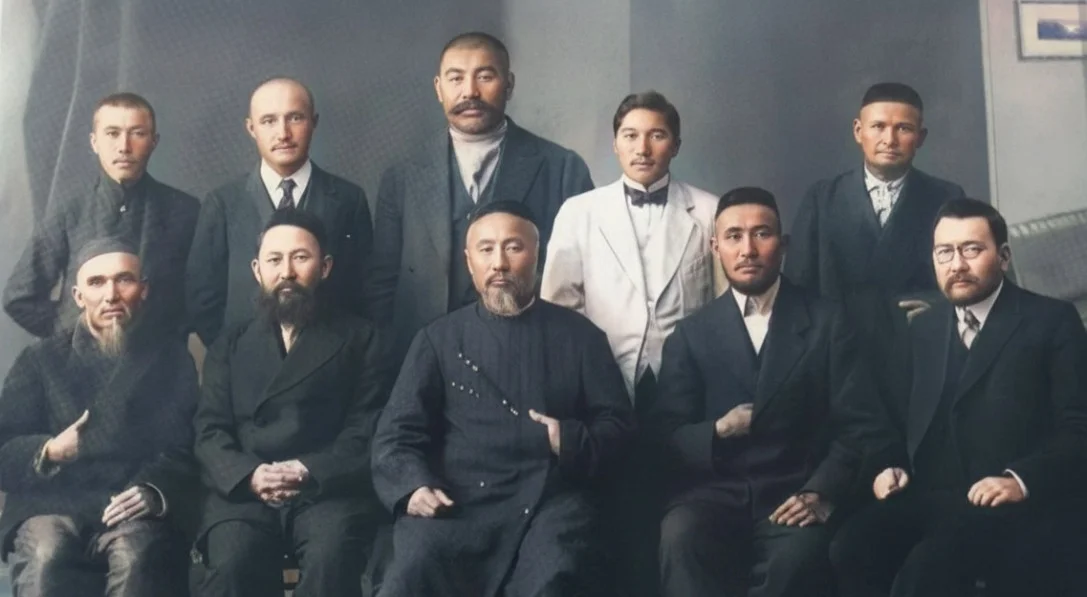
In December 1917, the Second All-Kazakh Congress took place in Orenburg, bringing together Kazakh leaders, intellectuals, and representatives from across the steppe. One of its key outcomes was the proclamation of the Alash Autonomy, a bold step toward self-governance amid the upheavals of the Russian Revolution. In this Qalam overview, we present the key facts of this event, which remain remarkable even more than a century later.
The Beginning
On 18 December 1917i This date converts to 5 December according to the Old Style, or Julian calendar, which was still in official use in the Russian Empire at the time., almost all prominent representatives of the Kazakh intelligentsia gathered in Orenburg for the Second All-Kazakh Congress. The gathering took place at a moment of profound uncertainty, when the foundations of state power across the former empire were collapsing. One of its main objectives was to develop a unified plan of action and defend autonomy amid turbulent times. By this time, the Russian Empire was in its final days, having gone through one revolution after another—first the February Revolution and then the October Revolution—and was entering a period of internal strife and civil war.
Against this backdrop, the Kazakh intelligentsia resolved to act. More than 200 delegates came to Orenburg, arriving from the Bukey Horde, Ural, Turgay, Akmolinsk, Semipalatinsk, Semirechye, and Samarkand regions, as well as from the Altai province. The prominent political activist Baqtykerei Qulmanov was elected chairman, with Azimkhan Kenesarin, another figure well-known for his role in the movement for autonomy, as his deputy. The congress presidium also included representatives of the Alash party, such as Alikhan Bukeikhan and Khalel Dosmukhamedul, with Gumar Karash, the poet and political figure, representing the Bukey Horde.
The Alash and Üsh Jüz Parties
The leaders of the Alash movement were key participants in the Second All-Kazakh Congress. However, they were not the only political force representing Kazakh interests in the post-revolutionary period. The primary opposition of the party Alash was the Üsh Jüz party (Kazakh for ‘Three Jüzes’), a nationalist Kazakh party founded in Omsk in the fall of 1917. Its founder and leader was Mukan Aitpenov, a public figure, politician, and journalist.
Both parties shared common goals: achieving liberation and a better life for the Kazakh people. However, their methods differed significantly. Representatives of the Alash party, who made up the majority of the Kazakh intelligentsia, envisioned an independent Kazakhstan, whereas Üsh Jüz advocated broad autonomy for Kazakhstan within a federation of Turkestan peoples under Russian rule.
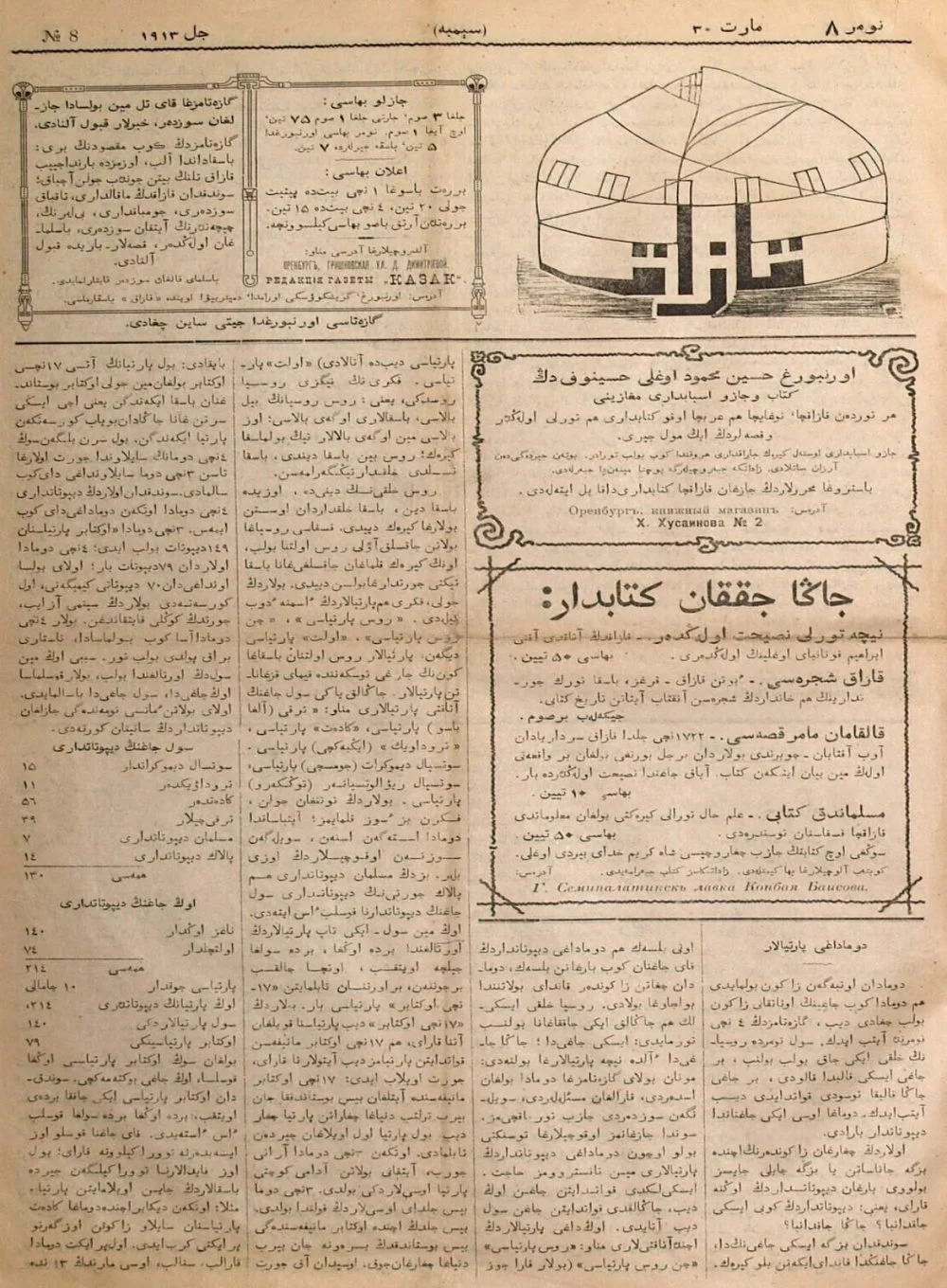
The Qazaq newspaper. No. 8, 1913 / From open sources
Each party had its own publication: Alash published the widely known newspaper Qazaq, established in 1913 by Alikhan Bukeikhan, Akhmet Baitursynuly, and Mirjaqyp Dulatuly. Interestingly, the Üsh Jüz party also published a newspaper of the same name in 1917–1918 in Petropavlovsk.
Both parties fought for the right to participate in the elections to the Constituent Assembly, initially scheduled for December 1917 but postponed to January 1918. In these elections, the Alash party achieved a decisive victory in all Kazakh regions. After this crushing defeat, representatives of Üsh Jüz began calling for a boycott of Alash initiatives and aligned themselves with the Bolsheviks.
The Main Discussion: The Second All-Kazakh Congress
The congress addressed not only the problems of famine-stricken regions but also the need to end party rivalry and achieve national unity.
Around ten key points were discussed, including: the positions on Siberian and Turkestan autonomies, the South-Eastern Union, and regional independence in general; the establishment of a militia, a national council, and a national fund; the functioning of the muftiateiA muftiate is a state-regulated Islamic religious authority in post-Soviet and Russian-influenced regions, overseeing Muslim affairs and issuing religious rulings. and people’s courts; village administration; public education; and the food supply issue.
The primary focus of the congress, however, was the establishment of autonomy, and Alikhan Bukeikhan delivered a report highlighting its necessity.
The Results of the Congress
After Alikhan Bukeikhan’s report was discussed, a vote was held on the immediate proclamation of the Alash Autonomy. Although Bukeikhan himself had argued for its necessity, he and his closest supporters—Akhmet Baitursynuly, Mirjaqyp Dulatuly, and Magzhan Zhumabay—were among the forty delegates who opposed its immediate proclamation. They planned to officially declare autonomy at the All-Russian Constituent Assembly.
Among the thirty-three delegates who voted in favor of immediate proclamation were Alash party supporters Zhakhanasha Dosmukhameduly and Khalel Dosmukhameduly, who later took part in negotiations with Vladimir Lenin and Joseph Stalin in Moscow. Only three delegates abstained, including the prominent political figure Mustafa Shokay.
The outcome of the Second All-Kazakh Congress was the creation of Alash Orda, a Kazakh state formation under the Provisional People’s Council, with Alikhan Bukeikhan being elected as chairman. The council consisted of twenty-five members: fifteen Kazakhs and ten representatives of other peoples, including Russians. The city of Semey (Semipalatinsk) was chosen as the capital of Alash Orda and renamed Alash-qala.
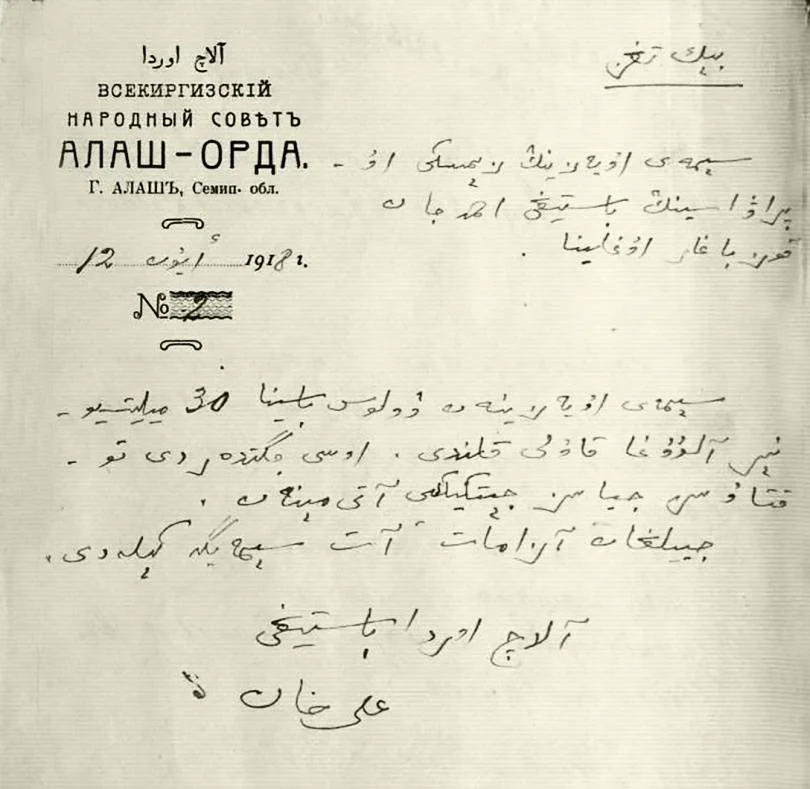
Notice of the Government of Alash Orda, 1918 / From open sources
The proclamation of autonomy was postponed until the convening of the All-Russian Constituent Assembly. At the same time, measures to create their own army to defend the territory, as well as initiatives to establish relations with the governments of other countries, continued without delay.
What Happened Next?
In January 1918, the All-Russian Constituent Assembly never began full operations as it was dispersed by the Bolsheviks. In the absence of a legitimate all-Russian authority, the representatives of Alash Orda shifted their focus from the idea of Alash autonomy to the project of the Alash Republic, seeking its international recognition through active diplomacy, including negotiations with the Bolsheviks. However, in the spring of 1920, the Soviet government abolished Alash Orda. By the late 1920s, the first wave of repressions targeted members of the Alash Orda government and the Alash party, and in the period between 1937 and 1938, the majority of them were executed.
