
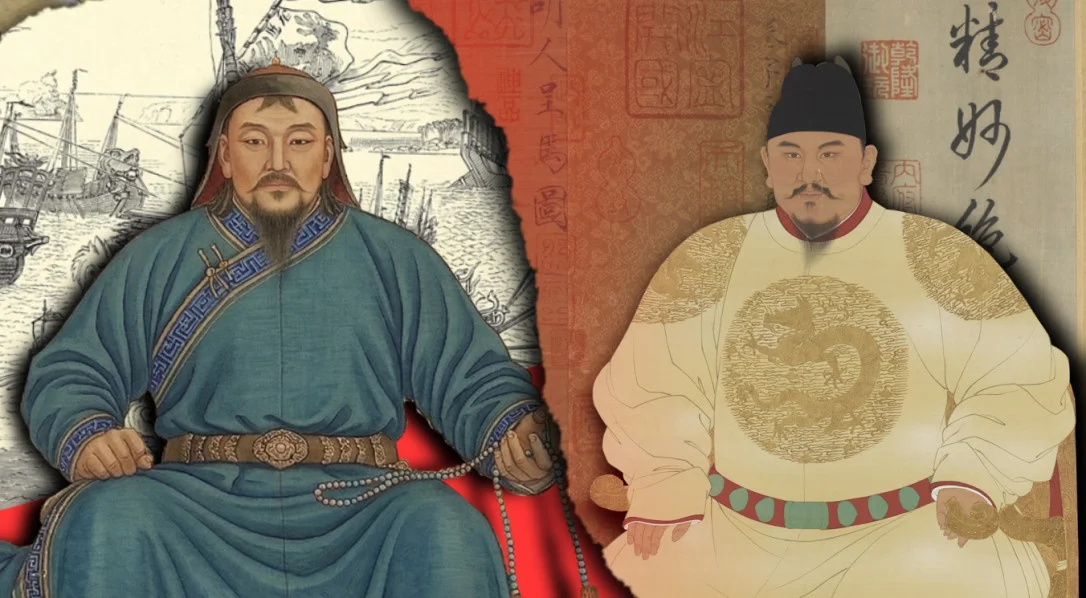
When Chinggis Khan and his descendants swept through Eurasia in the thirteenth century, they didn’t just conquer lands—they irrevocably transformed the world. Scholars still debate whether the Mongol Yuan state should be seen as a legitimate continuation of the Chinese imperial tradition or as something new, fundamentally distinct in its nature and ideology. But one fact remains beyond dispute: the Mongol Empire changed everything. In the midst of conquest and chaos, it established an extensive network of relay stations that connected East and West on an unprecedented scale, forging extensive diplomatic, commercial, economic, and cultural connections.
In the third lecture of his course on the history of Kazakh–Chinese relations, Professor Nabizhan Mukhametkhanuly examines the complex dynamics that existed among the Chinggisids, the intricate struggle between the Yuan Empire founded by Kublai Khan and the uluses of his brothers, the Ulus of Jochi’s drive for independence, and the Timurids’ efforts to reshape the geopolitical map of Eurasia.
The Four Pillars of the Khan’s Throne
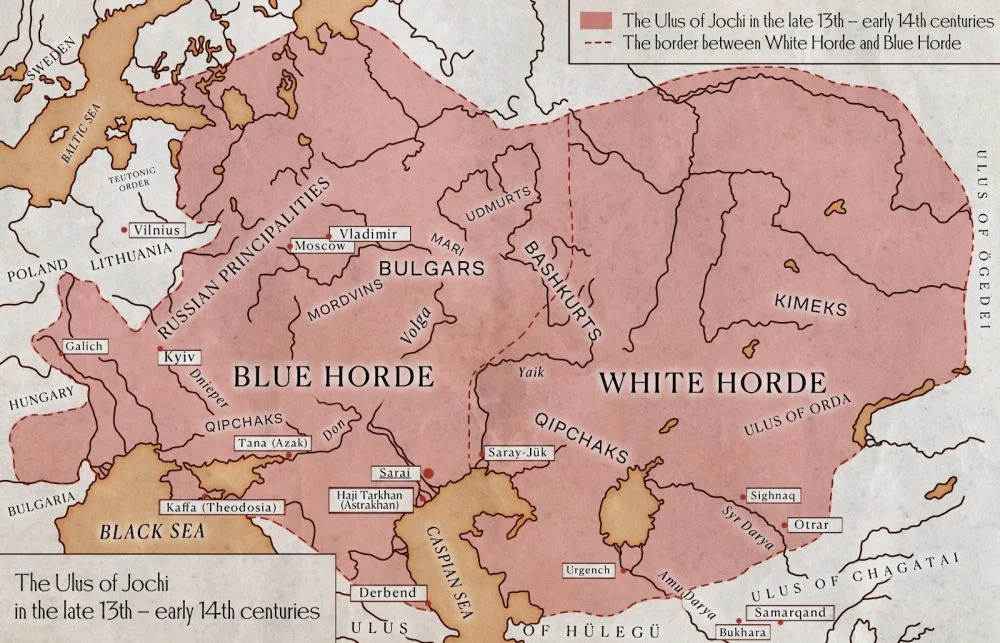
Before turning to the history of the Yuan Empire that was founded by Chinggis Khan’s grandson Kublai Khan, it is important that we understand the other states that either disappeared or, conversely, emerged across Eurasia as a result of the waves of Mongol conquests. Among them was the Golden Horde, also known as the Ulus of Jochi.
Qalam
According to the Persian historian Ala al-Din Ata-Malik Juvaynii Ala al-Din Ata-Malik Juvayni (1226–1283) was a Persian historian and governor under the Mongols, and the author of Tarikh-i Jahangushay (History of the World Conqueror), an important first-hand account of the Mongol conquests., the territories granted to Chinggis Khan’s eldest son Jochi extended from Kayalyk and Khwarazm to the farthest reaches of Saksin and Bulgar, as well as all lands ‘touched by the hoof of the Tatar horse’. Historian Z. Kinayatuly described the boundaries of the Ulus of Jochi as follows:
The question of dividing the lands, populations, and spoils seized during the Khwarazmian and the western campaigns was resolved not at Qūlanbasy, but at a great assembly (kurultai) held in the autumn of 1224 at Būqashoshyğan on the Irtysh. Jochi himself was not present there; instead, he was represented by his trusted envoys. Nevertheless, among the descendants of Chinggis Khan, it was Jochi who received the largest domain. His possessions encompassed vast lands from the Irtysh to the Caucasus Mountains in the west, including Saksin and Bulgar. This territory covered the entire Desht-i KipchakiDesht-i-Kipchak is the medieval name for the vast Kipchak Steppe that formed the heartland of the Golden Horde., including the western part of Semirechye and lands reaching the lower Volga.
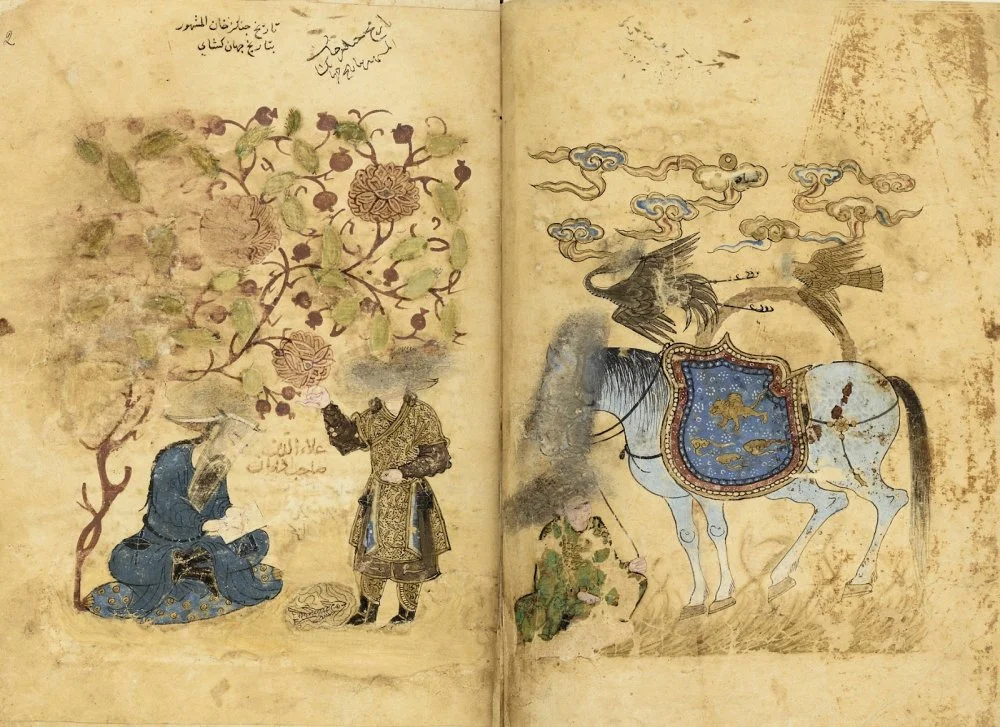
Miniature from the manuscript Tārīkh-i Jahān-Gushā (“History of the World Conqueror”) by Ata-Malik Juvayni. Persia, c. 1290. Bibliothèque nationale de France / Wikimedia Commons
The Great Mongol State, the official name of the Mongol Empire which made the world tremble, did not rise by the will of Chinggis Khan alone. A special role in its rise and consolidation was played by his son Jochi and his three younger brothers. Together, they were the engine of conquest, each commanding armies, governing territories, and enforcing their father's authority across Eurasia. Regarding the role of his sons, Juvayni wrote:
From this wife, Chinggis Khan had four sons who risked their lives, performing feats and great deeds for him; they were the four pillars of the throne of the realm and the four columns of the khan’s palace.
After the death of Chinggis Khan in 1227, in accordance with his will, the title of Great Khan was inherited by his third son, Ögedei. Following the death of Jochi himself—who died just a few months before his father—his position was taken by his second son, Batu, who was proclaimed khan.
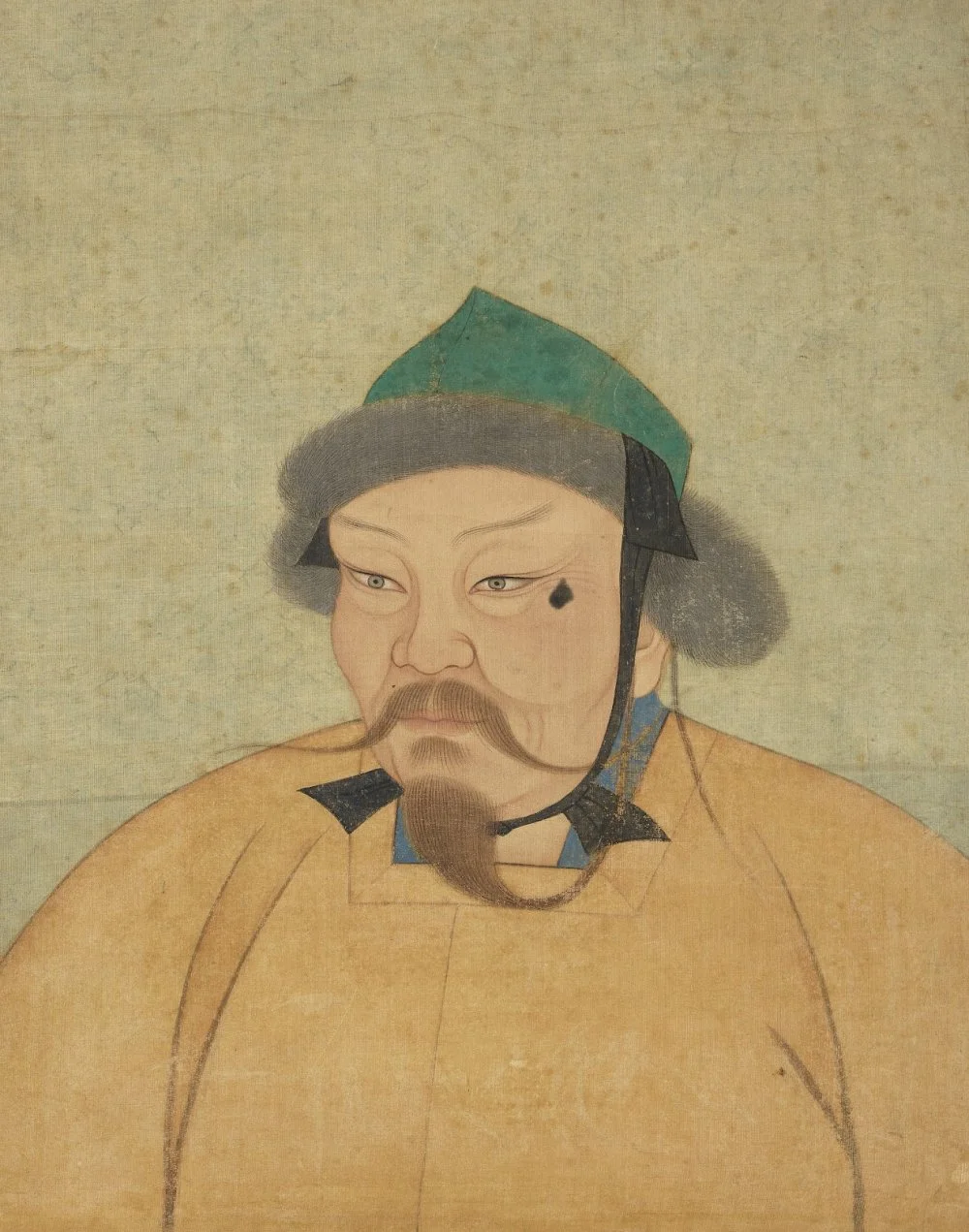
Ögedei Khan — second Great Khan of the Mongol Empire. Portrait from the “Album of Yuan Emperors,” China, 13th–14th centuries / Wikimedia Commons
At that time, no one could have imagined that within just a few years, the descendants of Chinggis Khan would enter into a fierce struggle for power that would change the course of history and redraw the map of the world.
Mongol Globalization
In 1229, Ögedei convened a great kurultai, at which he was officially elected Great Khan of the Mongol Empire. Immediately after ascending the throne, he undertook decisive measures to strengthen the system of state administration and centralize the authority of the khan. Through a series of decrees, he clearly defined the scale of taxes levied on the population, established state storehouses, granaries, supply depots and a treasury, and initiated the construction of a network of relay stations.
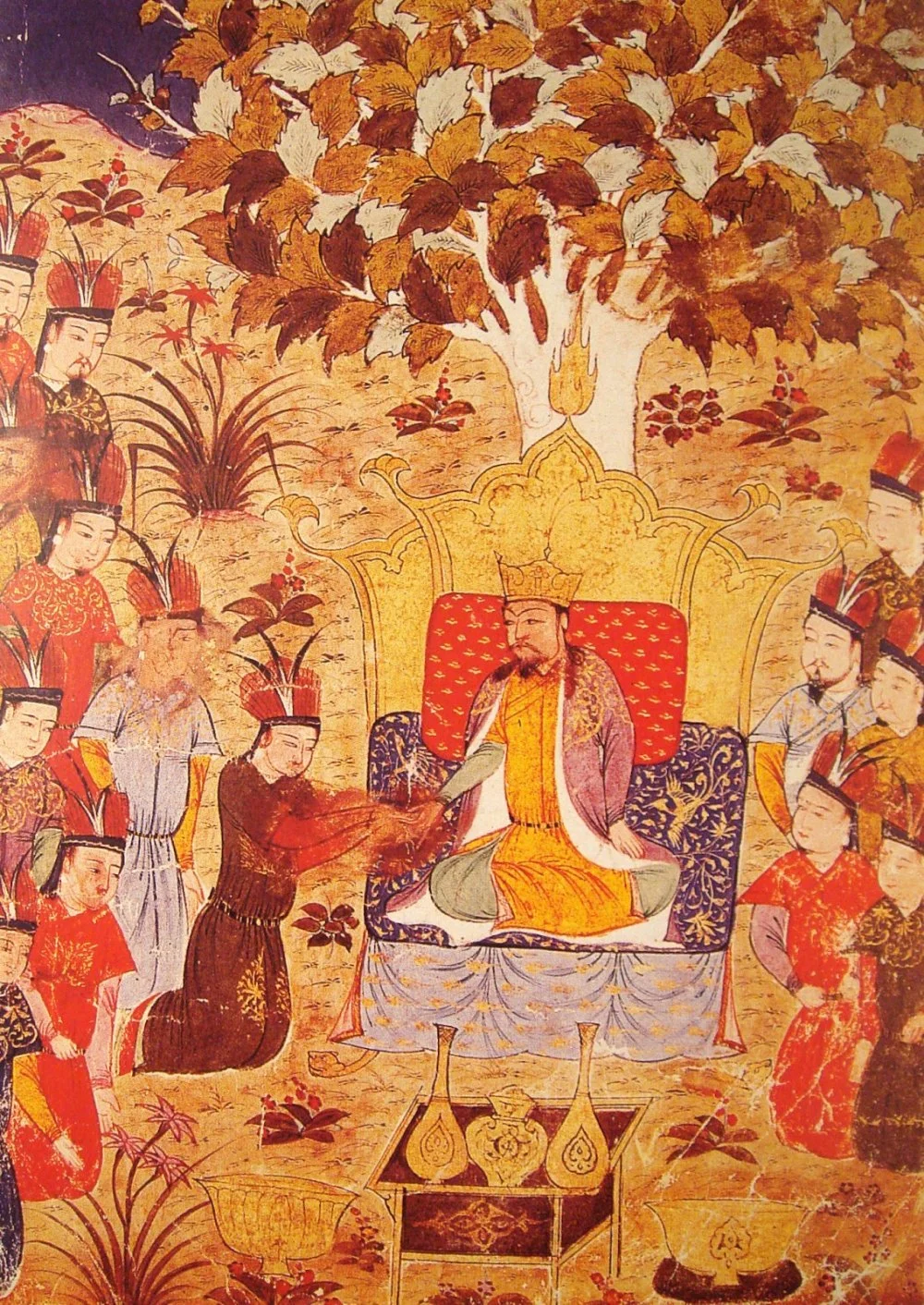
Coronation of Ögedei Khan at a kurultai, 1229. Miniature from the manuscript Jāmiʿ al-tawārīkh, Persia, early 14th century / Wikimedia Commons
During the same period, at Ögedei's command, Batu launched a large-scale western campaign that lasted from 1236 to 1240. In the course of this campaign, he subdued the Kipchak and Bulgar tribes west of the Ural River and in the lower reaches of the Volga. He also brought the Rus’ principalities under his control, obliging them to pay regular tribute.
When he returned to the Volga region in 1243, Batu firmly consolidated his authority in the Kipchak Khanate (as the Golden Horde was sometimes called), whose domains now stretched from the Irtysh River in the east to the Rus’ lands in the west, and from Lake Balkhash and the Aral Sea in the south to the Black Sea and the subpolar regions in the north.
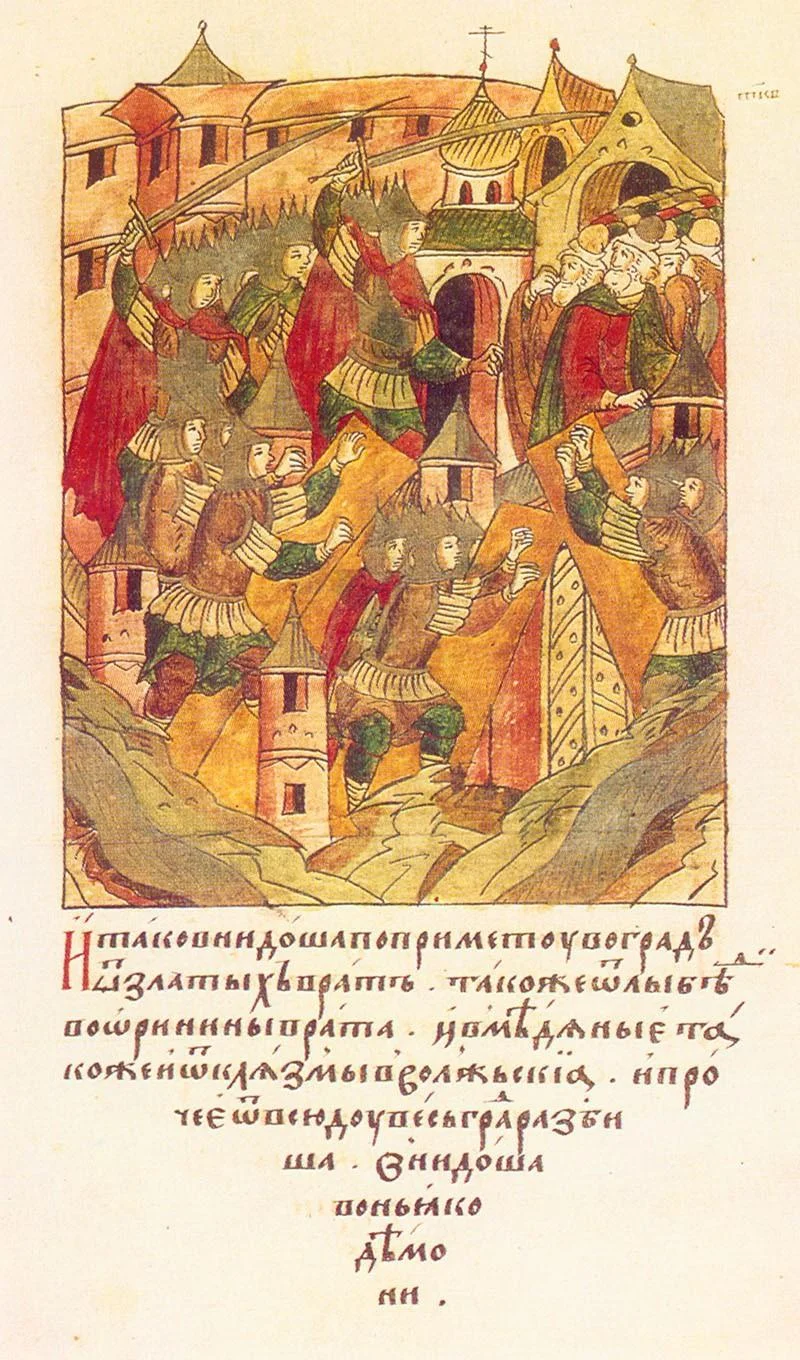
Mongols at the walls of Vladimir. Miniature from a Russian chronicle, 16th century / Wikimedia Commons
Among the grandsons of Chinggis Khan, Batu stood out for his authority, wisdom, and military talent. For these qualities, he was popularly nicknamed ‘Sain Khaan’, meaning ‘good’ or ‘noble’ khan in Mongolian.
By establishing a network of relay stations across this vast territory, he linked the uluses of Jochi, Chagatai, and Ögedei with one another, as well as with Karakorum, which was the capital of the Mongol Empire. And in this way, a well-organized system of roads and postal relay stations known as the Yam was formed between the central regions of the Great Mongol State and its uluses. These stations not only ensured uninterrupted communication within the vast empire, but also created favorable conditions for the development of political, cultural, and trade/economic ties between East and West.
Thus, in 1245, at the request of Pope Innocent IV, Giovanni da Plano Carpini, an Italian Franciscan friar who eventually wrote the earliest detailed European account of the Mongol Empire, undertook a journey from the French city of Lyon to Mongolia. The delegation passed through the lands of the Golden Horde, traveling along the southern shore of Lake Balkhash and, after passing Alakol, headed eastward. Crossing the Urungu (Ulunghur) and Irtysh rivers and traversing the Altai Mountains, the mission reached Karakorum. By changing horses several times a day and replenishing their provisions at the relay stations, the travelers were able to advance practically without interruption.
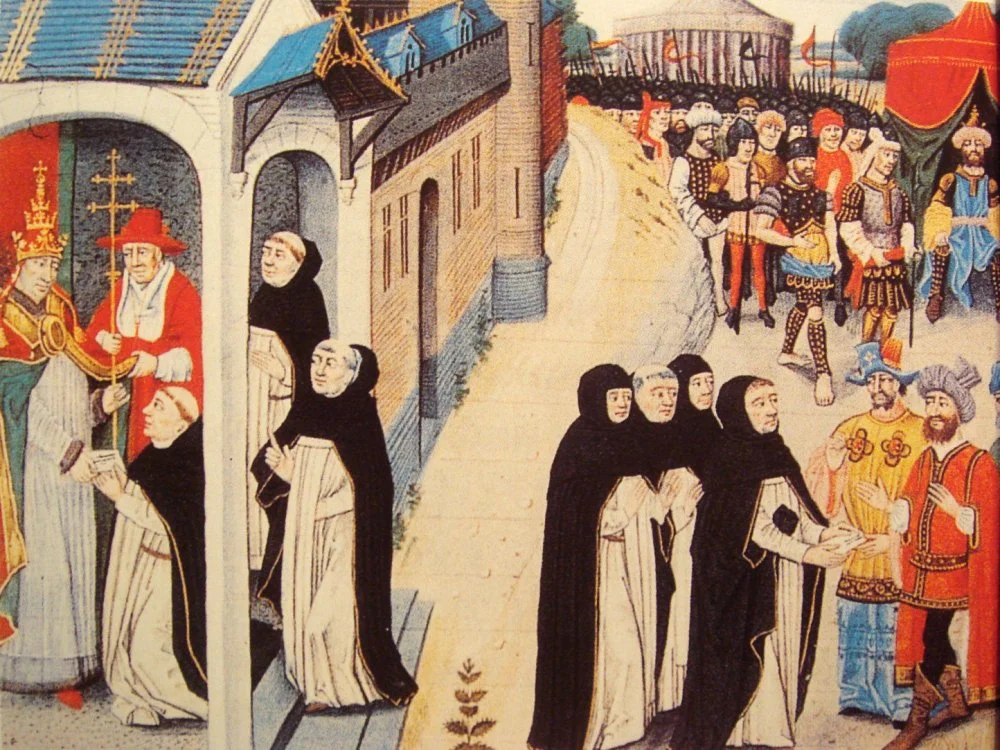
Embassy of the Franciscan Ascelin of Cremona to the Mongols. Manuscript miniature, 13th century / Wikimedia Commons
The Eurasian Tandem
In 1246, Güyük, the eldest son of Ögedei, was elected Great Khan. He had not forgotten the past, harbouring a deep resentment toward Batu for having failed to support his candidacy for the throne previously. This hostility, fueled by internal divisions, prompted Güyük to launch a campaign against Batu, but before he could strike, the khan died suddenly in 1248.
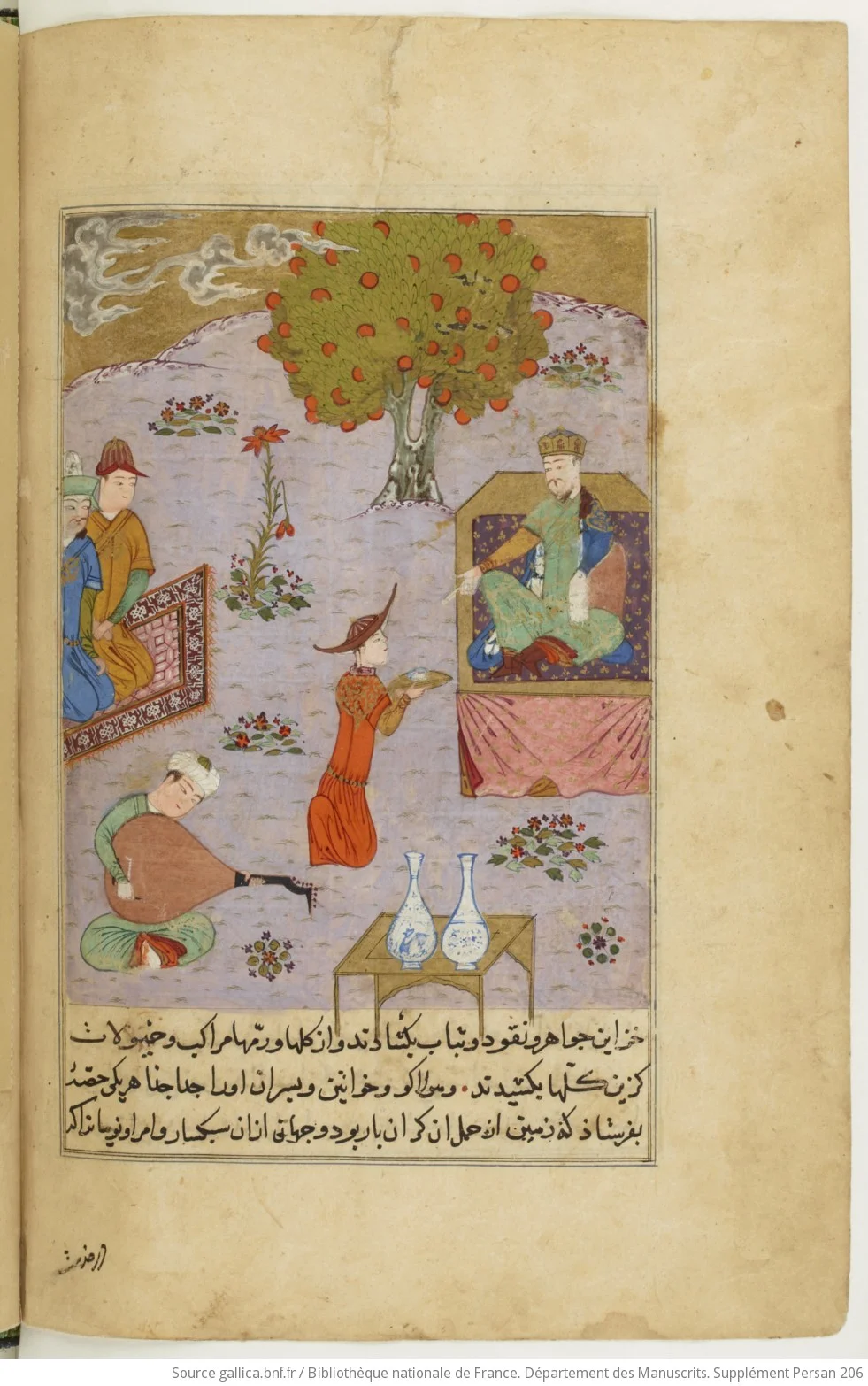
Güyük Khan at a feast. Miniature from the manuscript Jāmiʿ al-tawārīkh, Persia, early 14th century / Wikimedia Commons
Even after his death, however, relations between the Great Mongol State and the Golden Horde did not normalize; on the contrary, tensions between the imperial center and the breakaway ulus only continued to grow.
At the same time, among the Chinggisids, Batu enjoyed unquestioned authority as the lineage's recognized senior figure. It was largely thanks to his decisive support that Möngke (1251–1259) was elected Great Khan. And so, supreme power in the empire passed from the descendants of Ögedei to those of Tolui, the youngest son of Chinggis Khan.

Möngke Khan. Miniature from the manuscript Jāmiʿ al-tawārīkh by Rashid al-Din, Persia, early 14th century / Wikimedia Commons
The alliance between Möngke and Batu manifested itself in both state affairs and the governance of the empire, and from 1251 to 1255, they effectively ruled the Mongol Empire in tandem. William of Rubruck, a Franciscan friar who, on the orders of the French king Louis IX, visited Karakorum in 1253, recorded Möngke’s words:
Just as the sun spreads its rays everywhere, so too does my rule and Batu’s extend everywhere. Therefore, we have no need of your gold or silver.
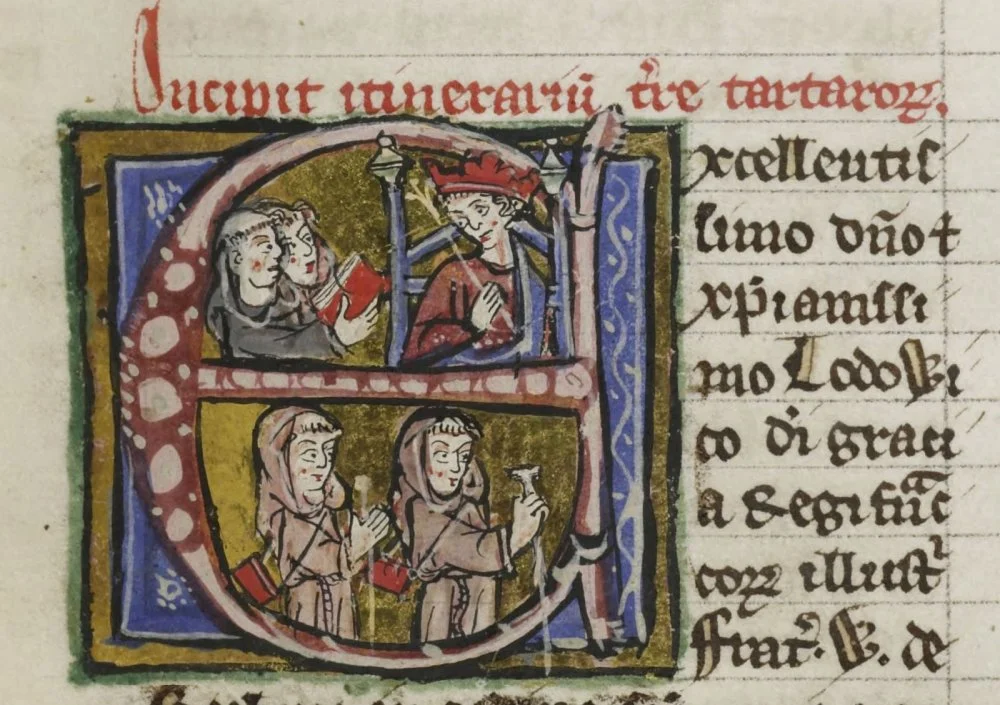
Top — William reports to King Louis IX; bottom — William travelling with a companion. Miniature from Corpus Christi College MS 66A, England, 13th century / Wikimedia Commons
The strong alliance between the two khans did not fall apart even after Batu’s death in 1255. Möngke exhibited special care for Batu’s descendants: he confirmed his sons Sartaq and Ulagchi on the khan’s throne, and later recognized the authority of Batu's brother Berke, ensuring the family line continued to hold power.
For his part, Batu, whose authority was unquestioned, consistently carried out Möngke’s orders during his lifetime. Thus, by decree of the Great Khan, he undertook western campaigns, advancing in battle as far as the borders of Albania. In this way, despite the nobility and honor that characterized the personal relationship between the two rulers, the state hierarchy was strictly observed in practice, with a clear division between central authority and regional governance.
The Struggle for Power in the Mongol Empire: Brother Against Brother
In 1259, Möngke, the Great Khan of the Mongol Empire, died during a military campaign in the province of Sichuan in southern China. His death marked the beginning of a prolonged internecine struggle for power between his brothers Kublai and Ariq Böke.
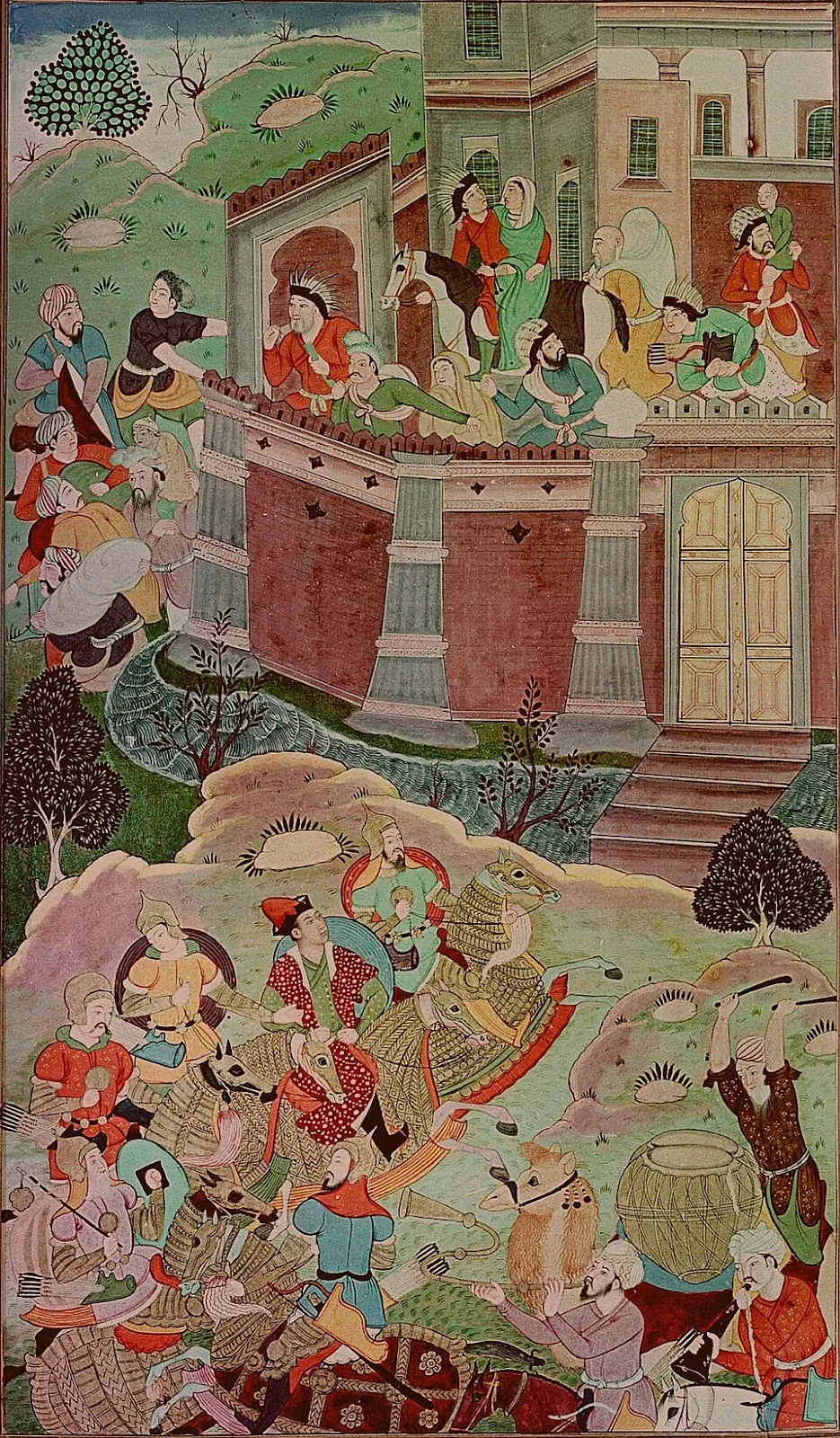
Miskin. Ariq Böke defeats Alghu. Miniature from the Mughal edition of Jāmiʿ al-tawārīkh by Rashid al-Din, India, 16th century / Wikimedia Commons
In March 1260, Kublai, relying on the support of nobles loyal to him, proclaimed himself Great Khan in the city of KaipingiKaiping was the original name of Xanadu (Shangdu), established by Kublai Khan in 1256 as the first capital of the Yuan Dynasty before later becoming the summer capital. His goal was ambitious: to transform the traditional Mongol social system and create a centralized feudal empire modeled on Chinese governance. However, in May of the same year, Ariq Böke, backed by his own supporters, had also declared himself Great Khan in Karakorum.
From that moment on, military force became the decisive factor in the power struggle. Kublai, skillfully mobilizing the vast resources of the conquered Chinese lands, dealt Ariq Böke a crushing defeat and retained the title of Great Khan.
In 1271, following Chinese political tradition, Kublai officially proclaimed the founding of the Yuan dynasty. The following year, he moved the capital from the old Mongol heartland of Karakorum to Beijing—then known as Khanbaliq, or Dadu. The transformation of the Mongol Empire into a Chinese-style dynasty was now complete.
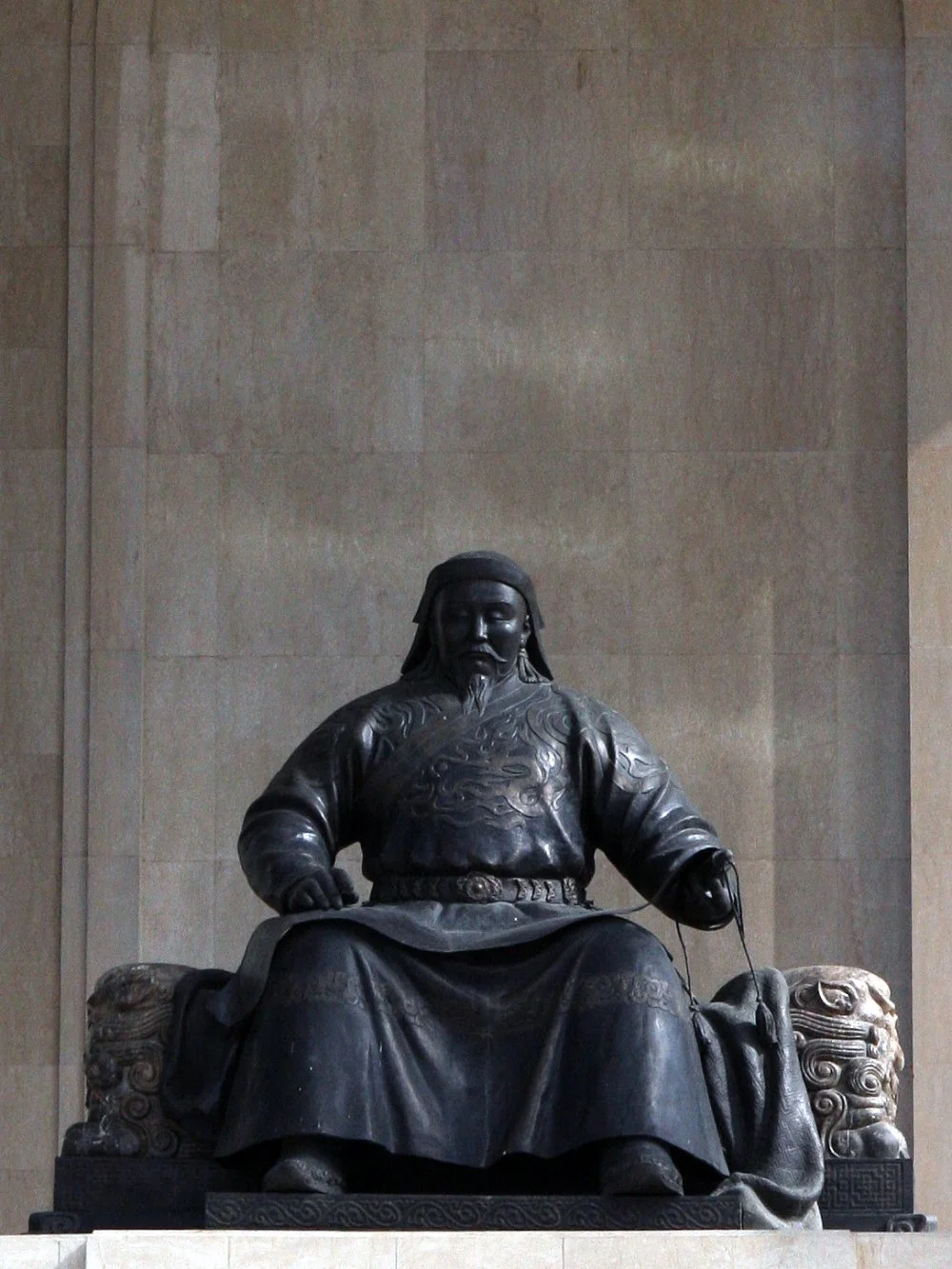
Statue of Kublai Khan. Sükhbaatar Square, Ulaanbaatar, Mongolia / Wikimedia Commons
Thus, in just a few years, the Great Mongol State was transformed into the Yuan Empire. This event irrevocably changed the history of the entire region. From that point on, Chinese historiography was compelled to recognize a new reality: the Yuan dynasty, founded by Kublai, a Mongol khan, as a legitimate continuation of China’s own dynastic tradition. Kublai, for his part, skillfully adopted Chinese law and used it to establish sole rule over the population of China. The conqueror had become the emperor.
It is important to note that at the height of the bitter internecine struggle between Kublai and Ariq Böke, Berke, the khan of the Golden Horde, sided with the latter. Even after the official proclamation of the Yuan Empire, Berke continued to support any efforts aimed at undermining Kublai’s authority. This indicated that the Golden Horde had already transformed into a sovereign state, no longer subject to either the imperial center or the Yuan dynasty. Indeed, after the kurultai of 1260, the Golden Horde was effectively regarded as an independent state.
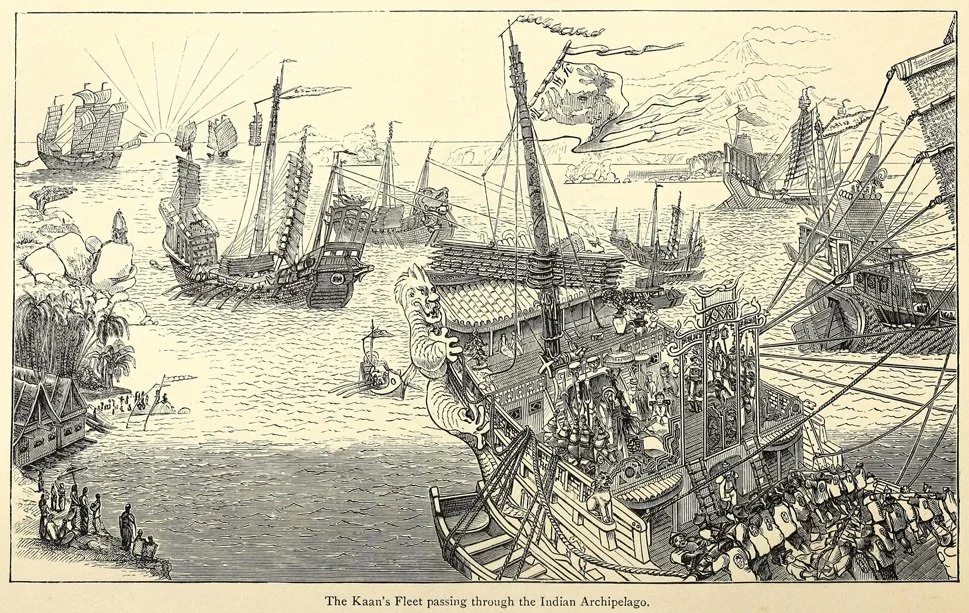
Henry Yule. Kublai Khan’s fleet passing through the Indian (Indonesian) Archipelago. Illustration from The Book of Ser Marco Polo, London, 1871 / Wikimedia Commons
In 1266, at the height of the war between the Golden Horde and the Ilkhanate (the Mongol state ruled by the descendants of Hulagu), Berke died, and his nephew Möngke-Temür ascended the throne. Upon coming to power, he continued the political course of his predecessor. Forming an alliance with Kaidu, a grandson of Ögedei who led the house of Ögedei and ruled the Chagatai Khanate, Möngke-Temür dealt a crushing defeat to Baraq Khan, the man Kublai had appointed to govern the Chagatai ulus in Transoxiana (the region between the Amu Darya and Syr Darya rivers).
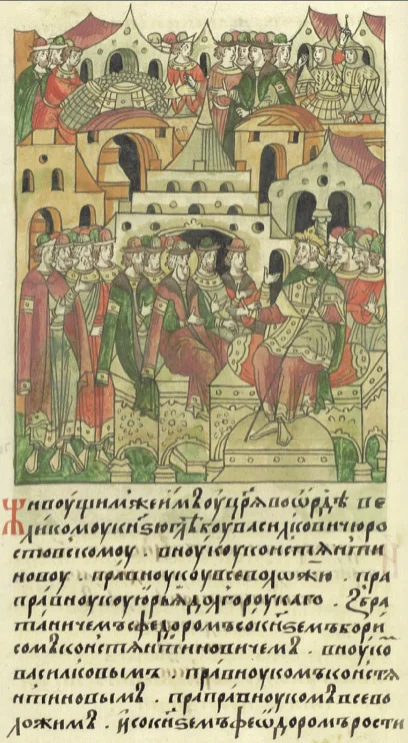
Mengu-Timur and Russian princes. Miniature from the Illustrated Chronicle Compilation, Russia, 1568 / Wikimedia Commons
In 1270, Kaidu, Berkechar, and Barak Khan convened a kurultai in Talas (Taraz) in southern Kazakhstan, at which the Great Khan Kublai was not present. At this assembly, a decision was made to divide Transoxiana: two-thirds of the territory went under Kaidu’s control and one-third to Baraq. In addition, a plan to undertake a joint military campaign against the Ilkhanate in Iran was also developed at this time. Through this, Möngke-Temür and Kaidu sought to undermine the alliance between the Hulaguids and the Yuan Empire, since both of those powers were ruled by descendants of Tolui, Chinggis Khan’s youngest son.
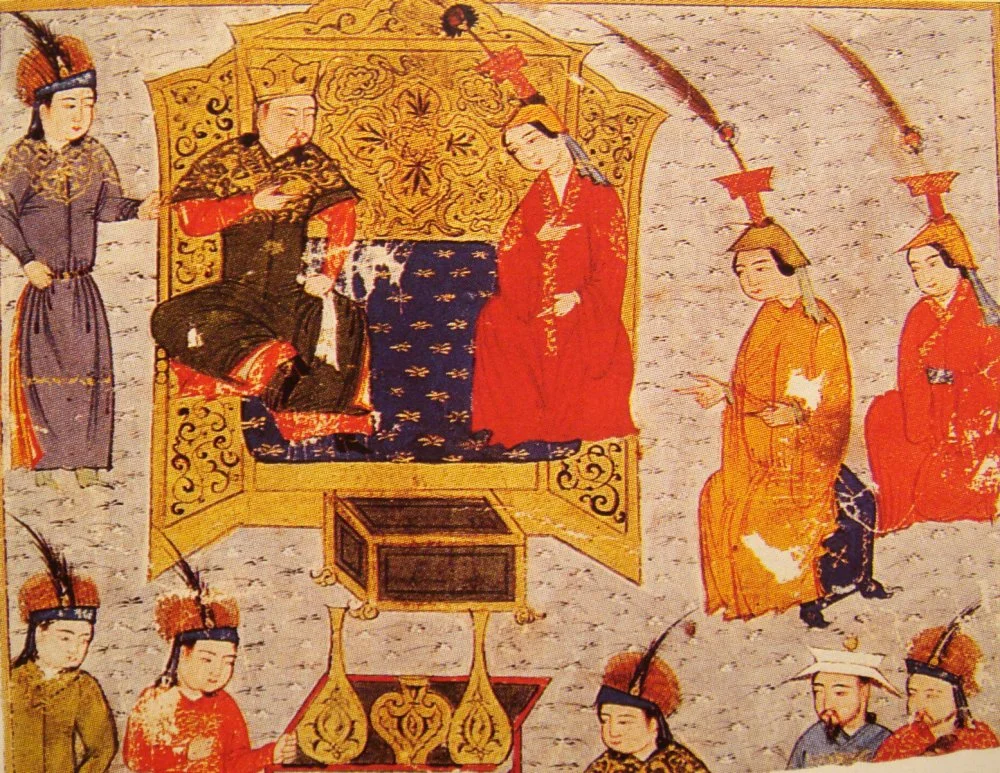
Tolui with Sorghaghtani Beki. Miniature from the manuscript Jāmiʿ al-tawārīkh, Persia, early 14th century / Wikimedia Commons
In essence, after these events, the era of peaceful coexistence between the houses of Jochi and Tolui came to a definitive end. Notably, during the reign of Möngke-Temür in the Golden Horde, the name of the Great Khan of the Mongol Empire disappeared from the coins of the Kipchak khans. This became yet another indication that the Golden Horde had fully freed itself from the political oversight of the Yuan Empire.
The internecine wars between Kublai and Ariq Böke became a clear signal of discord and division within the Altan Urag (meaning ‘the golden lineage’), the direct descendants of Chinggis Khan. At the same time, the Chagatai Khanate under Duwa and the house of the Ögedeids led by Kaidu were steadily strengthening their positions. Firmly established in Central Asia, they turned their attention eastward and intensified their struggle against the Yuan Empire. And the consequences were severe. The system of road routes and postal relay stations established under Ögedei was disrupted, leading to the decline of trade and cultural ties between East and West.
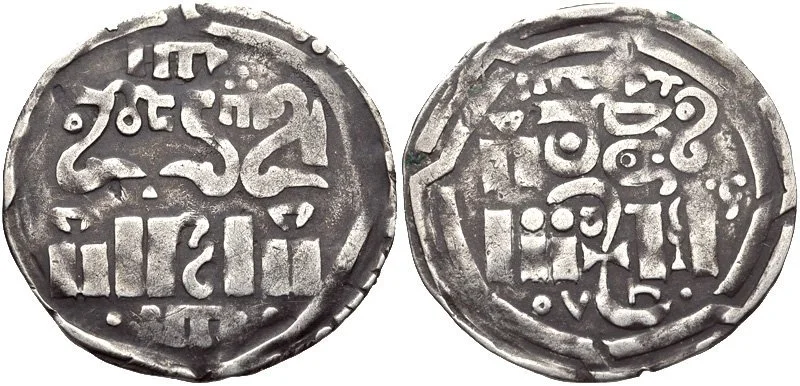
Coin of the Chaghatayid Khans, time of Qaidu. Samarqand mint, dated AH 685 (1285) / Wikimedia Commons
At the same time, two key aspects must be taken into account. First, there were no shared economic or political interests between the Golden Horde and the Yuan Empire that could have ensured that they stayed allies. The political trajectories of these states had completely diverged, and by the third generation, any familial ties between the ruling dynasties had completely lost their significance. As a result, open military clashes driven by conflicting interests became inevitable.
Second, the spiritual orientations of these states proved fundamentally opposed. Kublai built his system of governance on Chinese political canons and philosophical traditions, while the Mongol elite in China had adopted Lamaism (Tibetan Buddhism). In contrast, the Golden Horde went in a completely different direction, and the processes of Turkification and Islamization took a strong hold. Beginning with the reign of Berke, Islam spread widely throughout the state.
The deep divergence in their worldviews became increasingly evident, and the cultural and spiritual distance between these states only continued to widen with each passing decade.
The Ming Empire and the Timurids: From Diplomacy to War
In 1368, Zhu Yuanzhang—rising from a poor peasant orphan and Buddhist monk—as a result of a large-scale uprising, overthrew the Yuan Empire and proclaimed the founding of the Ming dynasty. However, the influence of the new dynasty on the west was limited to the region of Hami (or Kumul)iHami is an oasis city in eastern Xinjiang, a historic Silk Road hub and former capital of the Kumul Khanate., which prevented it from maintaining direct diplomatic contacts with the Golden Horde. As a result, between the fourteenth and fifteenth centuries, trade relations between China and Central Asia were concentrated primarily within the framework of interactions between the Ming dynasty and the Timurid Empire. Although these states represented two fundamentally different civilizations, both sides were compelled to establish contact due to pressing trade and economic interests.
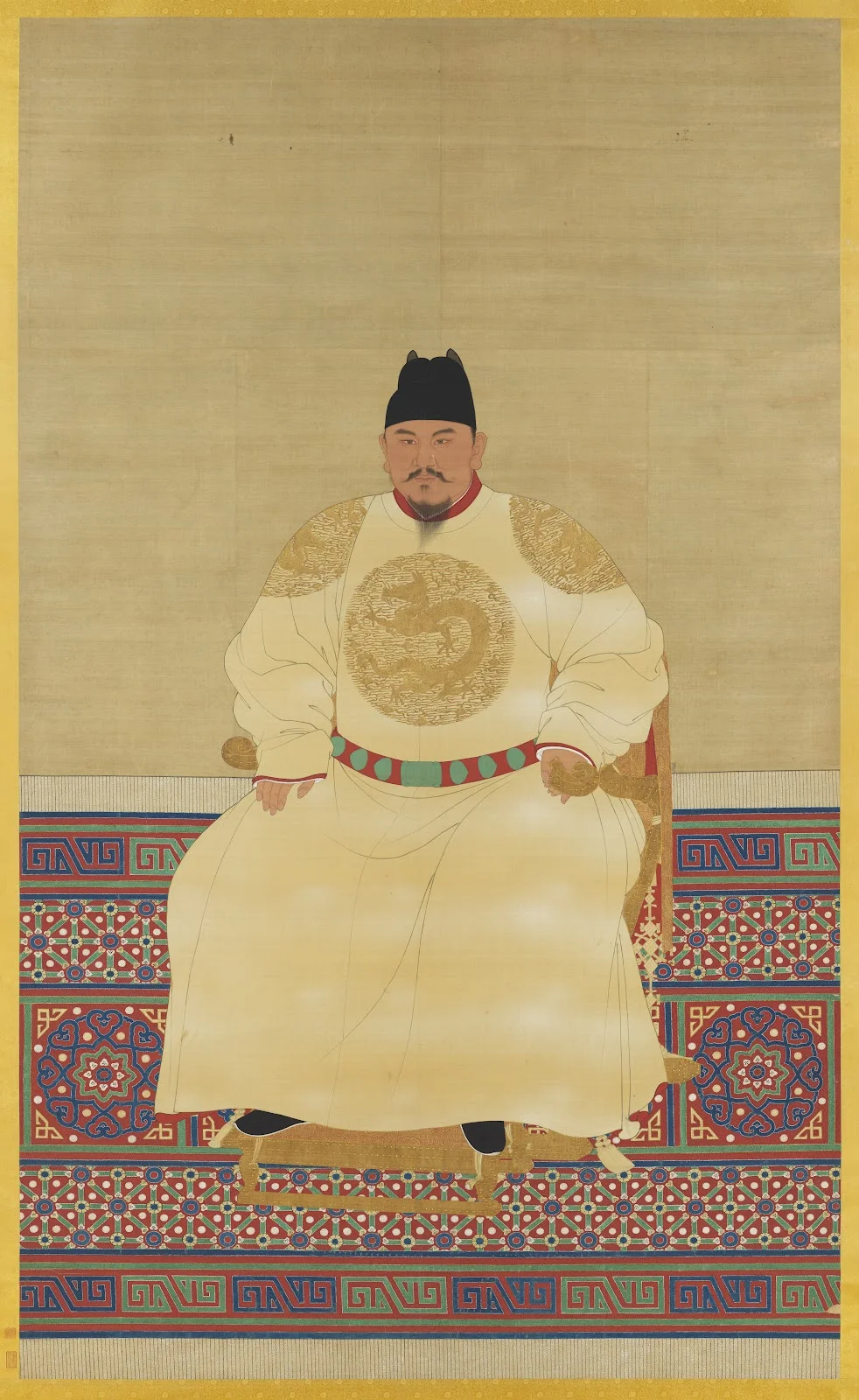
Seated portrait of the Hongwu Emperor (Zhu Yuanzhang), founder of the Ming dynasty. China, Ming dynasty (1368–1644), ink and color on silk. National Palace Museum, Taipei / Wikimedia Commons
Chinese empires of that period perceived the arrival of embassies from neighboring countries bearing gifts exclusively as a recognition of the emperor’s status as suzerain. In Chinese historiography, this phenomenon is known as the ‘chaogong system’ (In Chinese ‘chaogong tixi’), that is, a system of tributary dependence on China. Guided by this logic, the Ming dynasty repeatedly sent envoys to Amir Timur, demanding formal recognition of vassal status and the presentation of tribute.
Unwilling to accept such arrogance and not intending to bow his head, Amir Timur, after completing his Iranian campaign, sent an embassy to the Ming Empire for the first time in 1387 led by Mullah Hafiz. Chinese chronicles describe this event as follows:
In the middle of the Hongwu reign, Emperor Taizu (Zhu Yuanzhang), seeking to establish ties with the Western Regions, repeatedly dispatched envoys there with letters. However, no return missions came from that distant ruler. In September 1387 (the twentieth year of Hongwu), Timur, for the first time, sent an embassy led by the Muslim mullah Hafiz, presenting, as tribute, fifteen fine argamak horses and two camels. The envoys were received with great ceremony; each of them was granted 18 seriiA seri or liang was a silver ingot weighing 50 grams.. From then on, such embassies arrived annually, bringing horses and camels as gifts.
Historian Klara Khafizova explains that those fifteen argamak horses and two camels were indeed interpreted as ‘gifts sent by the Amir as an official offering’.
In September 1394, Amir Timur sent an embassy to the Ming Empire headed by Delbish, presenting 200 horses as a gift. Thereafter, he dispatched envoys for three consecutive years, with the number of horses offered increasing each year. In accordance with the diplomatic etiquette of ‘gift for gift’, the Ming Empire, in turn, sent monetary rewards and other valuable presents in response.
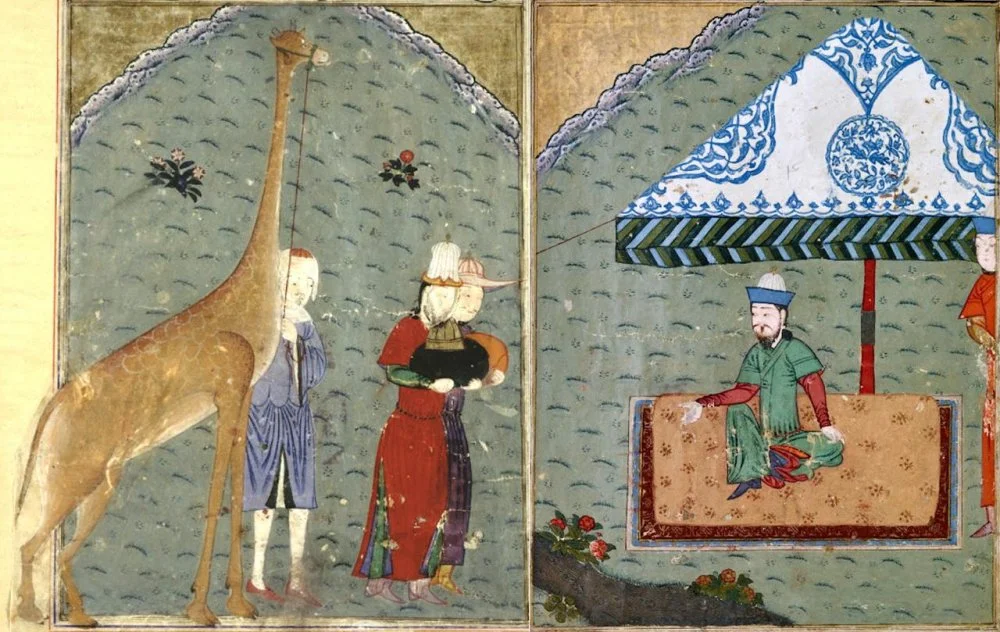
Ambassadors of the Egyptian Sultan presenting gifts, including a giraffe, to Timur. Miniature from the Zafarnama by Sharaf al-Din Yazdi, 1436. Johns Hopkins University Library / Wikimedia Commons
Interestingly, Chinese archives preserve a message from that period, purportedly written by Amir Timur. It is saturated with elaborate expressions of deference and recognition of the Chinese emperor as the supreme ruler:
Great Emperor of the Great Ming Empire! By the will of Heaven, you have united the four quarters of the world. The common people bask in your boundless grace, and myriad lands rejoice.
… Your radiance has spread to all horizons, illuminating the realm under Heaven like a mirror, and has brought all—both near and far—to your feet. Your humble servant, Timur, dwelling thousands of versts away on a distant frontier, has heard that your sacred benevolence surpasses the deeds of all your predecessors. An unprecedented fortune, never before granted since ancient times, has been bestowed upon you! Lands that once submitted to no one are now obedient to you.
Some historians explain such seemingly humiliating flattery on the part of Amir Timur toward the Ming emperor as an attempt to extract maximum benefit from frontier trade. However, these messages were, in fact, the product of a cunning scheme by merchants, who wrote in the rulers’ names for their own profit. The Ming emperor, believing them to be genuine, sent an embassy to Amir Timur in 1395 headed by court officials Fu An and Liu Wei to express gratitude for the ‘fulfillment of vassal duty’. However, enraged at being addressed as a subordinate, Timur ordered all the envoys imprisoned. Diplomats who arrived in 1397 were similarly taken captive and denied the right to return to their homeland.
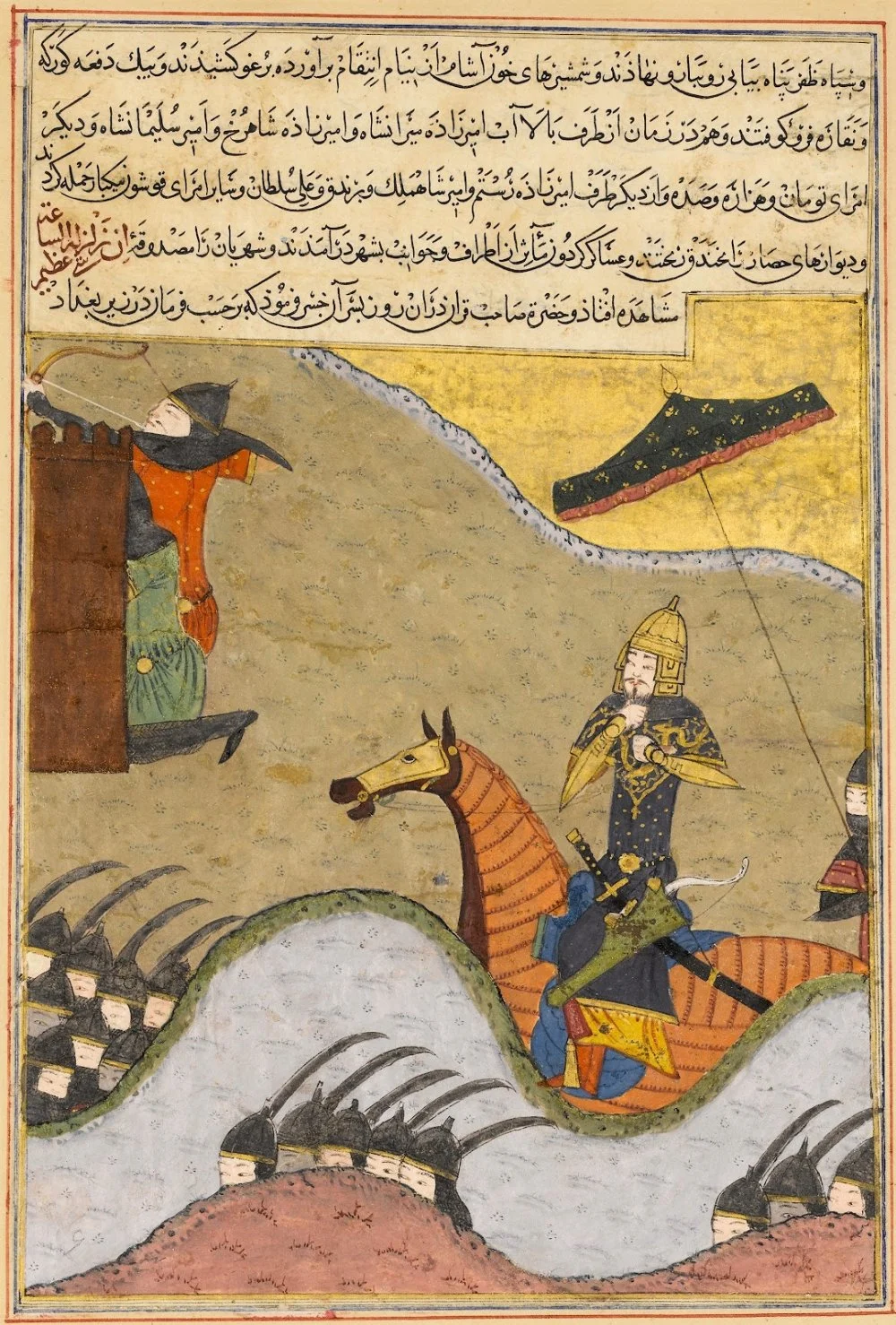
Conquest of Baghdad by Timur. Miniature from the manuscript Zafarnama by Sharaf al-Din Yazdi, Shiraz, 1435–1436. Metropolitan Museum of Art, New York / Wikimedia Commons
Yongle, the new Ming emperor on the imperial throne, demanded that Timur release the captured envoys. However, Amir Timur not only continued to hold them as hostages but also sent his own agents, disguised as merchants, into the Ming Empire. His aim was to conduct a detailed assessment of the internal situation, geographical conditions, and the state of the roads in preparation for a full-scale military campaign against China. Nevertheless, the Ming Empire managed to anticipate these intentions. In 1404, by the time Amir Timur set out on a campaign at the head of a 200,000-strong army, Emperor Zhu Di (Yongle) had already taken action. He ordered General Sun Cheng in the province of Gansu to place his troops on combat alert, warning that the enemy would advance via Beshbalyk [15]. The stage was set for a massive confrontation—but it would never take place.
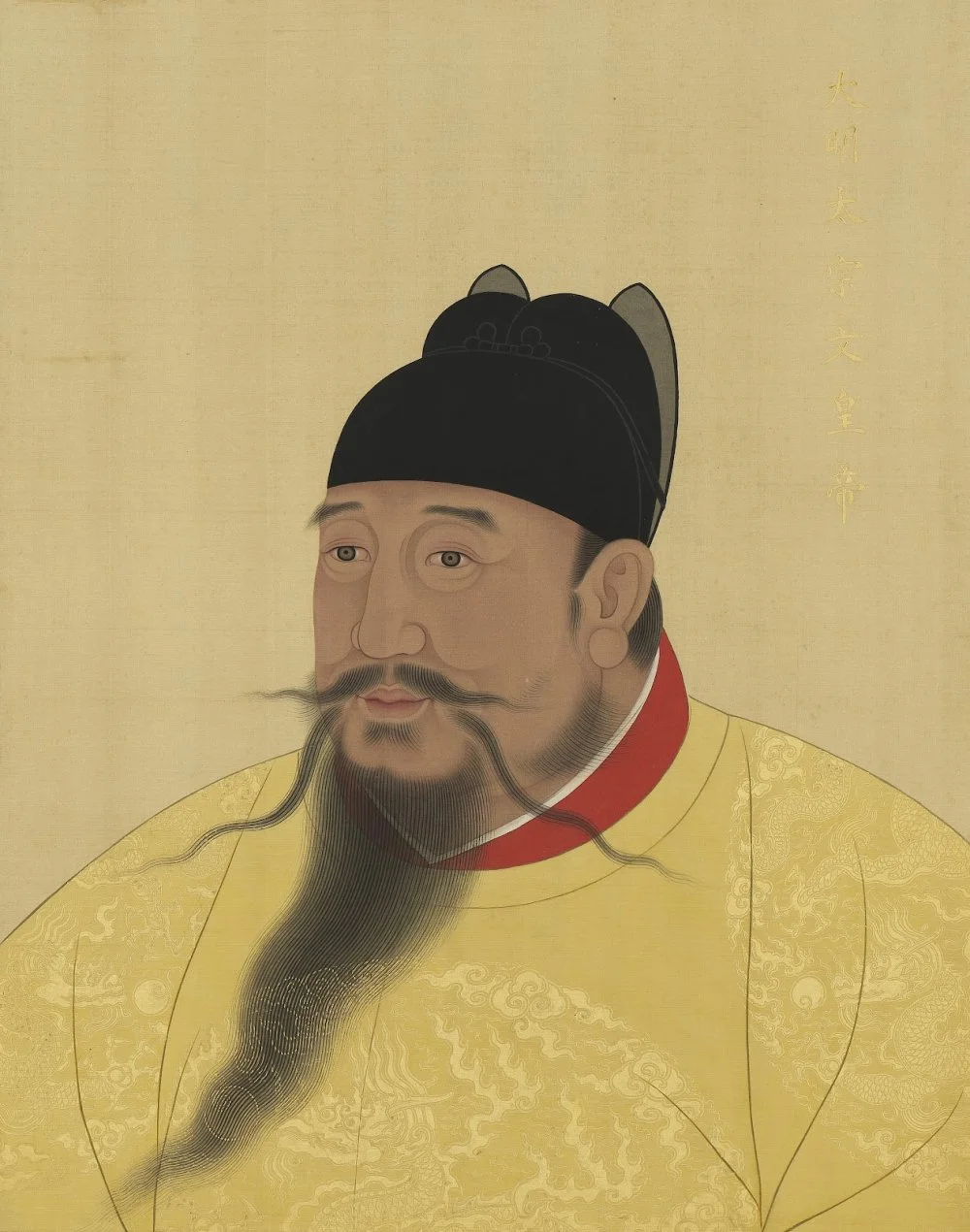
Unknown artist. Portrait of the Yongle Emperor (Zhu Di), third emperor of the Ming dynasty. China, Ming dynasty (1368–1644). National Palace Museum, Taipei / Wikimedia Commons
The sudden death of Amir Timur on the march halted the course of events and prevented an inevitable war. After his death, relations with the Ming Empire entered a new phase. Chinese chronicles describe this period as follows:
After Timur’s death, power was inherited by his grandson Khalil Sultan (Mirza Khalil). He sent his vizier, Kushidu, and other close associates to escort Fu An (who had spent many years in Timur’s captivity) back to China and presented the emperor with gifts of local manufacture. The emperor generously rewarded them and dispatched the military commander Beiyarshintai to Khalil Sultan with an official expression of condolences, sending silver coins for him and his subjects.
… Fu An and his retinue returned to their homeland after seven years; together with them arrived Timurid envoys bearing rich gifts. From that time on, diplomatic missions became regular: they arrived annually, every two years, or every three years. In 1415 (the thirteenth year of the Yongle reign), Timurid envoys arrived, accompanied by Li Da and Chen Cheng. Upon their return, the emperor ordered Chen Cheng and Fu An to set out again with them as a return embassy.
At the same time, Shahrukh, the younger son of Amir Timur who ruled in Khorasan, sent an embassy to the Ming Empire with rich gifts, thereby restoring trade relations with the Yongle Emperor. According to historical chronicles, between 1407 and 1524, a total of twenty official delegations arrived in the Ming Empire from Timurid territories. The envoys traditionally brought pedigree horses, camels, and sheep, receiving in return silk fabrics, clothing, and paper money intended exclusively for the purchase of local goods.
However, the regular exchange of embassies and mutual presentation of gifts did not necessarily indicate the establishment of lasting and genuine peace. Full diplomatic relations never developed into a stable form. In essence, this ‘exchange of courtesies’ remained merely a form of distant and carefully polite mutual observation.
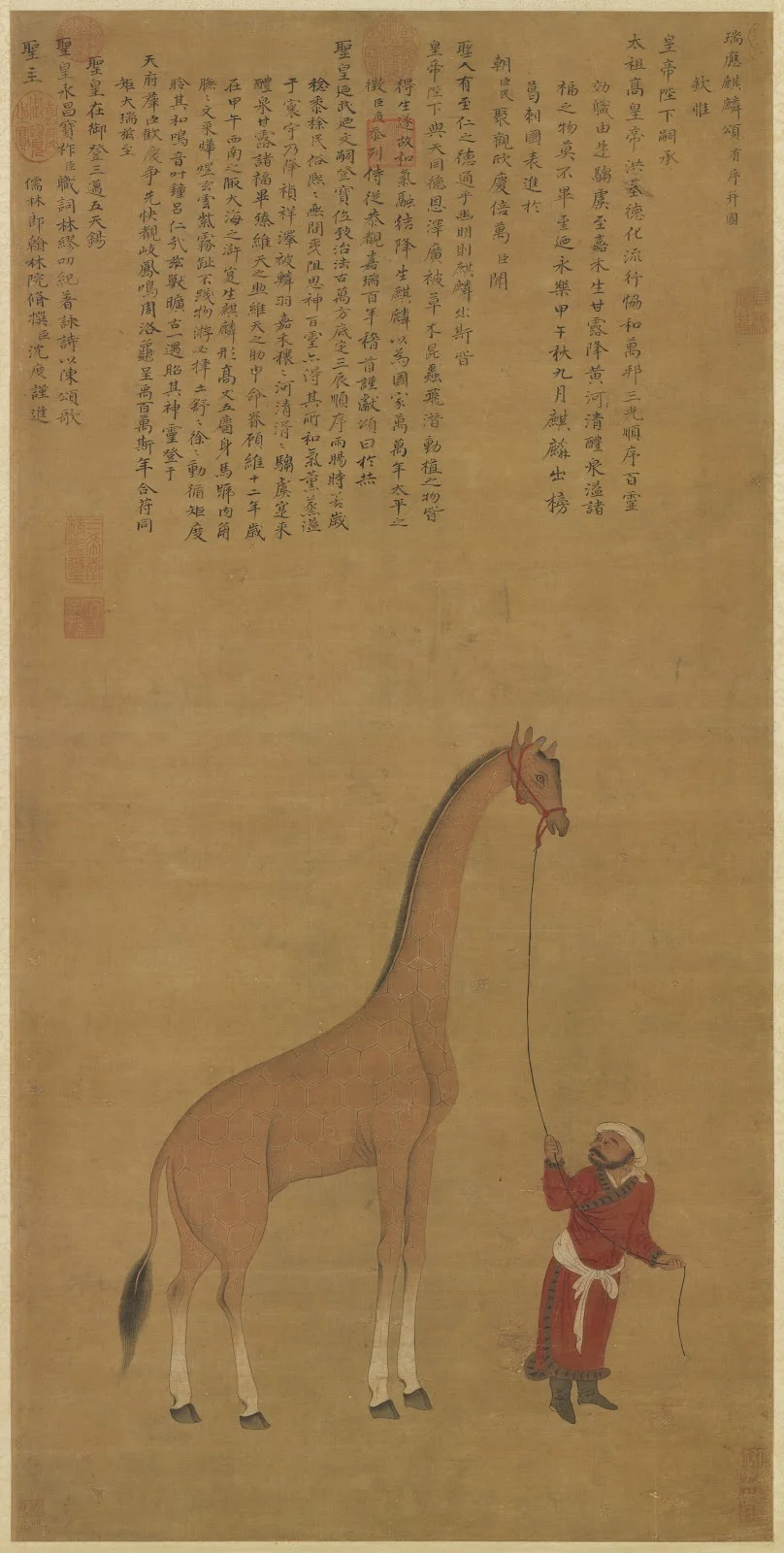
Giraffe brought from Bengal during Zheng He’s voyages. Painting by Shen Du, 15th century. Palace Museum, Beijing / Wikimedia Commons
From Imperial Ambitions to Economic Constraints
Over time, the grandiose chaogong system, although aligned with the long-term political ambitions of the Ming Empire, became an unbearable burden from an economic perspective. The diplomatic doctrine of bo lai hou wang, or ‘giving far more than one receives’, literally drained the state treasury, provoking a deep financial crisis. Eventually, Beijing was forced to sharply reduce its diplomatic expenditures. In June 1547, Yang Bo, the governor of Gansu province, submitted a memorial to the emperor stating:
The flow of petitioners from the Western Regions arriving under the guise of tribute-bearing missions has become excessive—their number must be strictly limited.
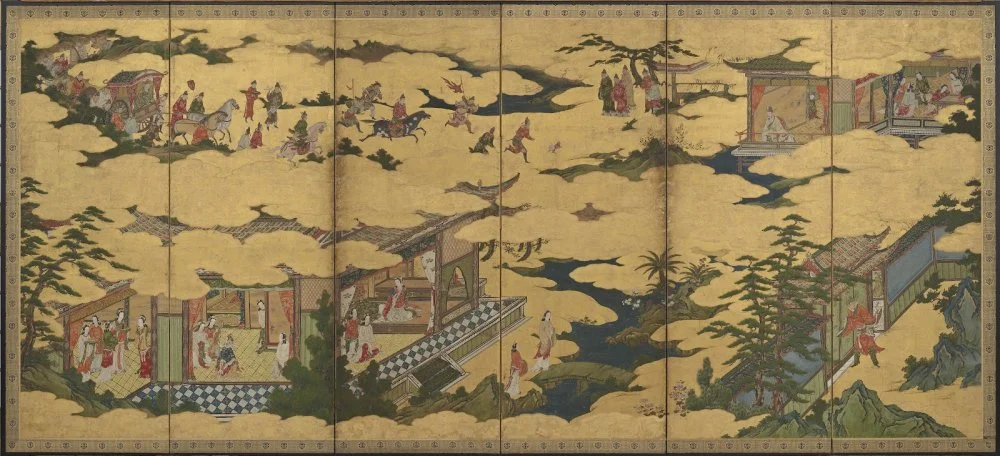
Scenes from the life of Emperor Minghuang (Xuanzong) and Yang Guifei. Japanese folding screens inspired by the poem Song of Everlasting Sorrow, Momoyama period, late 16th–early 17th century / Getty Images
Supporting this initiative, the Ministry of Rites (known in Chinese as Lǐbù) presented its recommendations to the emperor:
Throughout the reign of seven generations of emperors, only Kumul [Hami] was permitted to bring tribute annually. Its delegation numbered up to 300 people, of whom only 11 were allowed to enter Beijing, while the rest remained in a garrison beyond the Great Wall under full state support. Henceforth, if missions from such states as Herat, Kasan, Turfan, Arabia, and Samarkand pass through Kumul, they are permitted to bring tribute only once every three to five years, and the size of each embassy must not exceed thirty to fifty people. All others must be subjected to the same strict rules established for Kumul. It is unacceptable to allow unrestricted entry into the capital for all who wish to come. Frontier officials are instructed to strictly enforce these regulations and to impose severe punishment for any violations.
The imperial court approved the proposal of the Ministry of Rites, after which the chaogong system officially ceased to exist. However, over time, this led to the gradual winding down of official trade relations between the Ming Empire and the Central Asian states.
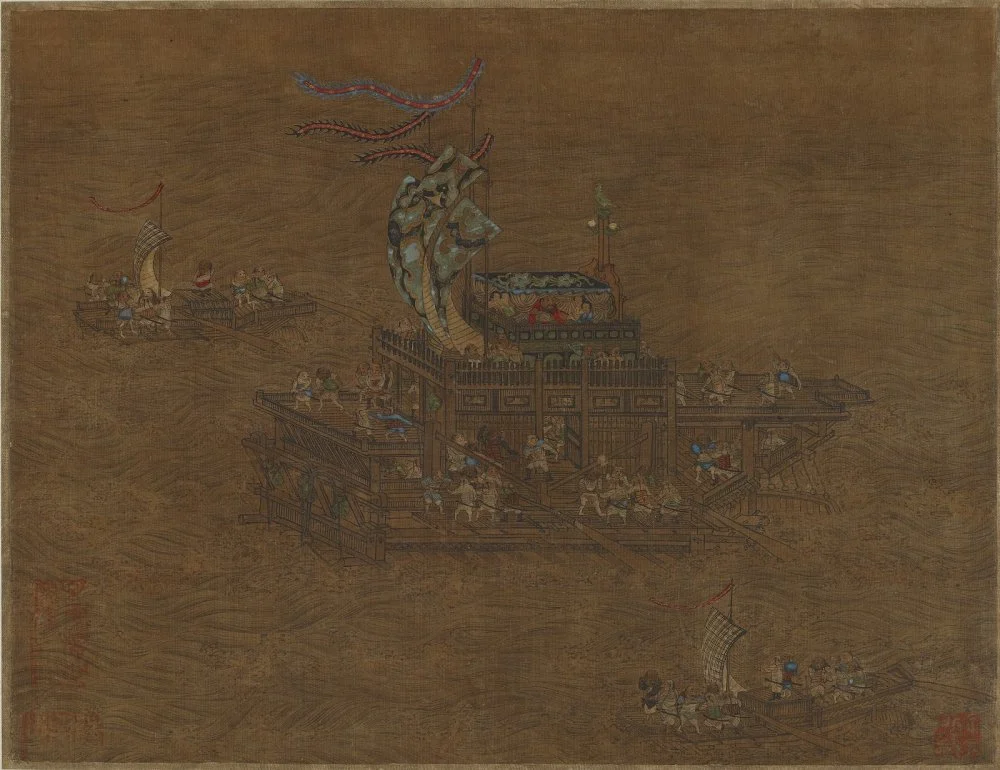
A royal barge at sea. China, Ming or Qing dynasty, 16th–17th century / Getty Images
Ultimately, the political and economic relations between the aforementioned dynasties and great empires underwent a series of complex historical transformations. Although their political trajectories often diverged, the parties remained significantly interdependent in the sphere of trade and economics. For this reason, over the course of three centuries—despite the collapse of empires, changes in ruling dynasties, and the restructuring of systems of power—connections between China and Central Asia were never interrupted but rather transformed, taking on various forms.
