For many young Kazakhs, Shamshi Kaldayakov (1930–1992) is first and foremost the man behind the national anthem. But for the older generation, he was the people’s composer, whose songs resonated and were performed in every corner of the country. Though he received official recognition and the title of ‘People’s Artist of Kazakhstan’ only at the very end of his life, Kaldayakov remained forever the ‘sun’ of Kazakh song, which is the literal meaning of his name, Shämşi. In this piece, researcher Leora Eisenberg shares exclusive insights with Qalam about Kaldayakov’s music and his difficult path toward the nation’s enduring love.
Ideology, 'Soviet Taste', and the Work of Shamshi Kaldayakov
In the late 1950s and early 1960s, when Shamshi Kaldayakov was just beginning his musical career, his work was regularly subjected to criticism from composers and musicologists. Working within the strict artistic standards of the Soviet era, some saw his music as the embodiment of poor taste and a violation of compositional principles.
Lyrics and music of the song “Ana turaly zhyr.” Culture and Everyday Life magazine, May 1962 / National Library of the Republic of Kazakhstan
At a 1963 meeting of the Committee for Radio and Television of the Kazakh Soviet Socialist Republic (Kazakh SSR), the eminent Kazakhstani composer Kuddus Kuzhamyarov, the creator of the opera Nazugum and the ballet Chin-Tomur, expressed his displeasure at the growing number of pop songs written by young composers like Kaldayakov, saying, ‘I believe that not every Kazakh song can be performed in the popular genrei
Kuzhamyarov himself championed a more formal style of music, the type that, in his view, was 'suitable for the stage' when performed by the newly founded pop-symphonic orchestra of the Committee for Radio and Television, established only in 1959. In his opinion, neither Kaldayakov nor his like-minded colleagues composed music that fit this standard. He said:
Very often, you hear the same songs by young composers on the radio, like . . . Kaldayakov . . . They absolutely need proper training—this is the root of the problem in the Committee’s orchestra. It’s alarming when young people don’t understand professional music.
On the one hand, Kaldayakov and other young composers were often criticized both for their 'unprofessional' music and for their 'illiteracy', accusations that carried the implication that they were merely 'amateurs' who lacked a ‘complete’ musical education. And indeed, Kaldayakov, who received his musical training at the Hamza College in Tashkent, never completed his studies at the Kurmangazy State Conservatory in Alma-Ata (now Almaty), where he had enrolled in 1956. The composer was expelled, allegedly for ‘incorrect harmony’.
Renowned composers of Kazakhstan, Merited Artists of the Kazakh SSR. 1963 / CSAFPS RK
On the other hand, Kaldayakov was also scolded for the growing popularity of this same 'amateur' and 'unprofessional' music, with critics claiming that it supposedly corrupted listeners' taste. At the same time, Soviet culture was being shaped by the ideological principle that Kazakhstani composers—like all Soviet composers—were expected to nurture and elevate the public’s taste. This idea originated at the First All-Union Congress of Soviet Writers in 1934, where Andrei Zhdanov, the secretary of the Central Committee for Ideology, quoted Stalin’s famous phrase calling writers 'engineers of human souls'. Composers, too, were expected to serve this ideological mission, and Kaldayakov’s accessible, emotionally direct music did not fit that mold.
By the early 1960s, during Khrushchev’s Thawi
Speech by Nikita S. Khrushchev, General Secretary of the CPSU Central Committee, at the Dynamo Stadium on the occasion of the 40th anniversary of the Kazakh Republic. 1962 / CSAFPS RK
In all these discussions, any criticisms of Kaldayakov’s professionalism were always paired with recognition of his growing popularity. For example, at the plenum of young composers of Kazakhstan in December 1963, one participant lamented: 'If we do not take mass genres under our control, very soon no one will listen to our operas, symphonies, or oratorios, because the public will become accustomed to the banality and lightness of mass art and will regard the songs of Espayevi
Plenary session of young composers. 1963 / CSAFPS RK
In 1965, composer and musicologist Vladimir Messman expressed a similar view during a discussion of CRT radio programs covering the first three months of that year:
At present, the works of composer Kaldayakov and other untrained musicians are being broadcast. Their compositions have no commonalities with other musical works . . . The music was written for the most backward tastes. It corrupts the listeners’ sense of tastei
The Star of Kazakh Radio
However, criticism of Kaldayakov’s music by representatives of state cultural institutions did not affect its popularity or the frequency of its radio airplay. At that time in the USSR, the opportunity to listen to a song at home was very limited, and to hear a favorite melody, one had to write a letter to the music editorial office of the Committee for Radio and Television to request that it be aired.
General view of the workshop of the Alma-Ata radio center. 1967 / CSAFPS RK
At a meeting in 1965i
The well-known music editor and composer Omirbek Baydildaev agreed with him, adding that in a single program, Kaldayakov’s songs were played four times. However, another participant in the meeting, a certain comrade Pankratova, openly acknowledged the inevitable rise in the popularity of the young composer, albeit expressed in the characteristic Soviet bureaucratic language:
His rather banal music permeates your ears and stays there; it’s very memorable. When there isn’t enough good music, we often receive requests to play Kaldayakov’s songs. I like his songs too. And if we don’t broadcast Kaldayakov—then what are we supposed to broadcasti
Kaldayakov vs. the Union of Composers
The ambivalent Soviet attitude toward Kaldayakov’s music—and pop songs in general—in the 1960s was partly due to the fact that almost all musicians of that era received roughly the same classical European musical education. Such training was hard to reconcile with song-based genres and pop-style performances.
Meeting of young composers of Kazakhstan — F. Mansurov, Bychkov, G. Zhubanova, soloist Evgeny Kogan. 1963 / CSAFPS RK
A soloist from a pop-symphonic orchestra explained it this way: 'When a composer has a solid academic background, he naturally thinks in the way that he was taught—to write symphonies, to write sonatas. But songs require a completely different way of thinking.' The fact is that Soviet music schools simply did not teach this kind of thinking.
Composer Mynzhasar Mangitaev, a contemporary of Kaldayakov, put it this way:
'At that time, the song genre wasn’t considered important. Most classically trained composers of “large forms” simply couldn’t write in a popular music style.'
At a 1963 Committee for Radio and Television meeting, the composer Gaziza Zhubanovai
In the same interview, Mangitaev noted that during the Soviet period, official musical organizations paid almost no attention to Shamshi Kaldayakov or to other pop composers, such as Ablakhat Espayev and Aset Veyseuovi
The paradox was evident: these composers hadn’t received a 'large-form' compositional education and were instead being trained in conducting, choral work, piano, or other disciplines—sometimes incompletely—and it was precisely this that enabled them to create the popular songs beloved by the people. Yet that same training, combined with their chosen genre, excluded them from joining the Union of Composersi
Shamshi Kaldayakov (6th from left) during a trip to the city of Shymkent. 1994 / CSAFPS RK
The official rule was straightforward: to become a member of the Union of Soviet Composers of Kazakhstan (abbreviated as the SSKK), a composer had to have formal compositional training and produce a work of so-called 'large form'—an opera, symphony, ballet, or similar composition. Without both, membership was out of the question. Exceptions were rare; one notable case was Muslim Magomayev, who was admitted to the Union of Composers of the USSR without formal compositional training.
In the Kazakh SSR, however, the rules were strictly enforced by the composers themselves. On this topic, in 1989, a listener named G. Orazaliyeva wrote the following in the newspaper Ortalyq Qazaqstan:
Once, our elder, Academician Akhmet Zhubanov, said, to become a member of the Union of Composers, you must graduate from a conservatory’s composition faculty. If not, you are an amateur composer . . . Even Shamshi Kaldayakov, Ilyas Zhakhanshev, and Kenes Duisekeev, whose songs became known throughout the country . . . are not members of the Union. Yet in the Union, there are those whose songs no one sings and whose names no one knowsi
Shamshi Kaldayakov’s elder brother, Kösherbai Kaldayakov, wrote that Kaldayakov himself was somewhat upset by this situation:
'Probably, deep down, he felt it, like any sensitive creator would. He had composed so many songs, yet wasn’t immediately recognized. However, he never shared these feelings with us; he kept them frozen inside.'
Ablakhat Espayev, the well-known pop composer and creator of many famous songs and romances, even dedicated a poem to Kaldayakov after yet another rejection of his application to join the Union of Composers:
Біз қазақ ежелден еркіндік аңсаған,
Худсовет шықты да, тәуелді болдық жан.
Союздан мүше болмасаң—ең жалған,
Талай сөз естисің, тура-тура, сен білейi
A Kazakh Song in the Rhythm of a Waltz
Despite all the difficulties that he faced with the Union of Composers, Kaldayakov managed to win the public’s affection fairly quickly. During the years in which he was popular, the Kazakhs were a minority in the republic, comprising 32.6 per cent of the population in 1970. At that time, it was not always easy for Kazakh-speaking listeners to find Kazakh music, or in modern terms, ‘Kazakh-language content’.
Streets of Almaty in 1969 / Getty Images
For example, at a 1972 radio listeners’ conference held by the Committee for Radio and Television at the M.I. Kalinin Lead Plant in Shymkent, many participants complained that Kazakh songs were broadcast very rarely on the radio. Mukhametzhan Karmanov, head of the lead smelting section, stated:
There is very little time for Kazakh concerts. A concert is labeled ‘Kazakh’ and included in the program, but in reality it offers a mix of everything, with only one Kazakh song or dancei
After a reporting trip to the Caucasus in 1965, a Committee for Radio and Television employee wrote:
When our colleagues looked at our television lineup, they pointed out how little Kazakh national music there was and asked why Kazakh motifs were missing. And their criticism was justified—the Russian language predominated in our programming.
Live broadcast at the Alma-Ata television studio. 1960 / CSAFPS RK
Yet listeners loved Shamshi Kaldayakov’s songs precisely because, by their nature, they were authentically Kazakh, and the composer did not seek all-Union fame. As the Soviet music ideologist V. Messman noted at the time: ‘It is no coincidence that neither Kaldayakov nor Zhamakaevi
And this was not because Kaldayakov’s work did not deserve all-Union attention: he was a composer of exceptional musicality and rare talent. Rather, Kaldayakov sought the love of his own people, who, at that time, did not form the demographic majority in their own republic. The composer listened to the wishes of ordinary people, voiced, among others, by the above-mentioned head of the lead smelting section, Karmanov.
Songs by Shamshi Kaldayakov / Open sources
According to Mukhtar Kaldayakov, Shamshi Kaldayakov’s son, the composer’s work 'was based on a solid understanding of the traditions of our culture and Kazakh song', which most likely resonated with Kazakh-speaking audiencesi
Musicologist Umitzhan Dzhumakova also highlights how Kaldayakov’s music is deeply rooted in both folk motifs and popular international music trends. She says:
In Kaldayakov’s songs, which are directly connected to folk songwriting traditions, modern dance rhythms—tango, Boston waltz—are clearly expressed, rhythms entirely foreign to their own culture. The combination of these traditions gave Shamshi Kaldayakov’s songs such originality and novelty that the listener’s attention would ‘slip past’ the familiar, the ‘native’i
It is for this reason that Kaldayakov’s music is considered simultaneously 'European' (due to its waltz rhythms) and 'Kazakh' (in terms of its sound and meaning).
“Menin Qazaqstanym,” music by composer Shamshi Kaldayakov to the lyrics of Zhumeken Nazhimedenov (1956) and Nursultan Nazarbayev (2005) / Wikimedia Commons
'My Kazakhstan'
It was precisely this combination of careful attention to Kazakh musical culture and openness to global musical trends that prompted Kaldayakov to compose ‘Menin Qazaqstanym’, which later became the national anthem of Kazakhstan. He wrote the music as early as 1956, and according to one account, the piece emerged as a subtle protest against Nikita Khrushchev’s proposal to transfer parts of northern Kazakhstan to the Russian Soviet Federative Socialist Republic (RSFSR)i
Later, Shamshi Kaldayakov recalled:
The people were outraged. It was during such a time that we wrote the song ‘My Kazakhstan’ as our call to action. The lyrics were penned by the talented poet Jumeken Najimedenov . . . Jamal-apai (Omarova) quickly learned the song and went straight to the radio to perform it. We asked the radio staff to play it several times a dayi
Later, the singer Zhamal Omarova would be called a 'nationalist' for her participation in creating the song, but she proudly objected: 'I am a patriot!'i
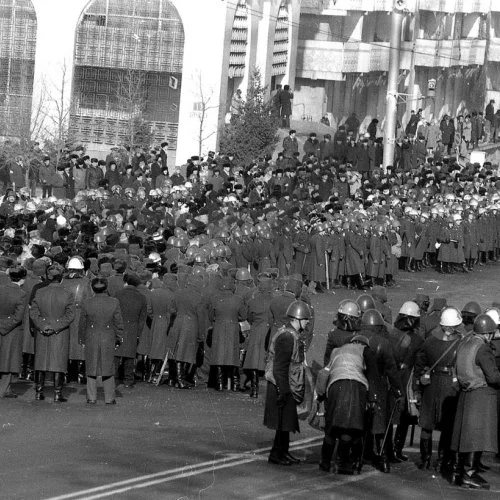
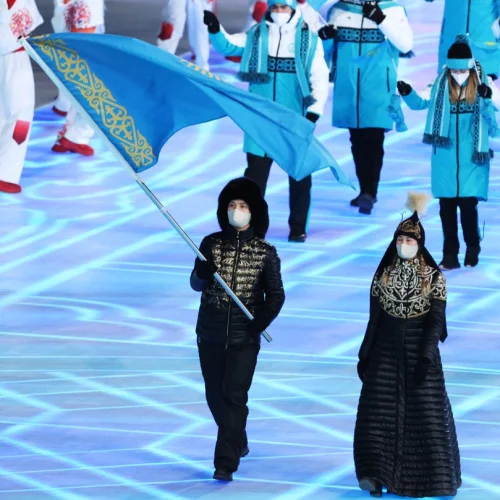
This song would come to be truly embraced by the people of Kazakhstan. In December 1986, it was sung by protesters opposing the appointment of Gennady Kolbin as First Secretary of the Central Committee of the Kazakh Soviet Socialist Republic (Kazakh SSR). In 2006, half a century after it was written, ‘Menin Qazaqstanym’ became the official anthem of the Republic of Kazakhstan.
Zhamal Omarova — People’s Artist of the Kazakh SSR. 1958 / CSAFPS RK
Shamshi Kaldayakov endured harsh criticism from the ideological machine, humiliation, and closed doors, yet his songs found the most reliable path to immortality—into the hearts of the people. He wrote for those who had no voice, and that is why his melodies quickly became part of the collective memory and shared hope. Today, one thing is clear: the love of the people proved stronger than any barrier, and the light he kindled with his songs continues to illuminate the Kazakh people’s hearts.