
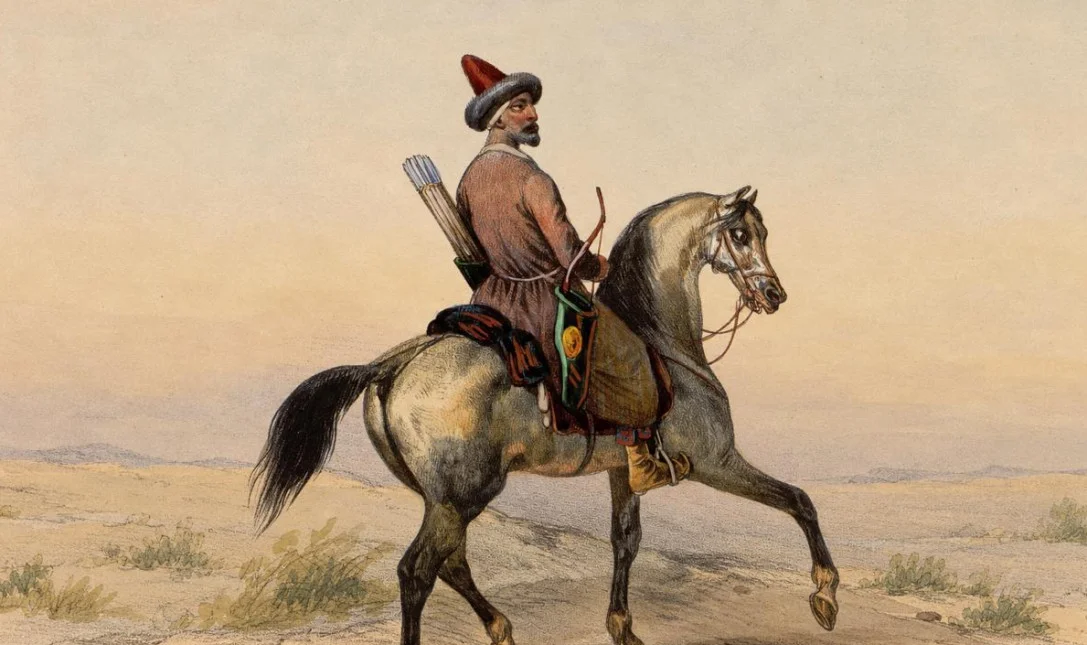
The Nogai Horde, a nomadic state that ruled the steppe north of the Caspian Sea from the fifteenth to the early seventeenth century, is one of the most underappreciated chapters in the history of the Great Steppe and the Kazakh Khanate. The Nogais are usually discussed in the context of their confrontation with Qasym Khani Qasym Khan was a ruler of the Kazakh Khanate in the early sixteenth century, when the khanate reached its greatest territorial extent. or their brief and unsuccessful struggle against the KalmyksiThe Kalmyks are a western Mongol (Oirat) people who migrated from Dzungaria to the Lower Volga region in the early seventeenth century, displacing the Nogais from much of their pastureland.. Yet much about the history of this state remains unknown. Why did non-Chinggisid leaders—men not descended from Chinggis Khan—rule the Nogai Horde? What did the Kazakhs and Nogais have in common? And where do the Nogais live today? In an exclusive interview for Qalam History, our YouTube channel, historian Yernar Uzhkenov answers these and other intriguing questions.
How Did the Nogai Horde Emerge?
Following the collapse of the Golden HordeiThe Golden Horde was the Mongol state founded in the 1240s by Batu Khan, Chinggis Khan’s grandson, which ruled the steppe from Eastern Europe to western Siberia., the Nogai Horde quickly emerged as a separate political entity. The key factor was the political standing of the Manghits, the most influential ruling tribe. The Manghit ulus (the people and lands under a ruler) was regarded as one of the most powerful tribal groupings. Its gradual emergence as a distinct political force had already begun under EdiguiEdigu was a Manghit emir and military commander who dominated the Golden Horde from the late 1390s, ruling through puppet khans because he was not Chinggisid., the de facto founder of the Nogai ulus.
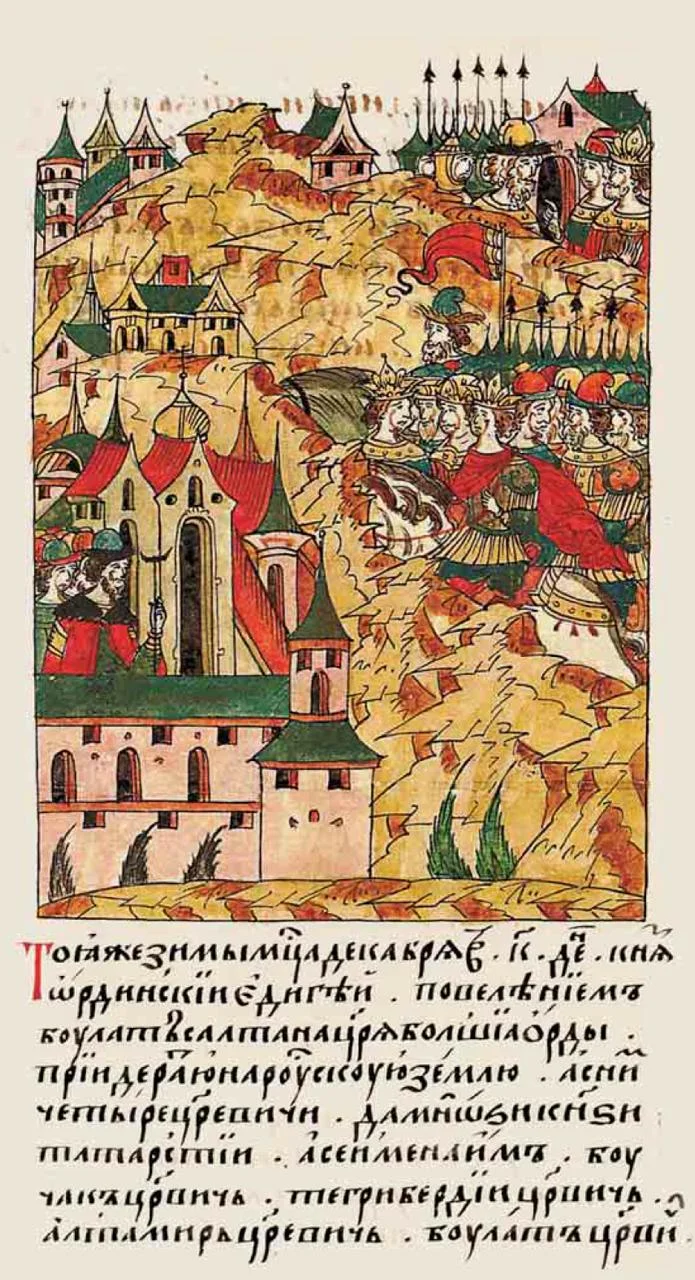
Edigu’s Invasion of Rus’ in 1408. Miniature from the Illustrated Chronicle of Ivan the Terrible. 16th century / Wikimedia Commons
Edigu clashed with the Chinggisids of the Golden Horde, particularly our khan, TokhtamyshiTokhtamysh was a Chinggisid khan who reunited the Golden Horde around 1380 but was overthrown after his defeats by Timur in the 1390s., and defeated him with Timur’s supportiTimur was a Turco-Mongol conqueror from Transoxiana who founded the Timurid Empire and led campaigns from Anatolia to northern India.. But one factor proved decisive: Edigu himself was not a Chinggisid. Because his legitimacy rested solely on his personal authority, he relied on puppet khans from the Chinggisid lineage to exercise nominal rule in his name.
In a sense, Edigu was our medieval ‘kingmaker’. Rather than concentrating his efforts on preserving the vast Golden Horde as a whole, he focused on securing his power in a specific region—the Lower Volga and the lands along the Ural River. It was there that the Nogai Horde emerged.
In 1392, Edigu was already an independent ruler. However, the process by which the Nogai Horde separated from the broader political and cultural sphere of the Golden Horde took considerably longer. Only Edigu’s successor, the biy (judge or tribal leader) Musa, completed this separation. Musa can be regarded as the true founder of the ethnonym ‘Nogais’ (a name usually traced to Nogai, a powerful thirteenth-century Golden Horde commander) and of the Nogai Horde as a distinct state.
If we are talking about the breakup of the Golden Horde, when several centers of power emerged, was this conditional ‘divorce’ peaceful? Or was it a violent struggle, a war of all against all?
There is a term that has come down to us from Old Russian literature: zamyatnya. It is often understood as a ‘great strife of all against all’. But in reality, what was taking place was a process in which separate ethnic groups were defining themselves and developing distinct identities. This gave rise to two parallel processes. The first was the Velikaya Zamyatnya, or the Great Troubles, a period of intense political fragmentation and civil war in the Golden Horde during the mid-to-late fourteenth century. But the second, which, in my view, has not received sufficient attention in Russian historiography, was centralization.
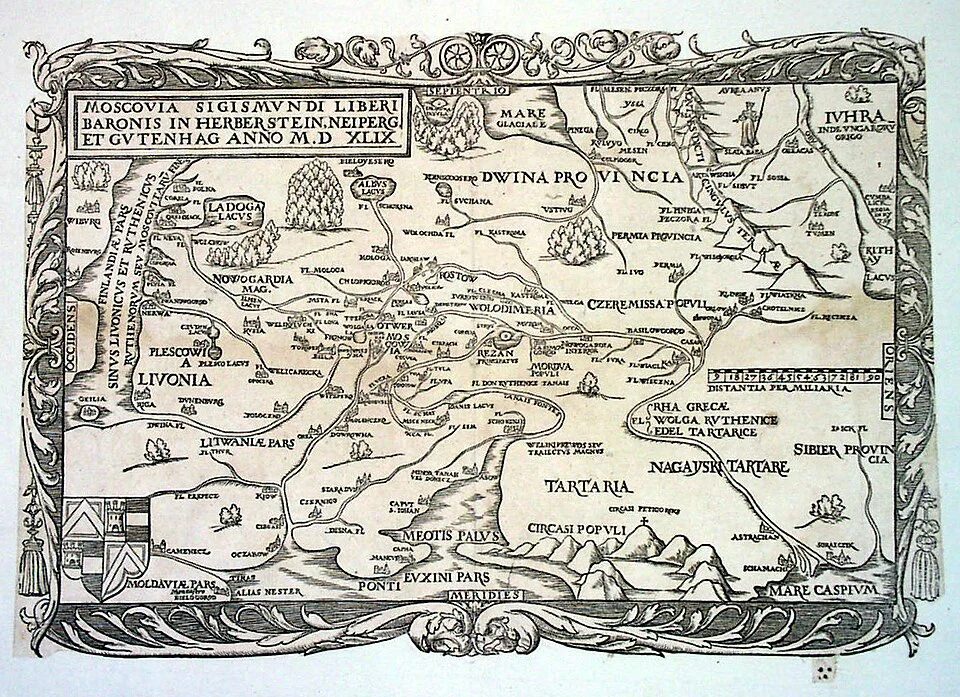
Sigismund von Herberstein. Map of Muscovy. 1549 / Wikimedia Commons
The Golden Horde virtually disintegrated after the death of Khan Tokhtamysh. Yet by the 1420s—or, according to other sources, in 1433—the Great HordeiThe Great Horde was the rump state of the Golden Horde on the Lower Volga, which survived until the Crimean Khanate destroyed it in 1502. emerged in the territory of the former capital ulus. This encompassed the Lower Volga, the lands along the Ural River, and Western Kazakhstan. In other words, centripetal processes continued. This is a key factor in understanding just how extensive, wealthy, and powerful the Golden Horde’s legacy was.
Cities remained under the control of nomadic rulers, and their inhabitants had a vested interest in maintaining peace within the state, free from constant raids and destruction. The centripetal forces, therefore, persisted. The Nogai Horde, itself a product of the nomadic political legacy of the Golden Horde era, soon chose Saray-JükiSaray-Jük was a medieval trading city on the lower Ural River, near present-day Atyrau, that became the capital of the Nogai Horde. as its capital and began to gravitate toward urban centers.
As for the Manghits, were they the backbone of the Nogai Horde? Were they the largest tribal group, or simply the most influential?
Both the largest and the most influential. In most cases, the size of a tribal or clan-based group determined its strength. The Manghits were a Mongol tribe that originally lived in northeastern Mongolia, along the Onon River, the Mongol heartland. They later came to the Kazakh Steppe with Chinggis Khan, fully adopted the Turkic language, local culture, and religion, and became an integral part of the Nogai ulus. Their authority was determined not only by the fact that they had been companions of Chinggis Khan, but also by their ability to field large numbers of warriors.
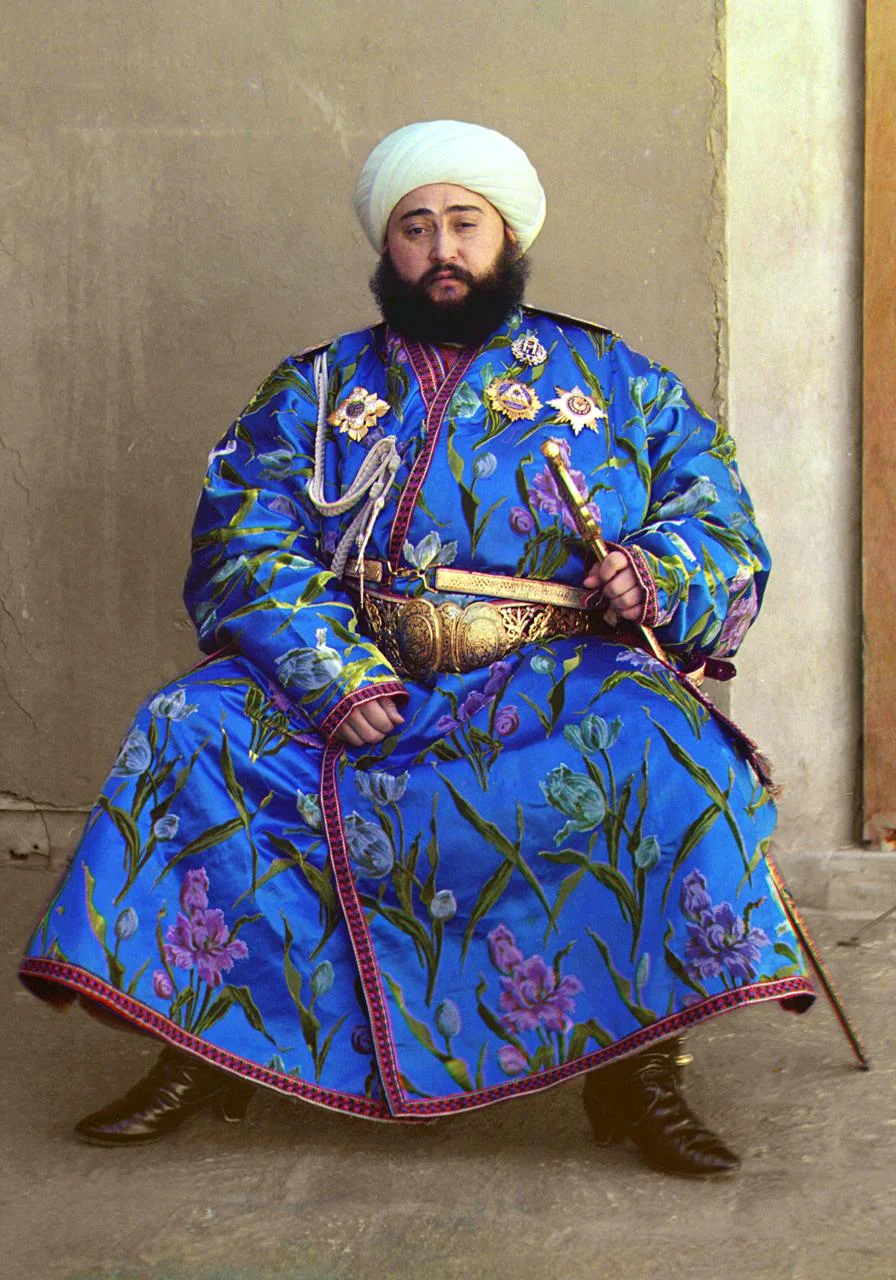
Sergey Prokudin-Gorsky. Alim Khan, the Last Emir of Bukhara from the Manghit Dynasty. 1911 / Library of Congress / Wikimedia Commons
When the entire Golden Horde system collapsed, individual large tribal and clan-based groups began to come to the fore. The more warriors you had, and the larger your ulus, the greater your chances of survival and political dominance in the region. This is precisely what happened with the Manghits.
By then, all the other tribes were in decline, having expended considerable manpower and resources in internecine struggles for power, alternately supporting one claimant and then another. The Manghits, by contrast, had a talented leader in Edigu, who carefully maintained a balance between the interests of the Manghit nomadic aristocracy and those of the Chinggisid ruler.
If we look at particular episodes in Manghit history that demonstrate their power and influence, it is worth noting that a Manghit dynasty ruled Bukhara, in present-day Uzbekistan, for nearly two centuries, until 1920, when it was overthrown after the establishment of Bolshevik rule. In other words, the Manghits continued to play a significant political role from the fourteenth century through the beginning of the twentieth century.
Tell us about Edigu. Who was he? Is it true that he ruled the Golden Horde toward the end of its existence?
Edigu is one of the steppe’s most beloved figures. Although he was not a Chinggisid, he was among the earliest historical figures whose image acquired distinctly heroic qualities in the popular tradition. A separate epic devoted to him emerged among the Nogais, Kazakhs, and KarakalpaksiThe Karakalpaks are a Turkic people of the Aral Sea region, closely related to the Kazakhs and Nogais, who live mainly in present-day Uzbekistan.. Edigu was a figure of profound significance to the history of the Central Asian region as a whole.
It is important to have a clear understanding of Edigu’s life and the historical context of his era. This was a period when the Chinggisid rulers had become increasingly weak, and their authority and prestige were gradually eroding. Many were no longer fit to rule. This helps explain Edigu’s rapid rise to power.
He was an undeniably gifted military commander. One example is the Battle of the Vorskla RiveriThe Battle of the Vorskla River was fought near present-day Poltava in Ukraine, and its outcome ended Lithuania’s attempt to extend its rule over the southern steppe. in 1399, in which he decisively defeated the forces of VytautasiVytautas the Great ruled Lithuania from 1392 to 1430 and backed the deposed Tokhtamysh in his attempt to regain the Golden Horde throne., Grand Duke of Lithuania. As for his military and diplomatic skills, his major campaign against Moscow in 1408, along with his other diplomatic successes, testifies to his exceptional talent.
He lived during the era when Timur came to power and witnessed these developments firsthand. I believe Edigu drew heavily on Timur’s practice of appointing puppet khans, governing and issuing decrees in their name while remaining the de facto ruler himself.
The relationship between Edigu and Tokhtamysh is also of particular importance here. Initially, there was no hostility between them. According to various accounts, Edigu even supported Tokhtamysh in the early stages. There was, however, a personal dimension to their conflict: Urus KhaniUrus Khan was a Chinggisid ruler of the eastern Golden Horde, often called the White Horde, whose descendants founded the Kazakh Khanate. had previously killed one of Edigu’s relatives—according to one version, his uncle; according to another, his father. Thus, an enduring blood feud persisted between them.
In the early stages, however, Edigu was not aligned with Tokhtamysh’s most active opponents. The fact remains that Tokhtamysh, also a legendary figure in our history, was more independent-minded than the other candidates for the position of supreme ruler of the Golden Horde. In this way, he posed a threat to Edigu, his authority, and his ambitions.
If we imagine that we traveled back to 1550 and found ourselves in what is now Western Kazakhstan, and encountered a Kazakh and a Nogai, would we have been able to tell them apart?
Absolutely not. Even today, ethnographers find it difficult to identify any significant differences in vocabulary, despite the fact that we have lived separately for a long time. Nogai is one of the languages most closely related to Kazakh. As for the degree of lexical similarity, I don’t remember the exact figure—linguists have cited either 97 or 98 per cent.
Let’s take a look at some Nogai television programs. I am certain that any Kazakh-speaking viewer would find it difficult to tell that the people speaking are not Kazakhs. I know that many members of the Nogai community watch Kazakh television. They live along the border between Astrakhan and Atyrau oblasts, receive our satellite broadcasts without difficulty, and follow the news.

Nogai and Crimean Tatars. 19th-century Illustration / Wikimedia Commons
If we are talking about the sixteenth century, all nomadic peoples lived in broadly similar ways. The same can be said of Kalmyk society; we would find few significant differences there either. I have been to Kalmykia, the Kalmyk republic within Russia, several times for conferences and visited its museums. Distinguishing what is ‘truly Kalmyk’ from what is ‘truly ours’—and I put both terms in quotation marks—is difficult; I think this is the case even for specialists who have devoted their lives to studying these cultures.
Nomadic conditions tend to level out cultural differences. Is the yurt practical? It is. Does a horse need to be equipped in a particular way? It does.
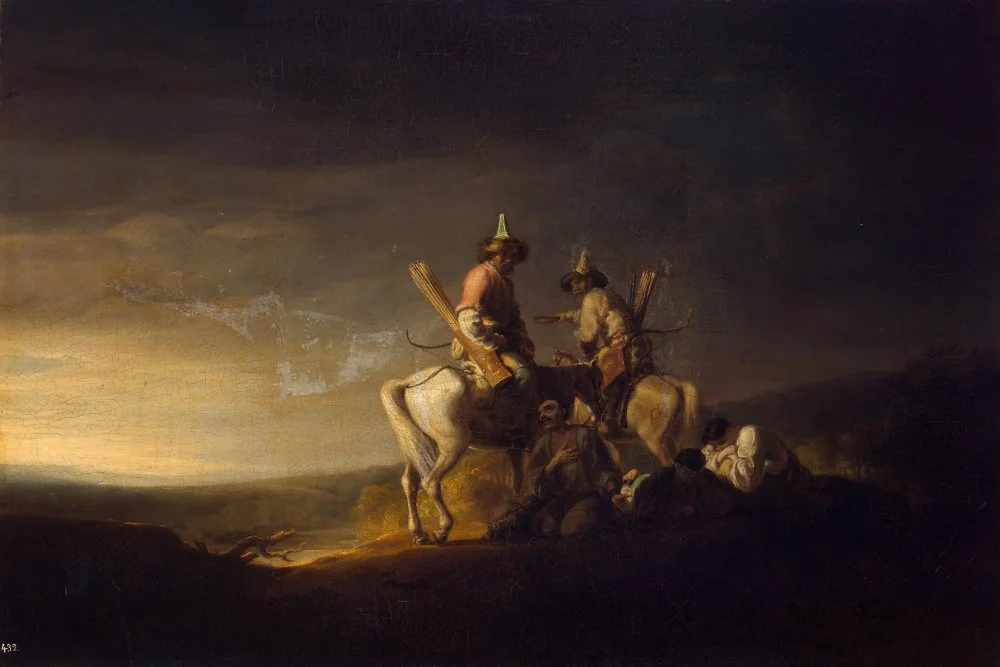
David Allan. Bashkirs. 1814 / Wikimedia Commons
The same was true in warfare. Even as enemies, if one side developed something new, the others adopted it. This was a common practice among peoples who had lived alongside each other for generations.
Had there been no marital alliances, we might still have discerned certain distinctions. Yet such alliances were so commonplace that historical sources rarely recorded them as anything out of the ordinary. They reflected the underlying unity of peoples and cultures that understood themselves to be part of a single whole, divided only by political ambitions. Some aligned themselves with Ismail BeyiIsmail Bey was a mid-sixteenth-century Nogai ruler whose alliance with Muscovy split the Nogai Horde into rival factions., while others supported Haqnazar KhaniHaqnazar Khan ruled the Kazakh Khanate from about 1538 to 1580 and brought many Nogai groups under Kazakh rule..
So they themselves did not distinguish one another in any meaningful way?
They distinguished one another by the Ural River, by their respective territorial positions, and by their seasonal migration grounds. Some lived on the left bank, others on the right. How else could they be distinguished? Their material culture remained essentially unified and, even after so many centuries, continues to reflect that continuity.
For someone living in the sixteenth century, this would have been a clear indication of just how remarkably uniform their culture was.
What factors contributed to the decline of the Nogai Horde? Natural disasters? And what role did the Kazakh Khanate play?
Undoubtedly, jutiA jut was a harsh winter that led to mass livestock deaths because there was no pasture to be found. and epidemics had a devastating impact on the population. Russian sources, including reports from scouts and accounts by merchants, describe massive livestock losses and the movement of people out of the Nogai Horde in search of places where they could survive. But in my view, the main cause was the weakness of the state structure itself.
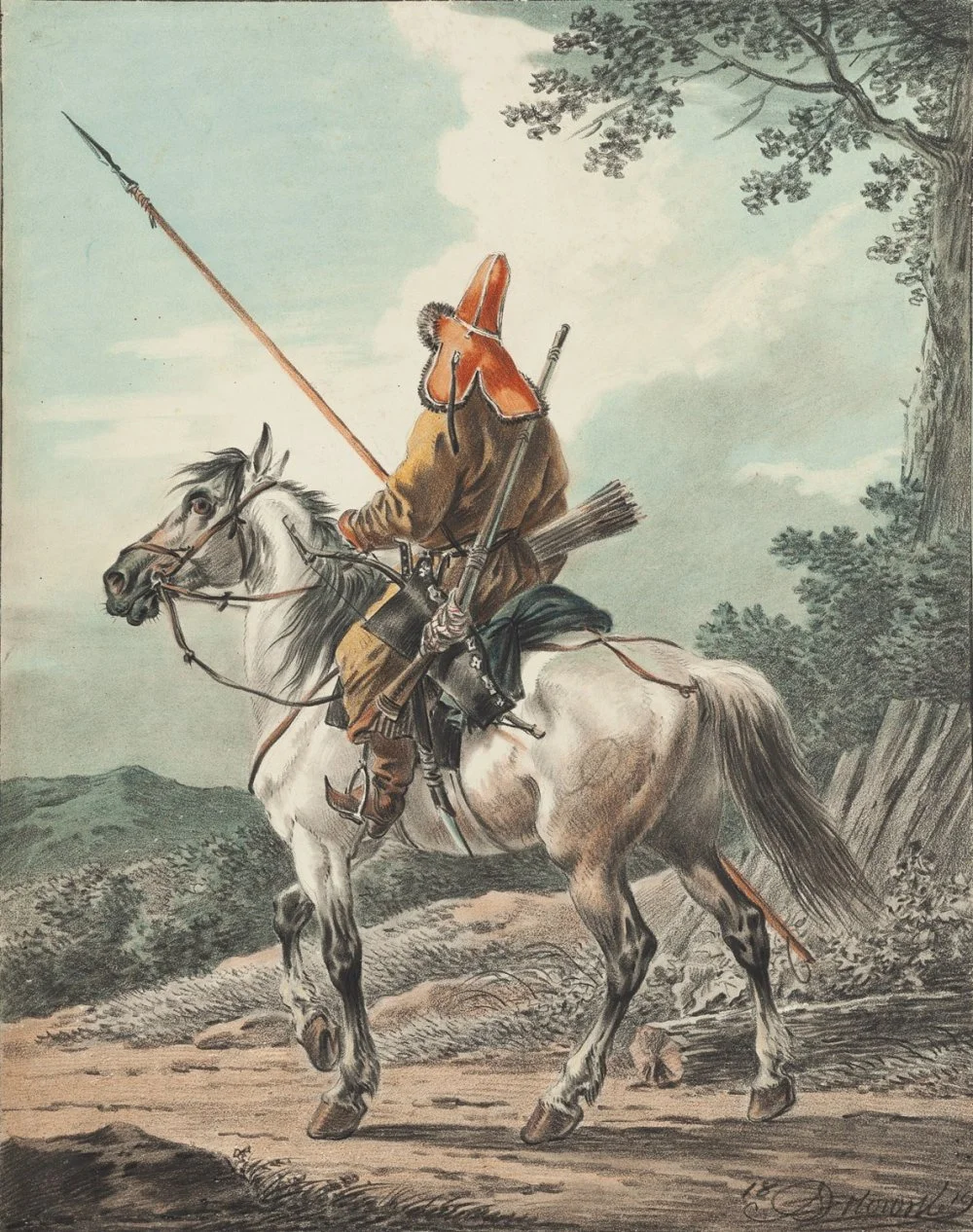
Aleksander Orłowski. Horseman. Color Lithograph. 1819 / Wikimedia Commons
In the Golden Horde, the central government had a vested interest in the cities, while the cities, in turn, depended on the central government. Later, this relationship weakened, and the cities increasingly came to depend on local feudal lords and tribal elites. In the Nogai Horde, wealth was concentrated around a single capital, Saray-Jük. After the capital was repeatedly devastated, there was virtually nothing left for the state to rely on.
By the time the Kalmyks arrived, the Nogais were already divided among themselves. There were individual rulers who could negotiate with neighboring powers, but they no longer had the unified military force that had once stood behind them. The Kalmyks then began taking the best migration grounds—pastures with wells and lands along the rivers. Nomadic peoples needed to feed their livestock, and that meant access to grazing land. So the Nogais were forced to move: some headed west, toward the Crimean KhanateiThe Crimean Khanate was a Tatar state on the Black Sea, founded in the fifteenth century and later a vassal of the Ottoman Empire., while others moved east, toward the Kazakhs. Some remained and paid tribute to the Kalmyks. It was a gradual process of displacement, although there were also raids, killings, and punitive campaigns.
I would not describe the role of the Kazakh Khanate as decisive. Rather, it was, in a sense, a natural consequence of the circumstances. Consider what happens when a state begins to weaken: people start looking for a stronger protector who can shield them from internal conflicts, raids, and livestock theft. The Kazakh khan was well suited to this role: he was distant enough to let them retain a degree of autonomy while still providing protection.
And the fact that some Nogais began paying tribute to another ruler does not, in itself, mean that this ruler was responsible for the destruction of their state.
Where do the Nogais live today? Are they found in present-day Russia, Kazakhstan, or elsewhere?
In present-day Kazakhstan, they are represented primarily as clan and tribal groups. In Russia, they are certainly present as well. There is a fairly large Nogai ethnocultural community with a special administrative status—if I am not mistaken, that of a national district. It is located in northern DagestaniDagestan is a mountainous Russian republic in the North Caucasus, on the Caspian coast, and home to dozens of ethnic groups.. Today, they are actively developing their language and studying their cultural heritage. However, under the influence of local mountain traditions, they have diverged considerably in terms of their everyday culture. Their language has also evolved: certain words are now more commonly pronounced with ch and zh sounds, but the vocabulary remains essentially the same.
As for the Nogais of Astrakhan, I know that they have an ethnocultural association. They form part of the multiconfessional and multiethnic population of Astrakhan Oblast. I am not aware of any particular achievements in promoting or studying their cultural heritage, but I understand that the organization brings together approximately 10,000 to 20,000 people.
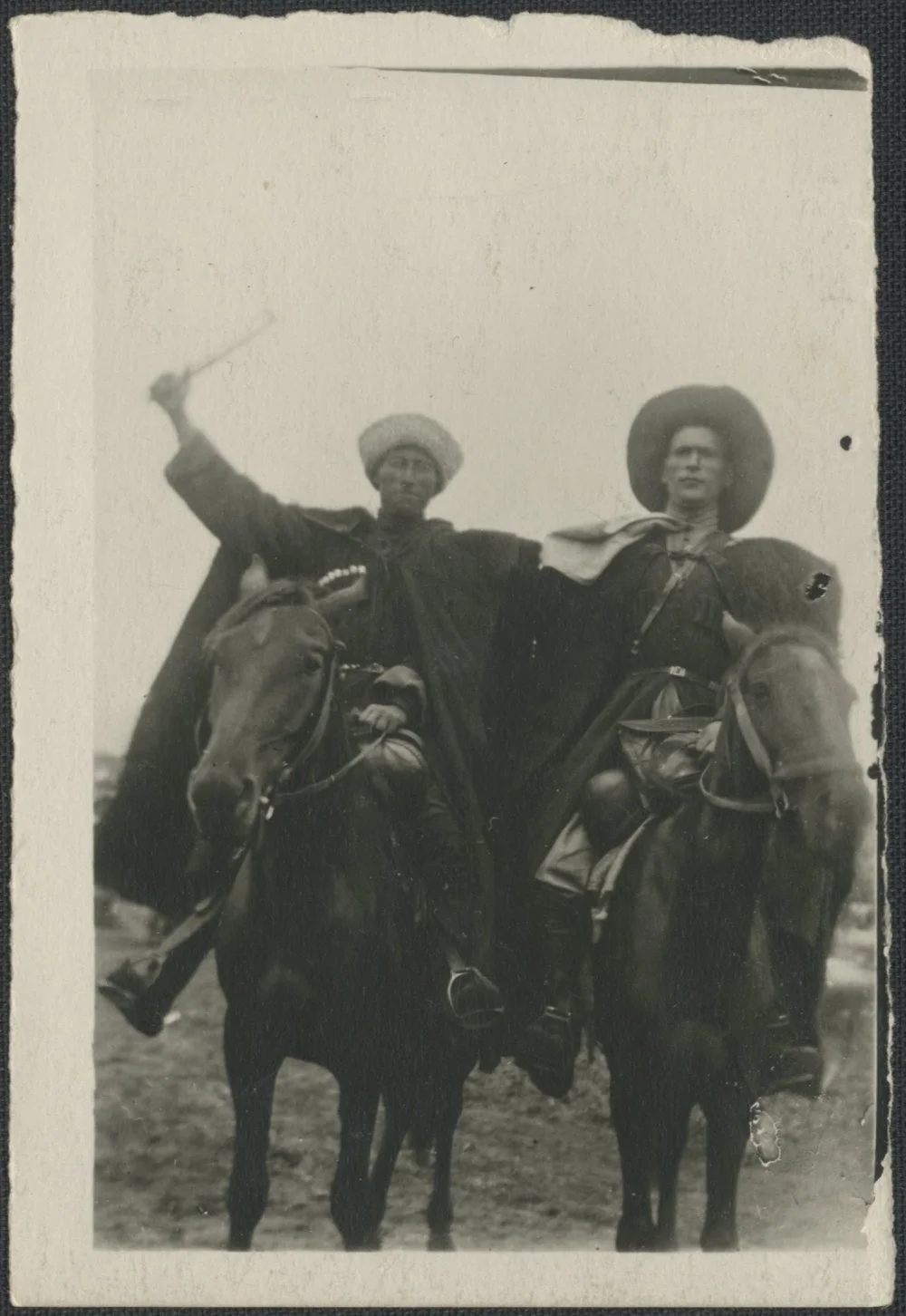
Karim Tinchurin. Nogai Horsemen. Kislovodsk, 1929 / Wikimedia Commons
Nogai communities are also found in Stavropol Krai and the Kuban region in southern Russia. These are separate communities, and as far as I know, they do not constitute a large, concentrated ethnic population anywhere.
Nogai identity survived relatively well in the Crimean Khanate, where some Nogai groups retreated following the defeat of the Nogai Horde, accepted the authority of the Crimean khan, and joined his army. Unfortunately, the history of the Crimean Khanate is not yet sufficiently represented in Russian historiography to allow us to draw far-reaching conclusions about the number of Nogais living there today. There is also some form of Nogai cultural movement in Crimea, if I am not mistaken. At least, I have heard of its existence.
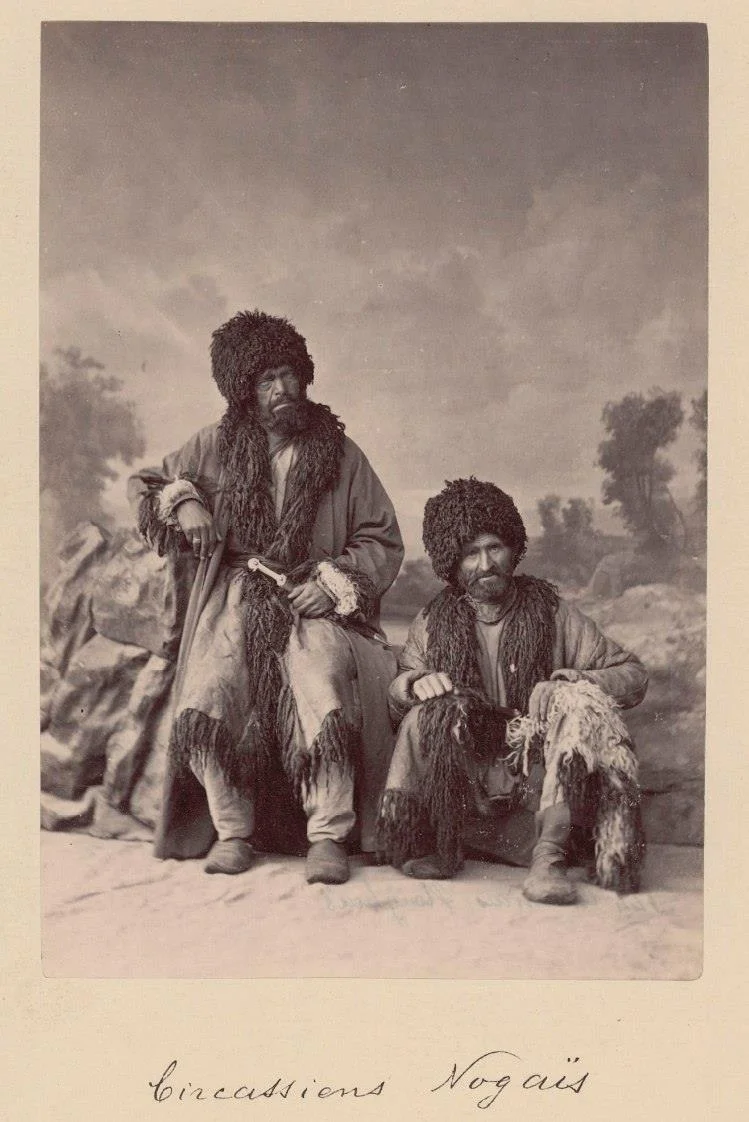
Nogais of Circassia. Photograph, late 19th–early 20th century / Wikimedia Commons
Numerous traces of Nogai ancestry and heritage can also be found among the BashkirsiThe Bashkirs are a Turkic people of the southern Urals who live mainly in Bashkortostan, a republic of the Russian Federation.. In present-day Tatarstan, in the Middle Volga, there are likewise Nogai place names and individual Nogai clan and tribal groups. But nowhere do they form a single, dominant ethnic population. They are scattered across different regions, yet they are making fairly successful efforts to preserve and revive their cultural traditions.
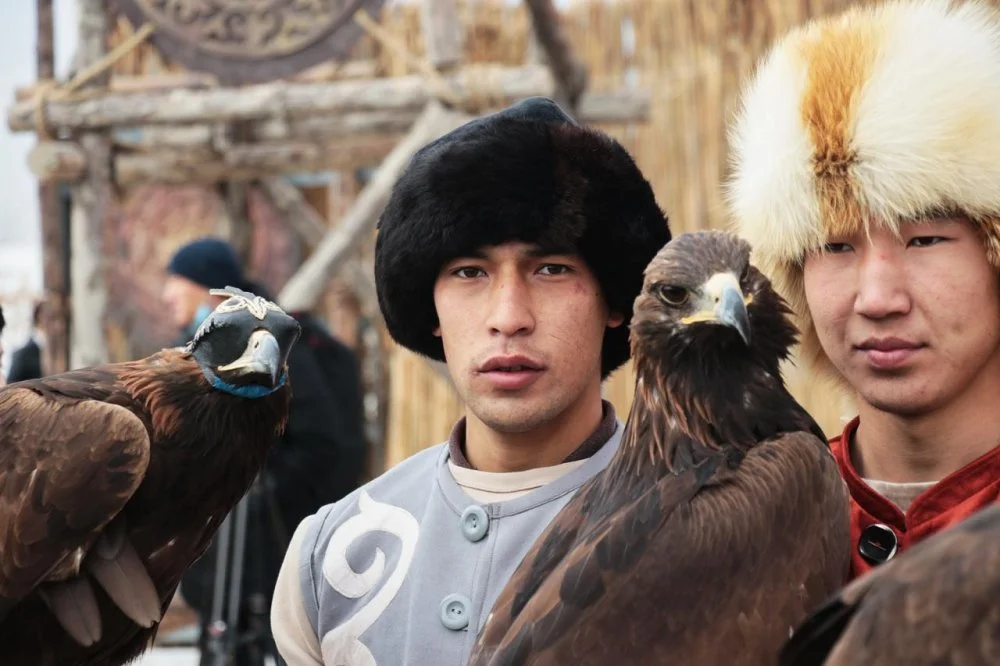
At a Festival Marking the Opening of the Museum Complex at the Historic Settlement of Sarayshyk. Atyrau Region, Kazakhstan, 2 November 2021 / Meiramgul Kussainova / Anadolu Agency via Getty Images
Do we need to look at the history of the Nogai Horde to understand Western Kazakhstan?
That is more than a philosophical question. Yes, absolutely. The Nogai character and warrior tradition significantly influenced the martial culture of our own people. But the lands inhabited by the Nogais extended far to the east, reaching as far as the Irtysh and Syr Darya rivers. Individual groups also migrated across central Kazakhstan.
Nogai place names are most frequently found in the west. The region was extensively inhabited by the Nogais and constituted the heartland of their statehood. The renowned warrior culture of Western Kazakhstan can, in a sense, be regarded as part of the Nogai mentality, which remains a significant component of the region’s historical and cultural heritage.
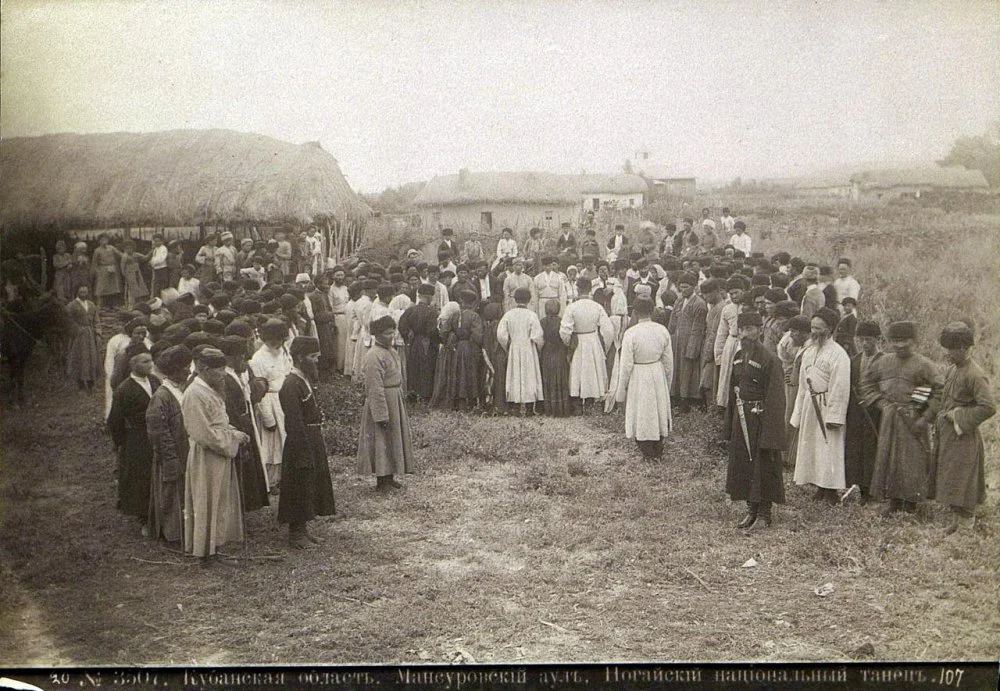
Dmitri Ermakov. Nogai National Dance. Mansurovsky Aul, Kuban Oblast. 1870s–1880s / Open sources
The Nogai Horde developed under conditions of intense competition. Its rivals included the Great Horde and the Astrakhan KhanateiThe Astrakhan Khanate was a Tatar state on the Lower Volga, formed from the Great Horde in the fifteenth century and conquered by Muscovy in 1556., which broke away from the Great Horde in the 1460s. The Bashkirs, meanwhile, were divided among the Nogai Horde, the Kazan KhanateiThe Kazan Khanate was a Tatar state on the Middle Volga, founded in the 1430s after the Golden Horde broke up, and conquered by Muscovy in 1552., and the Khanate of Sibir. From the outset, the Kazan Khanate was unwilling to submit to Nogai authority.
I have one final question. The Nogai Horde was a unique and fascinating state, yet the Bashkirs consider it part of their history, the Kazakhs consider it theirs, and the Tatars consider it theirs. In your view, whose history is it? Who has the right to claim it?
There is ongoing work to strengthen the role of the Nogai language and culture among Nogai youth. We can speak of a shared history, but first and foremost, the history of the Nogai Horde is the history of the Nogai people.
When we speak about our shared history with the Nogais, we should remember how inseparably intertwined we are. As we have already discussed, in some respects the Nogais are no different from the Kazakhs. Our poets, our aqyns (bards who improvise verse to music)—all of this belongs to a shared past that connects us. We share a great many proverbs.
Speaking from personal experience, my father is buried in the city of Atyrau, near the Caspian Sea, in a cemetery known as ‘Nogaybit’, literally meaning ‘Nogai cemetery’ or ‘Nogai mausoleum’. References to the old Nogai Road—a trade route connecting the Volga region with the Aral Sea region—survived in accounts of nineteenth-century military expeditions, as well as in the writings of travelers and merchants.
Just imagine what kind of legacy survived intact all the way into the nineteenth century—and continues to live on today. We could say a great deal about this, but I want to emphasize once again: the history of the Nogai Horde is, first and foremost, the history of the Nogai people. What we are discussing here represents only one part of a shared history.
This is only part of our interview with historian Yernar Uzhkenov. Watch the full version on the Qalam History YouTube channel.
