
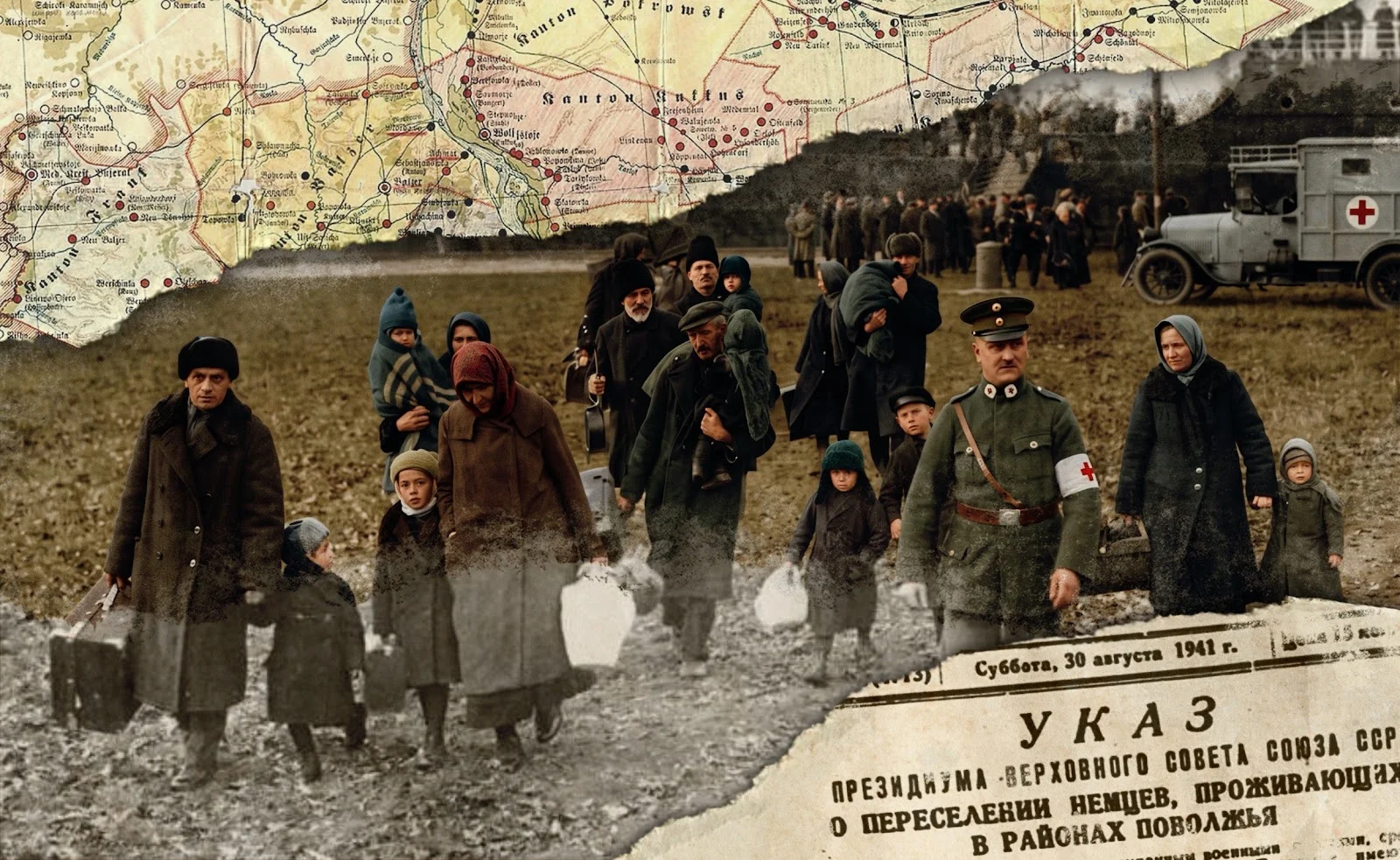
On 28 August 1941, at the height of the German offensive, the Soviet leadership issued a decree ‘On the Resettlement of Germans Living in the Volga Region’. This document marked the beginning of the forced relocation of ethnic Germans from across the Soviet Union to Central Asia and Siberia. In total, nearly one million people were deported. Some 400,000 of them ended up in Kazakhstan. Alfred Eisfeld, a leading expert on the history of Soviet Germans, discusses the causes and circumstances of this tragedy, from Soviet suspicion of ethnic Germans to the journey east and the years in the special settlements.
Germans—Spies?
Anti-German sentiment within the Soviet leadership intensified during the 1930s. One key factor was the rise to power of the National Socialists under Adolf Hitler, which brought Germany and the Soviet Union into direct ideological confrontation.
The Nazis were hostile to communist ideology and regarded it as a manifestation of the so-called Jewish-Bolshevik conspiracy, whose ultimate goal, they claimed, was world domination. In Nazi Germany, communists and representatives of other left-wing movements faced various forms of repression.
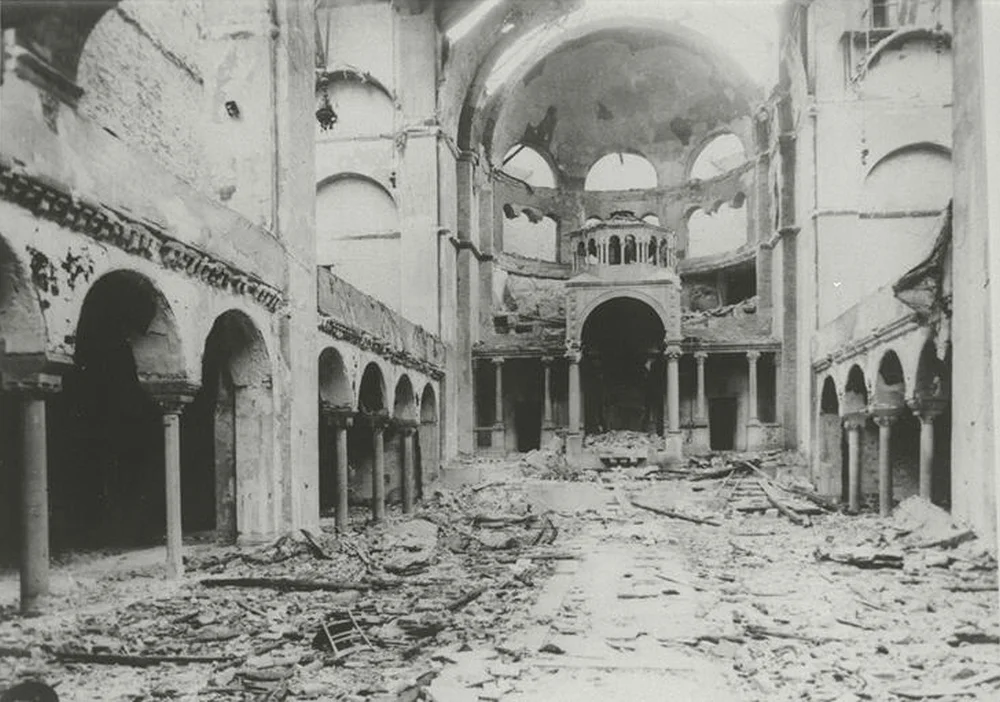
Interior of the destroyed Fasanenstrasse Synagogue after Kristallnacht. Berlin, 1938 / Wikimedia Commons
By contrast, Bolshevik ideology officially rested on anti-fascism and anti-Nazism, which it counterposed to a supranational struggle for the rights of the international proletariat. In addition, both countries’ foreign-policy agendas envisaged expansion into Eastern Europe.
In essence, the Soviet Union and Germany at the time represented two ‘mutually exclusive’ totalitarian political systems. This, together with the increasingly tense international situation and the expectation of another major war in Europe, fueled spy mania and anti-German sentiment within the Soviet Union. However, even before Hitler, in the 1920s, Soviet secret services characterized Germans in their reports as follows:
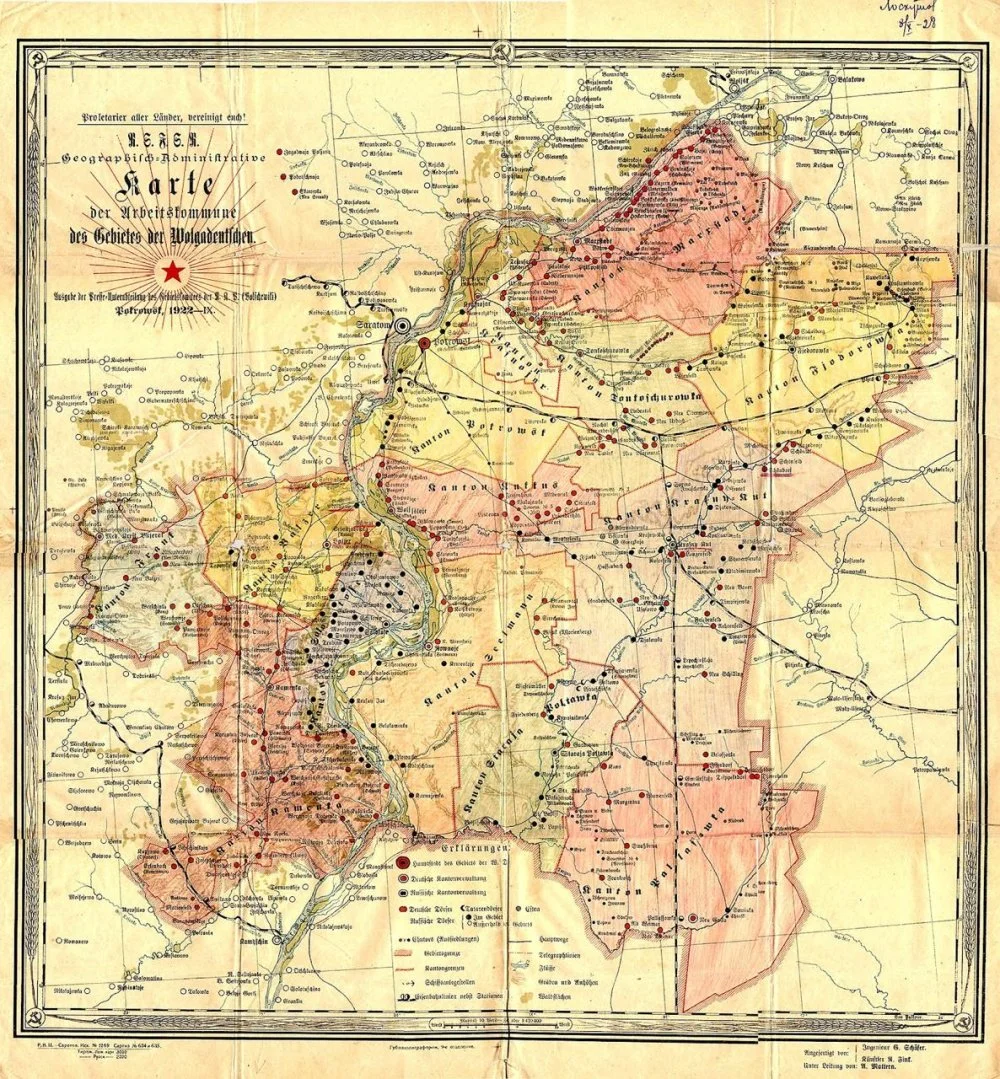
Map of the Volga German ASSR, 1922 / Private collection via Wikimedia Commons
By virtue of their numbers, their social composition was predominantly kulaki A kulak was a relatively prosperous peasant; Soviet authorities treated kulaks as class enemies in the late 1920s and 1930s, seizing their property., and their political aspirations (fascist-nationalist), they constitute the greatest danger as a segment of the population hostile to both communism and the Union of Soviet Socialist Republics (USSR).
Stalin’s domestic political campaign against the ‘enemies of the people’i‘Enemy of the people’ was a Soviet label for political and class opponents, used to justify their repression. intensified dramatically following the assassination in 1934 of Sergei Kirov, head of the Leningrad Party organization—in other words, the city’s de facto ‘mayor’. The People’s Commissariat for Internal Affairs (Narodnyy komissariat vnutrennikh del in Russian and abbreviated as the NKVD) rapidly stepped up surveillance of Germans deemed to have counterrevolutionary and anti-Soviet views. Acting on orders from Moscow, local authorities began ‘uncovering’ groups and organizations of ‘spies and saboteurs’ throughout the country—groups of which the local NKVD authorities had known nothing before receiving these directives.
Why Kazakhstan in Particular?
The Soviet leadership regarded Kazakhstan and Siberia primarily as sources of raw materials. In the authorities’ view, these sparsely populated ‘desert’ lands required additional labor. Accordingly, on 22 August 1925, the Soviet government adopted a resolution entitled ‘On the Initiation of Planned Resettlement to the Volga Region, Siberia, and the Far Eastern Territory’.
Initially, the authorities sought to make the resettlement voluntary. The state promised settlers land and the assistance needed to establish themselves in their new locations. However, inadequate preparations for their settlement and accommodation meant that the number of people relocated during the first few years fell far short of the planned numbers.
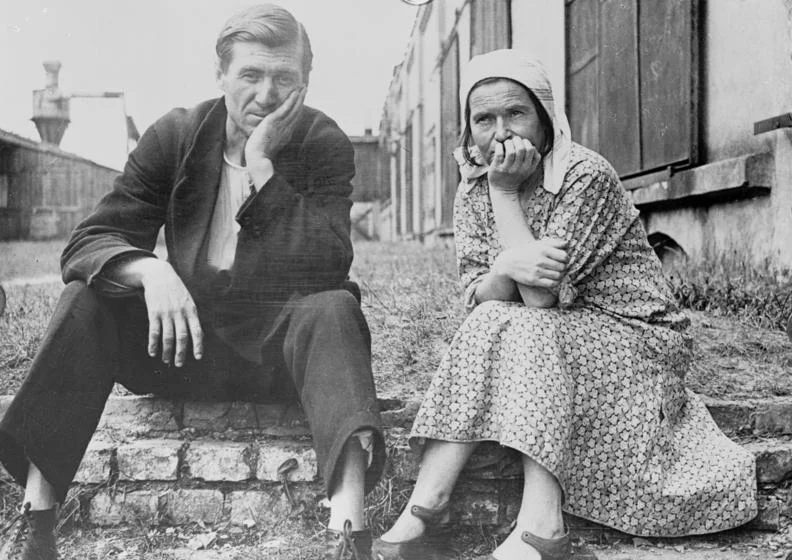
German peasant couple from the Volga region in a refugee camp in Schneidemühl (now Piła, Poland), c. 1920–1925 / Bundesarchiv via Wikimedia Commons
Deportation as a standard practice began after the adoption of the First Five-Year PlaniThe First Five-Year Plan, which ran from 1928 to 1932, prioritized heavy industry and imposed the forced collectivization of agriculture. for the development of the national economy in 1928. Peasant farmers who had been dispossessed as ‘kulaks’ in the European part of the USSR were forcibly ‘resettled’ in Kazakhstan and Siberia. Among them were nearly 25,000 Germans from the Volga region. However, the plans for such ‘resettlement’ were far more ambitious. In 1933, the Unified State Political Directorate (the Soviet state security agency that existed from 1923 to 1934) proposed relocating two million people to Kazakhstan and Western Siberia.
To implement these plans, the special Resettlement Department was established within the NKVD, which oversaw the process from 1936 to 1939. During this period, Poles and Germans were deported from Ukraine, and Koreans from the Soviet Far East. Yet the labor force brought to Kazakhstan through these measures—approximately 170,000 people—amounted to less than 20 per cent of the planned total.
The state subsequently planned to accelerate the relocation of people to Kazakhstan ‘for the development of grain farming’. The plans were laid out through 1941, but on 22 June 1941, Germany invaded the Soviet Union. The authorities shifted focus to a higher-priority task: the deportation of the entire ethnic German population. The deportation was now driven less by economic considerations than by political ones.
Population Exchange
Despite their ideological and geopolitical rivalry, on 23 August 1939, the governments of Germany and the Soviet Union signed an agreement dividing Eastern Europe into spheres of influence, assigning Finland, Estonia, and Latvia to the Soviet sphere and dividing Poland. The agreement became known to history as the Molotov–Ribbentrop Pact. In the Soviet Union, it was presented as a non-aggression treaty; in reality, the document contained secret protocols that set out the respective areas of control of each side there.
The two sides also agreed to the resettlement of ethnic Germans from territories within the Soviet sphere of influence to provinces controlled by Germany, while Ukrainians and Belarusians were to be relocated from German-controlled territories to the Soviet Union.
Following the resettlement of ethnic Germans to Germany, concerns grew within the Soviet leadership from late 1940 onward over signs of pro-emigration sentiment in various parts of the USSR. At the same time, the NKVD had failed to ‘uncover’ any sabotage or insurgent groups. In June 1941, just days before the outbreak of war, the People’s Commissariat for State SecurityiThe People’s Commissariat for State Security was separate from the NKVD only from February to July 1941 and again from 1943 to 1946. issued a directive entitled ‘On Intensifying Intelligence and Operational Work among Germans and Their Contacts’, once again calling for the identification of German agents, saboteurs, and individuals sympathetic to the Nazi regime, as well as the compilation of lists of those to be arrested.
Similar orders had been issued both before the war and during its first months, but the search for ‘enemies’ frequently yielded no results. Finding no evidence did not end the campaign; the outbreak of war gave it a new pretext.
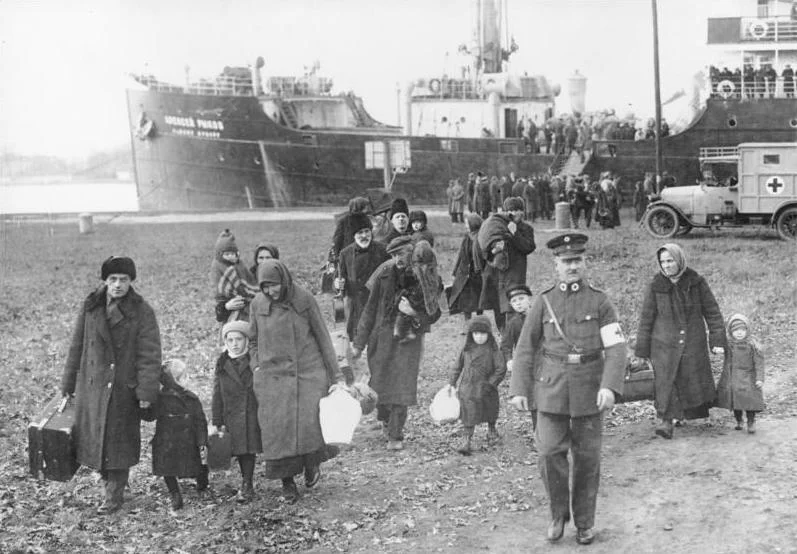
Robert Sennecke. German refugees from the Soviet Union arriving in Swinemünde (now Świnoujście, Poland), 2 December 1929 / Bundesarchiv via Wikimedia Commons
What Did the War Change?
As the Red Army retreated, the NKVD and the People’s Commissariat for State Security arrested and deported the German population. According to a People’s Commissariat for State Security directive dated 22 June, suspicion of criminal intentions was sufficient grounds for arrest. Beginning in early August, a series of decrees and resolutions led to the deportation of several tens of thousands of Germans from the western regions of the USSR to Kazakhstan.
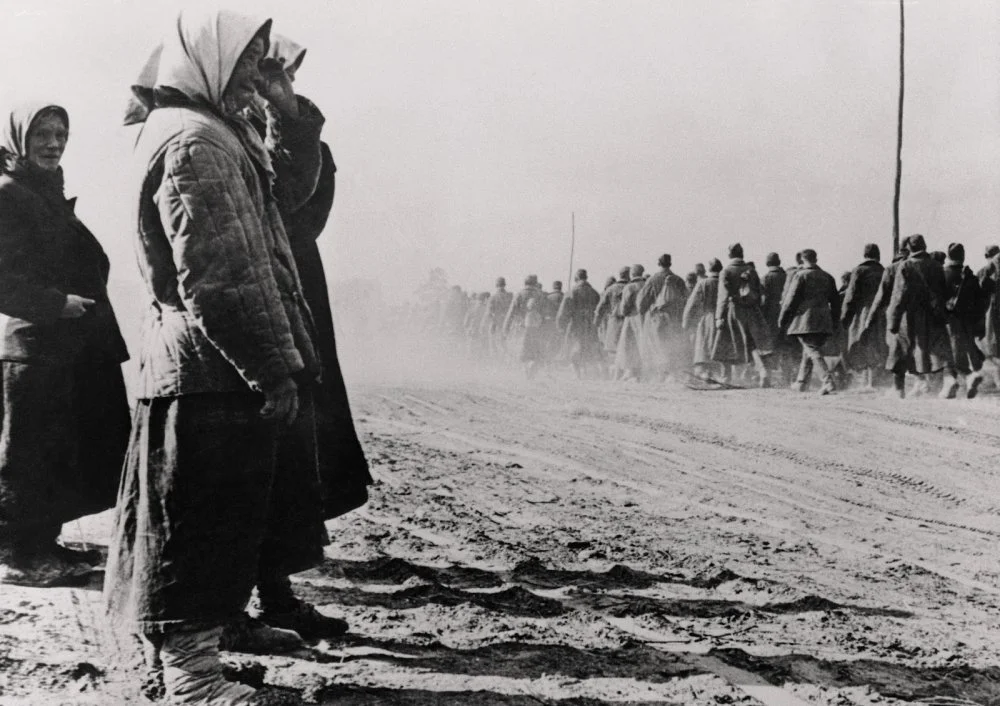
Soviet women weep at the roadside as columns of captured Red Army soldiers are marched to the German rear. 1 November 1941 / Bettmann / Getty Images
The key document is generally considered to be the decree of the Presidium of the Supreme Soviet of the USSRiThe Presidium of the Supreme Soviet was the permanent body that acted for the USSR’s legislature between sessions and issued decrees. dated 28 August 1941. It was published in both German and Russian in the union- and regional-level newspapers of the Autonomous Soviet Socialist Republic (ASSR) of Volga GermansiThe ASSR of Volga Germans was created in 1924 and abolished in September 1941; its territory was divided between Saratov and Stalingrad regions.. It begins with an accusation of treason:
According to reliable information received by the military authorities, among the German population living in the Volga region there are thousands, indeed tens of thousands, of saboteurs and spies who, upon receiving a signal from Germany, are allegedly preparing to carry out acts of sabotage in areas inhabited by the Volga Germans. None of the Germans living in the Volga region has reported the existence of such a large number of saboteurs and spies among the Volga German population to the Soviet authorities. Consequently, the German population of the Volga region is concealing enemies of the Soviet people and of Soviet rule within its midst.
The Presidium decided that, ‘in order to prevent bloodshed’, the entire German population should be resettled to other regions, where they would be provided with land and receive state assistance to establish themselves in their new places of residence. Western Siberia and Kazakhstan were designated as the new areas of settlement. History had never before witnessed such a form of ‘punishment’ for treason against the Motherland.
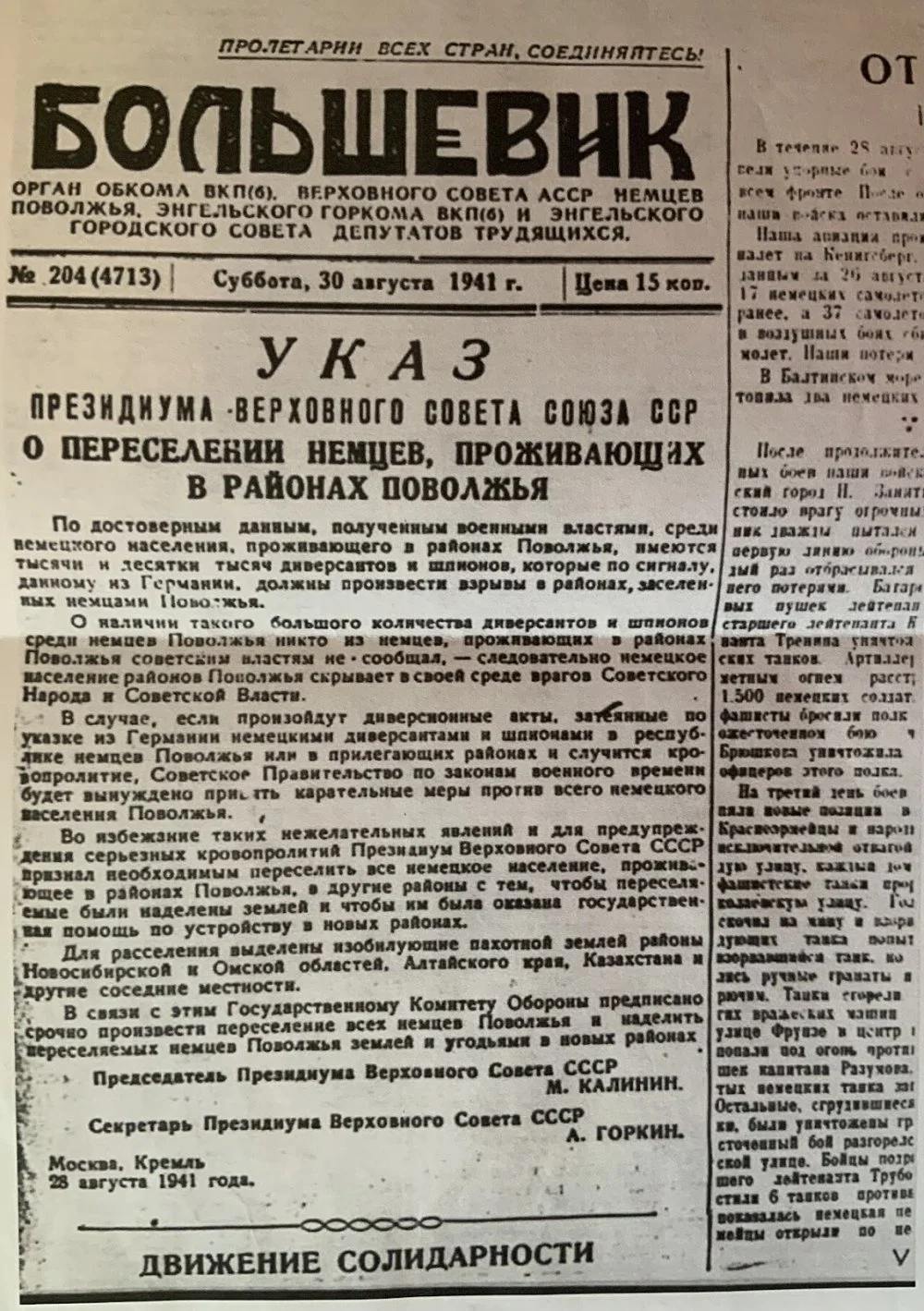
Decree on the resettlement of the Volga Germans in the newspaper Bolshevik, 28 August 1941 / Wikimedia Commons
Between 3 and 20 September, all Germans living in the ASSR of Volga Germans, as well as in Saratov and Stalingrad regionsiStalingrad, renamed Volgograd in 1961, was the name of the city on the Volga from 1925 to 1961., were deported—including members of the All-Union Communist Party (Bolsheviks) and the KomsomoliThe Komsomol, officially the All-Union Leninist Young Communist League, was the Communist Party’s youth organization., as well as family members of Red Army personnel, both enlisted soldiers and officers.
The mass deportation of the Volga Germans can also be explained by what the Soviet leadership saw as the need to create space in the region for people evacuated from areas threatened by occupation. For example, seven central archives, several Moscow universities, the People’s Commissariats of the Russian Soviet Federative Socialist Republic, and numerous industrial enterprises were relocated to Saratov. On 15 October, the official relocation of the capital from Moscow to Kuybyshev beganiKuybyshev is now called Samara; in October 1941 it became the Soviet Union’s alternative wartime capital..
Thus, the authorities systematically sought to rid the region of what they considered its ‘surplus’ population. The ‘cleansing’ of the Volga region of its German population was completed by November 1941. At the same time, another 302,288 Germans, who were registered at the time in other Soviet republics and regions, were deported.
How Was the Deportation Carried Out?
Before announcing the deportation, the authorities cut German settlements off from the outside world. Thousands of police, army, and NKVD personnel carried it out.
Those being deported were given as little as two days to prepare, depending on when freight cars or barges became available for transport to Kazakhstan or Siberia. Each train carried more than 2,000 people, along with their belongings. Regulations allowed each person to take up to 200 kilograms of luggage.
This is how Ekaterina Grauberger, a deputy of the Supreme Soviet of the USSR representing the ASSR of Volga Germans, recalled the deportation from the Bolshevik collective farm in the pages of the Moscow-based German-language newspaper Neues Leben in 1988:
I remember that during the night, all the Communists in the village were urgently summoned to the collective farm administration. We entered the chairman’s office, and there he sat, looking gloomy and hunched over, as though he were ill, smoking incessantly. Once everyone had gathered, he began reading aloud a document stating that, ‘in order to prevent unnecessary bloodshed’, all Germans were to be deported from the Autonomous Republic of Volga Germans. I asked him, ‘But the front is far away—why are we being deported?’ He did not answer. He only said, ‘Take only what is essential with you. Leave everything else behind—your belongings, furniture, livestock …’
Grauberger continued her account:
Well, the next day everyone was loaded onto trucks and, accompanied by soldiers, taken to Bezymyannaya railway station. I was the only German left on the collective farm because I was in charge of the livestock operation. There were no milkmaids, so soldiers milked the cows under my supervision. And the grain probably went to waste—there was no one left to harvest it. Later, female students from EngelsiEngels, across the Volga from Saratov, was the capital of the Volga German republic until it was abolished in 1941. were brought in, and I turned the farm over to our collective-farm shepherd. He was Kazakh by nationality, so they left him alone.
As a deputy of the Supreme Soviet of the USSR, I was given a separate railway car so that I could load our belongings into it. The others were crammed into the cars like herring in a barrel. Of course, I left all my belongings behind. I took nothing with me, and women with small children were placed in our car …
Deportees were supposed to receive a hot meal once a day and hot water twice a day, but often went without during the journey, because the train’s route and destination station frequently changed while it was already en route. As the autumn cold set in, conditions worsened dramatically, since the cars had no stoves for heating.
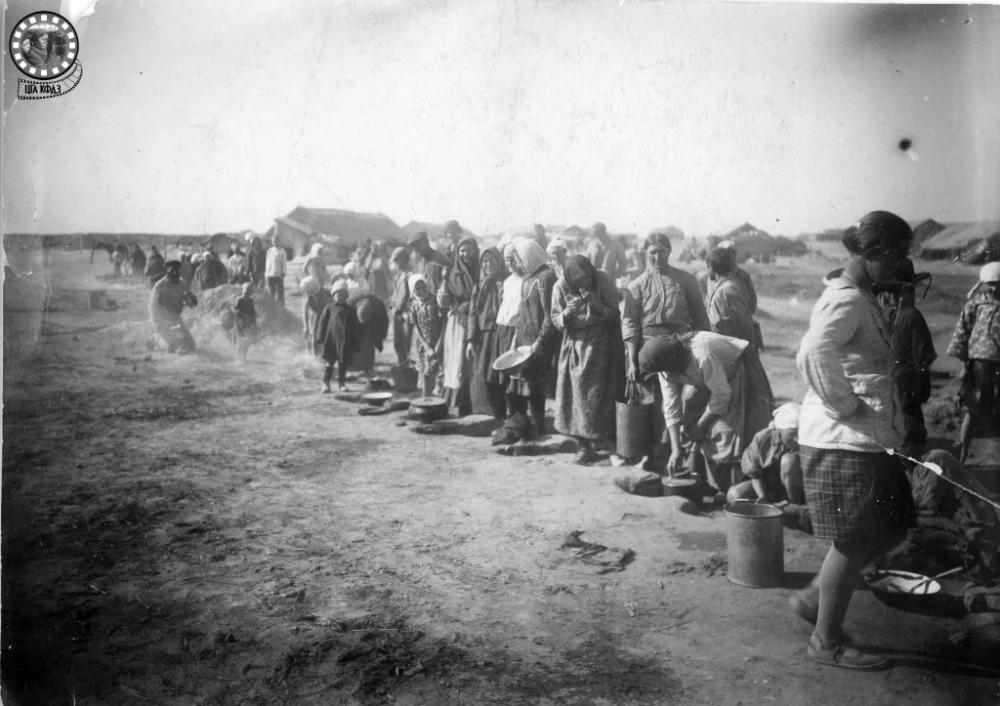
Settlers cooking food. Almaty Region, 1931 / Author unknown / From the personal archive of Aleksandr Reingoldovich Tkachev / CSACPA
Deaths from hypothermia and gastrointestinal illnesses occurred on every train. Young children and the elderly were particularly likely to die. Eyewitnesses recalled that the dead and seriously ill were removed from the trains at railway stations. After that, their fates were unknown.
German men were often deported first. They were arrested and sent to labor camps or mobilized for construction work. Women, children, and the elderly were promised that they would be transported later, but as the front drew closer, they were increasingly left to fend for themselves.
One particularly telling incident occurred in Zaporizhzhia Region. Near Tokmak railway stationiTokmak is a town in Zaporizhzhia Region, in southern Ukraine., 25,000 German women and children spent several days waiting to be sent east. The front was rapidly approaching, but no trains arrived. The NKVD cordon and police disappeared, and the deportation never took place.
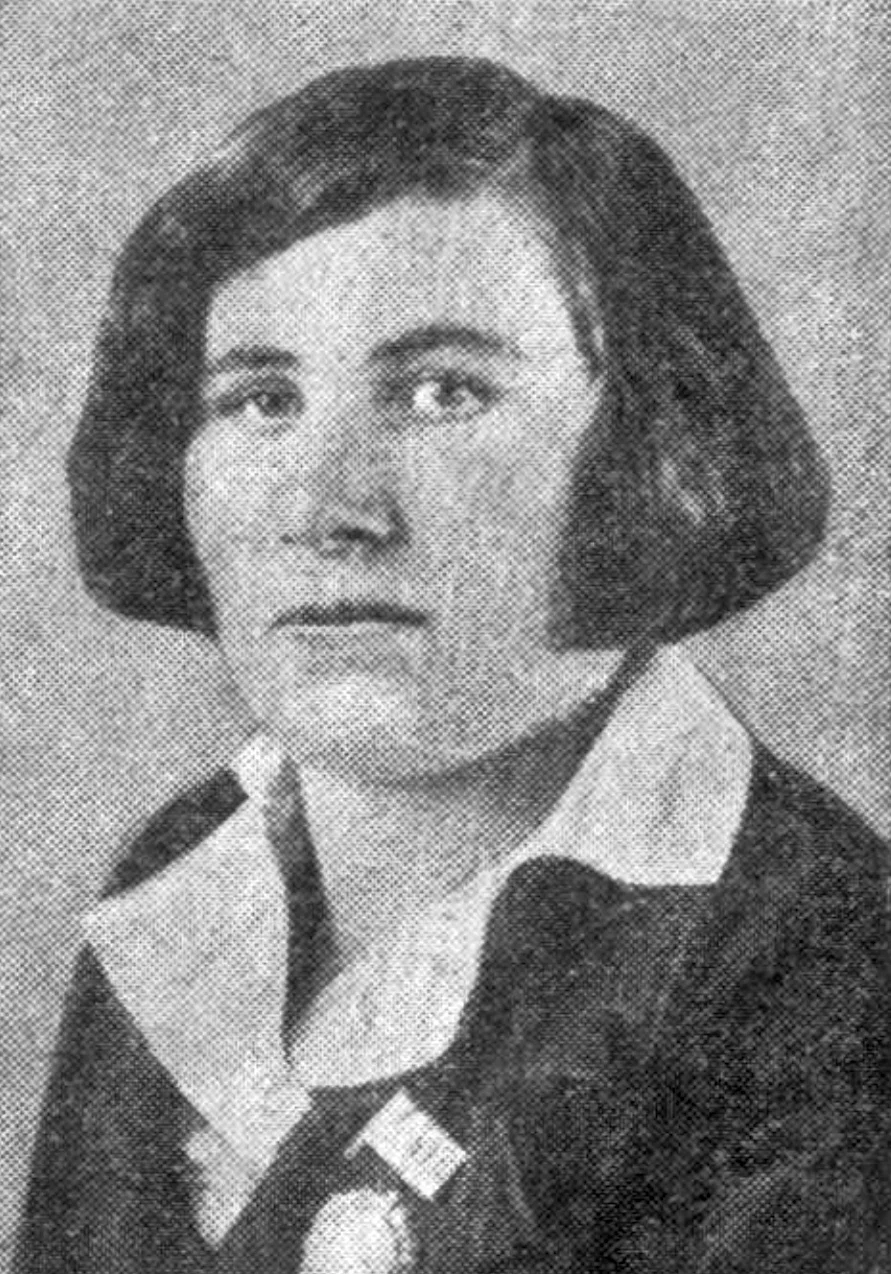
Ekaterina Davidovna Grauberger / Wikimedia Commons
Yakov Gering, who decades later became a Hero of Socialist LaboriHero of Socialist Labor was the Soviet Union’s highest honor for outstanding achievement in industry and other fields., recalled the tragic fate of those deported from the Georgian Soviet Socialist Republic:
It took us forty-five days to reach our destination. Under guard, we were first transported by rail, under bombardment, in battered freight cars from Tbilisi to Baku. From there, we went by sea to Krasnovodsk, and from Krasnovodsk by train to SemipalatinskiSemipalatinsk was renamed Semey in 200iKrasnovodsk is now called Turkmenbashi, in Turkmenistan; the city was renamed in 1993.7; the city stands on the Irtysh River in eastern Kazakhstan.. There, the deportees, who had arrived in three trainloads, were transferred onto barges and sent down the Irtysh River to PavlodariPavlodar is a city in northeastern Kazakhstan, the administrative center of Pavlodar Region and a port on the Irtysh River, downstream from Semipalatinsk.. It was already late October. The weather was cold, with a piercing wind. Exhausted by the long journey and their ordeal, people were dying of hunger and typhus.
Near Belogorye, slush ice began to form, and the crew of a tugboat towing a barge became fearful of being trapped in the ice. The deportees were abandoned to their fate: the tugboat continued on to Pavlodar, while dozens of dying people were left in the middle of the river without warm clothing or food.
Local residents—Kazakhs from a nearby auliThe word aul means ‘village’ in Kazakh, and typically encompasses 100–200 yurts.—tried to help those abandoned on the barge. However, the ice was too thin, and the barge couldn’t be reached. By the time they finally managed to do so, fewer than half of those who had left Semipalatinsk were still alive. The guards threw the bodies overboard, while the survivors were hauled to shore with ropes and then transported by horse-drawn carts to nearby auls.
From the beginning of September through the end of 1941, 779,459 Germans were deported. As of 5 January 1942, according to various sources, 374,901 or 390,112 Germans had been transported to Kazakhstan. These figures suggest that roughly half of those deported by the end of 1941 had reached Kazakhstan by early January 1942.
What Awaited the Deportees in Their New Homes?
The NKVD’s plans for distributing and ‘settling’ the deportees were often impossible to implement. The collective farms and enterprises receiving them had extremely limited suitable housing, so deportees were placed in the homes of local residents through forced ‘densification’. As many as ten to fifteen people were often crowded into a single room. Unfinished houses, storage facilities unfit for habitation, barns, and unheated, unlit cowsheds were also used as accommodation.
More about
OPERATION ‘LENTIL’
The History of One of the Most Brutal Deportations in the USSR
Because the Germans arrived after the agricultural season ended, those assigned to collective farms had no opportunity to earn trudodni (labor-day credits), which could be exchanged for grain. Only a small number had receipts documenting agricultural produce and livestock they had handed over to the authorities before deportation, for which they were entitled to compensation. Moreover, the regions receiving the deportees were not allocated any additional food supplies.
An extremely critical situation developed everywhere: only deportees who were employed received a bread ration, while elderly people unable to work, the sick, and children received no food at all. Because deportees lived in unsanitary conditions and went hungry, epidemics broke out—including measles and scarlet fever—and mortality among children and the sick increased. To survive, people sold the few possessions they had left or exchanged them for bread, sought work from local residents, or begged for food.
Years later, I often heard moving stories of homeless children reduced to begging, while Kazakhs—who were themselves living in poverty and could not understand the children’s language—shared their bread with them and, in some cases, took them into their homes.
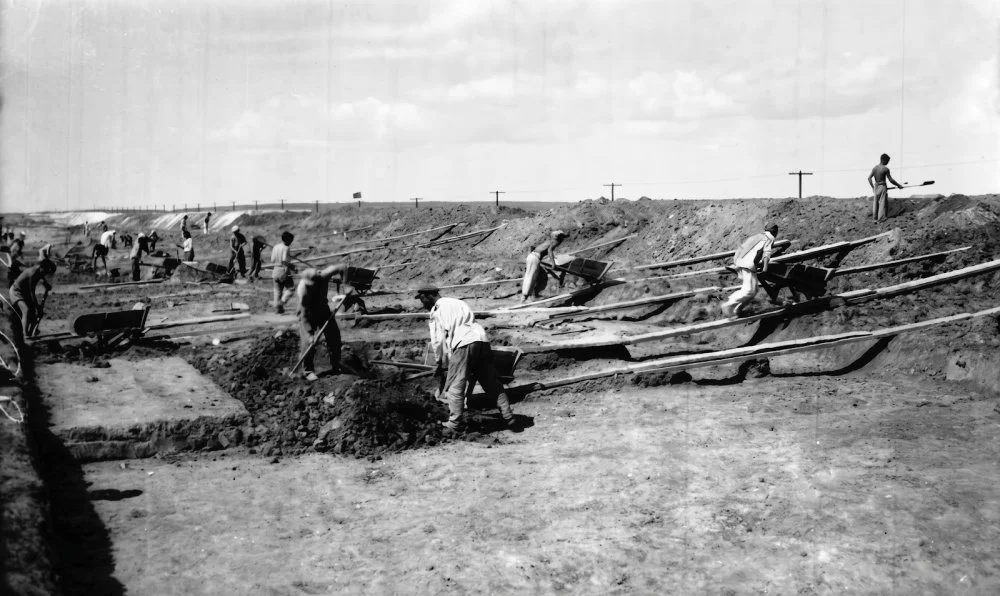
Construction of the Pavlodar–Akmolinsk railway. Pavlodar Region, 1940 / Central State Archive of Film, Photo Documents and Sound Recordings of the Republic of Kazakhstan
The German men who arrived at the special settlementsiSpecial settlements were NKVD-supervised villages where deportees lived with their families under tight restrictions on movement. in Kazakhstan did not stay long with their families. On 10 January 1942, the State Defense CommitteeiThe State Defense Committee, chaired by Stalin, was the emergency body with full state power from June 1941 to September 1945. ordered the mobilization of 120,000 German deportees of working age—from seventeen to fifty—who were in Kazakhstan and Siberia, into labor columnsiNKVD labor columns were militarized forced-labor units, made up mostly of ethnic Germans, that later literature informally called the ‘labor army’. for the duration of the war. Most were sent to logging operations and to build factories in the Urals. In Kazakhstan, those mobilized for forced labor built the Akmolinsk–KartalyiAkmolinsk was the name of Astana, Kazakhstan’s capital, from the early 1830s until it became Tselinograd in 1961. and Akmolinsk–Pavlodar railways.
Women were also mobilized. Only pregnant women and women with children under the age of three were exempt. They were sent to oil fields in Guryev RegioniGuryev is now called Atyrau, a city in western Kazakhstan; it was renamed in the early 1990s., to the coal industry in KaragandaiKaraganda is a coal-mining city in central Kazakhstan., and to construction sites for industrial enterprises. Those left in the special settlements were primarily people unable to work and the sick, who faced the difficult task of caring for children left without their parents.
Some of the deportees were not sent to special settlements but directly to labor camps. In September 1941, for example, more than 2,000 men were transported to the Kimpersai NKVD camp. According to former prisoners, the shipment included rolls of barbed wire, posts, picks, shovels, crowbars, and tents. Upon arrival, the men themselves fenced off the camp with barbed wire, erected light summer tents, and dug pits for the barracks.
Resettled Permanently
The Volga Germans, convinced of their innocence, hoped to return to their homes after the war. In response to inquiries from various regions of Kazakhstan regarding the Germans’ legal status, Ivanov, head of the NKVD’s Special Resettlement Department, stated in January 1942:
You must … explain to all Germans and firmly warn them that they have been resettled permanently and will not be returned to their former places of residence. Furthermore, Germans are not permitted to leave for a new place of residence without special authorization. … Therefore, take every measure to ensure that the Germans remain permanently at their new places of settlement and are provided with employment and the means to establish themselves economically.
If Germans left their assigned settlements without authorization, they were prosecuted for violating the passport regime. Over time, the system of surveillance over special settlers was tightened by expanding the NKVD’s network of agents and informants, appointing ‘heads of ten households’ from among the special settlers, and increasing the penalties for unauthorized departure (escape) from the settlement.
Two years after the end of the war, the penalty for escaping from a settlement rose to three years in prison; for those mobilized into labor columns, it was set at five to eight years. ‘In order to strengthen the settlement regime’ for deported peoples, a decree of the Presidium of the Supreme Soviet of the USSR (26 November 1948) established a punishment of twenty years of hard labor. Anyone who sheltered escapees faced five years in prison.
In 1950, the Special Resettlement Department came under the jurisdiction of the Ministry of State Security (Ministerstvo gosudarstvennoi bezopasnosti in Russian and abbreviated as the MGB)iThe Ministry of State Security was created in 1946, when the People’s Commissariat for State Security was renamed., which further tightened the special settlement regime. In an order dated 16 November 1950, the USSR Ministry of State Security instructed its regional offices:
Exiles and deportees, as well as special settlers, should be regarded not as a source of labor, but above all as persons who must be kept under constant state-security surveillance.
The first easing of the special settlement regime began in 1954, and the Presidium of the Supreme Soviet of the USSR formally abolished it by decree on 13 December 1955. Every special settler over the age of sixteen had to acknowledge in writing that they could not return to the region where they had lived before the war. Property confiscated during the deportation was not subject to restitution.
For many years, information about the fate of men and women mobilized into labor columns circulated largely through private conversations. It was not until the second half of the 1960s that the press began to mention them. These accounts emphasized that German labor conscripts had contributed through their work to the Soviet victory over Nazi Germany.
Activists campaigning for the full rehabilitation of the Volga Germans and the restoration of the ASSR of Volga Germans sought to use this narrative to persuade the leadership of the Communist Party and the Soviet state to recognize the German population as equal Soviet citizens and to redress the injustice they had suffered.
Only after the collapse of the Soviet Union, when researchers gained access to the archives of the NKVD and the GulagiThe Gulag was the Soviet agency that ran the system of forced-labor camps; the word is also used for the camps themselves., did a clearer picture begin to emerge of what had taken place behind the barbed wire of the ‘labor front’ camps.
